Gila County Memorandum and Notice of Agreement Form
Last validated October 16, 2026 by our Forms Development TeamFormatted for recording in Gila County, for property anywhere in the county: rural and unincorporated areas as well as Claypool, Globe, Hayden, Miami, Payson, Peridot, Pine, Roosevelt and 4 more.
- 3 documents included
- Immediate PDF download
- Formatting guarantee
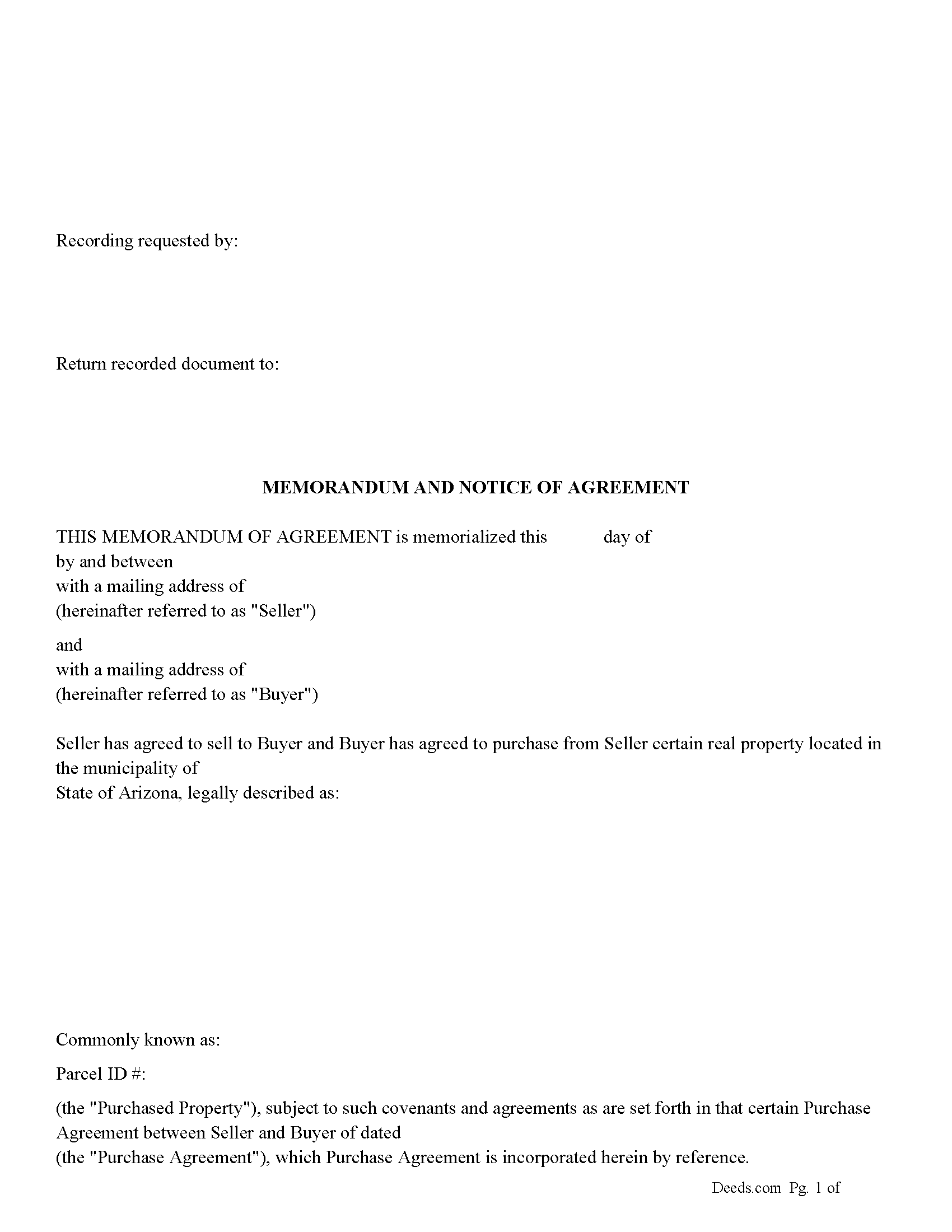
Gila County Memorandum and Notice of Agreement Form
Fill in the blank Memorandum and Notice of Agreement form formatted to comply with all Arizona recording and content requirements.
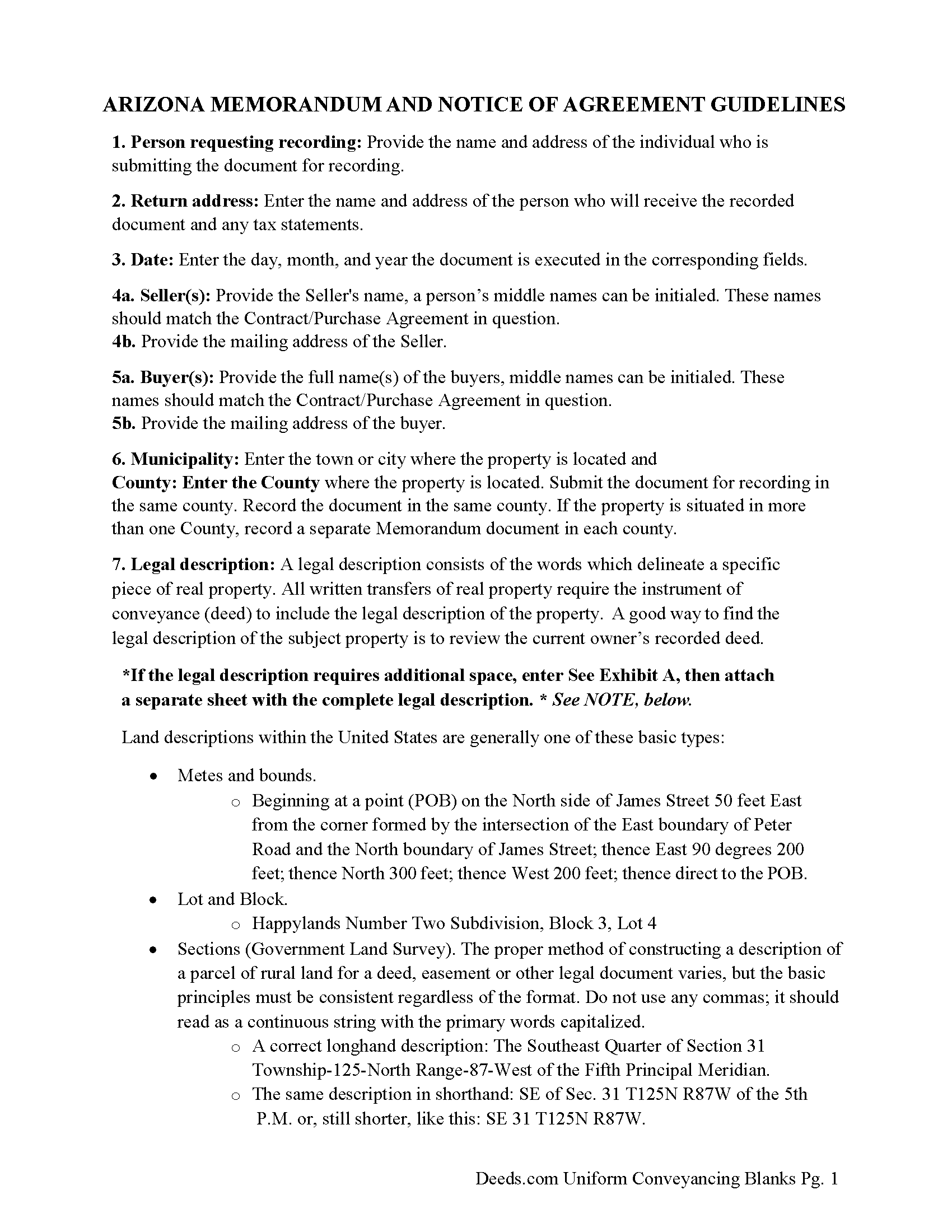
Gila County Memorandum and Notice of Agreement Guide
Line by line guide explaining every blank on the Memorandum and Notice of Agreement form.
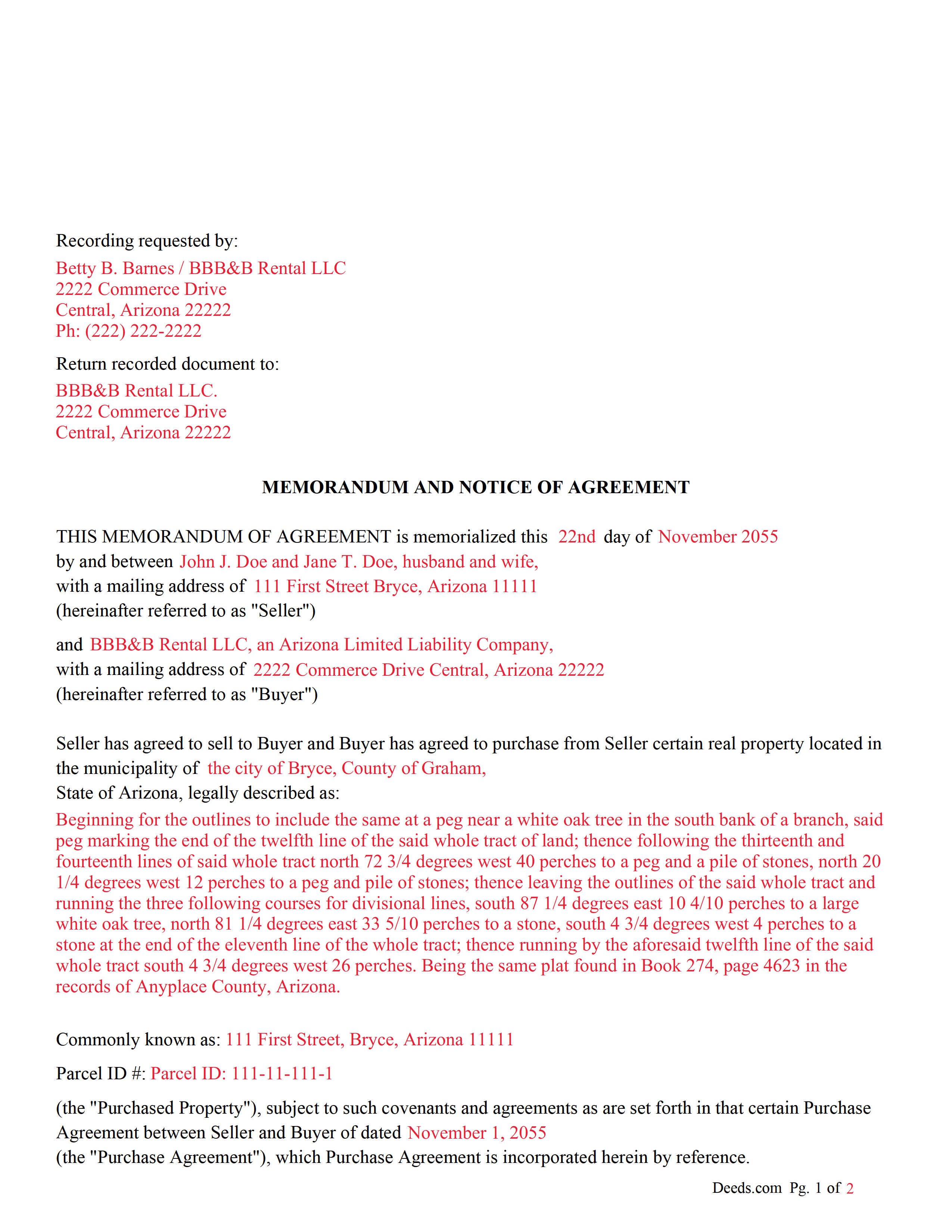
Gila County Completed Example of the Memorandum and Notice of Agreement Document
Example of a properly completed Arizona Memorandum and Notice of Agreement document for reference.
All 3 documents above included • One-time purchase • No recurring fees
Immediate Download • Secure Checkout
Additional Arizona and Gila County documents included at no extra charge:
Where to Record Your Documents
Recorder: Main Office
Globe, Arizona 85501
Hours: 8:00 - 5:00 Monday through Friday
Phone: 928-402-8740
Satellite Office
Payson, Arizona 85541
Hours: 8:00 - 12:00 & 1:00 - 5:00 Monday through Friday
Phone: 928-474-7198
Recording Tips for Gila County:
- Bring your driver's license or state-issued photo ID
- Ensure all signatures are in blue or black ink
- Request a receipt showing your recording numbers
- Ask about accepted payment methods when you call ahead
- Ask for certified copies if you need them for other transactions
Cities and Jurisdictions in Gila County
Properties in any of these areas use Gila County forms:
- Claypool
- Globe
- Hayden
- Miami
- Payson
- Peridot
- Pine
- Roosevelt
- San Carlos
- Tonto Basin
- Winkelman
- Young
Hours, fees, requirements, and more for Gila County
How do I get my forms?
Forms are available for immediate download after payment. The Gila County forms will be in your account ready to download to your computer. An account is created for you during checkout if you don't have one. Forms are NOT emailed.
Are these forms guaranteed to be recordable in Gila County?
Yes. Our form blanks are guaranteed to meet or exceed the applicable formatting requirements used for recording in Gila County, including margin requirements, font requirements, and other layout standards. This guarantee applies to formatting, not to the legal sufficiency of information entered by the user or the suitability of a form for a particular transaction.
Can I reuse these forms?
Yes. You can reuse the forms for your personal use. For example, if you have multiple properties in Gila County you only need to order once.
What do I need to use these forms?
The forms are PDFs that you fill out on your computer. The free Adobe Acrobat Reader is recommended, and most PDF apps also work. You do NOT enter your property information online - you download the blank forms and complete them privately on your own computer.
Are there any recurring fees?
No. This is a one-time purchase. Nothing to cancel, no memberships, no recurring fees.
How much does it cost to record in Gila County?
Recording fees in Gila County vary. Contact the recorder's office at 928-402-8740 for current fees.
Questions answered? Let's get started!
The Arizona Memorandum and Notice of Agreement is a short recordable instrument used to put the public on notice that a buyer, optionee, or other party holds an equitable interest in a specific Arizona parcel under an unrecorded underlying agreement — typically a purchase contract, option to purchase, right of first refusal, or similar instrument. The memorandum records the existence and essential facts of the agreement without recording the full contract, which lets the parties preserve the confidentiality of pricing, financing terms, contingencies, and negotiated concessions while still establishing priority under Arizona's race-notice recording rule at ARS 33-412. In a state where purchase and option agreements frequently run for extended periods before closing — commercial transactions, entitlement-contingent deals, long-term options on development parcels — the memorandum is the working tool for protecting the buyer's position against intervening sales, liens, and conveyances by the seller during that gap.
When the Arizona Memorandum and Notice of Agreement Is Used
Memoranda are used in any transaction where an enforceable agreement affecting Arizona real property has been executed but not yet closed, and the party with an equitable interest wants the world to know. Typical uses include residential and commercial purchase agreements during a due diligence or contingency period, options to purchase held by developers, investors, or adjacent owners, rights of first refusal granted to tenants or neighbors, agreements for sale and contracts for deed where the parties want to record a summary rather than the full terms, lease-purchase arrangements, letters of intent that have matured into binding obligations, and profit-sharing or joint venture agreements that give one party a contingent interest in real property. The memorandum is also used when parties to a contract for deed under ARS 33-741 et seq. want to record notice of the transaction without publishing the full economic terms — the notice function is satisfied by the memorandum, while the contract remains between the parties.
Why Record a Memorandum Instead of the Full Contract
Recording the full underlying contract accomplishes the same notice function, but at a cost: every term of the agreement becomes part of the public record. Purchase price, earnest money, financing contingencies, inspection rights, escrow holdbacks, repair allowances, seller concessions, and any negotiated unusual terms are all visible to anyone who pulls the document. In commercial transactions, that exposure can compromise the buyer's negotiating position on other deals; in residential transactions, it exposes personal financial information; in option transactions, it reveals the strike price and may signal the buyer's strategy to competitors. A memorandum records the fact of the agreement, the parties, the property, and the basic framework — enough to establish the equitable interest and the priority date — without publishing the details. That trade-off is why the memorandum form has become the default for most recorded real estate agreements in Arizona.
What the Memorandum Typically Contains
A memorandum records the essential facts necessary to put third parties on notice of the underlying agreement. The content typically includes the date of the underlying agreement, the names of all parties (buyer and seller, optionor and optionee, or equivalent), the legal description of the property, the general type of agreement (purchase agreement, option to purchase, right of first refusal, contract for deed), the effective date and expiration or performance date of the agreement, and a statement that the full agreement is held by the parties and available under its own terms. What the memorandum does not contain — intentionally — is the purchase price, the payment schedule, the contingency framework, or the other economic details that the parties wish to keep private. A memorandum that is excessively abbreviated can fail to give meaningful notice; one that is excessively detailed sacrifices the confidentiality benefit. The balance is between "enough to notice" and "no more than necessary."
Race-Notice and Priority
Arizona's race-notice rule at ARS 33-412 is what makes the memorandum worth recording at all. Under the rule, an unrecorded conveyance or equitable interest is void as against a subsequent purchaser for value who records first without notice of the prior interest. Translated to the memorandum context: if a buyer has a valid purchase agreement but does not record a memorandum, and the seller sells the same property to a second buyer who has no knowledge of the first agreement and records first, the second buyer takes the property free of the first buyer's rights. The first buyer's recourse is against the seller for breach of contract, but the property itself is gone. Recording a memorandum fixes the first buyer's priority date at the moment of recording and puts subsequent buyers on constructive notice, protecting the first buyer's equitable interest against intervening transfers.
The same principle applies to options. An unrecorded option to purchase can be defeated by a subsequent sale to a buyer without notice of the option. Recording a memorandum of the option fixes the optionee's priority and prevents the seller from defeating the option by selling to someone else during the option period. For rights of first refusal, recording the memorandum gives the beneficiary constructive notice protection against sales that purport to extinguish the right.
Impact on the Seller's Title
A recorded memorandum does not transfer title or create a new encumbrance in the mortgage sense — it documents the existence of a contractual relationship that itself affects the seller's ability to convey clean title during the agreement's term. The practical effect on the seller is that the property becomes difficult to sell or mortgage to any third party without first addressing the memorandum. Title insurers will flag the memorandum as an exception to coverage until it is released or its underlying agreement has been performed, and lenders will typically refuse to fund against property with an unresolved memorandum of purchase agreement on the record. This is exactly what makes the memorandum work as a protection for the buyer — but it is also something the seller should understand before consenting to the recording. A memorandum that remains on the record after the underlying agreement has expired or terminated is a cloud the seller has to clean up before selling to someone else.
Who Signs and Authority
A memorandum of agreement typically requires the signatures of all parties to the underlying agreement. Some Arizona practitioners record memoranda signed only by the party with the equitable interest (the buyer, optionee, or tenant), on the theory that the memorandum documents only that party's claimed interest rather than a bilateral instrument; other practitioners require all parties to sign, following the logic that the underlying agreement is bilateral and the recorded notice should reflect that bilateral execution. The bilateral-signature approach is the safer practice when the parties are cooperating, because it eliminates any future argument about authenticity and preserves the record's integrity if the relationship later deteriorates. When the underlying agreement expressly authorizes one party to record a memorandum unilaterally, that authorization should be referenced in the memorandum itself.
Termination of the Memorandum
A memorandum needs to be released from the record when the underlying agreement has run its course — whether by closing of the sale, exercise or expiration of the option, termination by the parties, or default. Closing is the most common path: when the purchase contract is performed and a deed is recorded, the original purchase contract has been satisfied and the memorandum should be released. Expiration of an option without exercise ends the optionee's equitable interest, but the memorandum stays on the record until a release is filed. Termination by mutual agreement requires both parties to sign a release, because the memorandum was (typically) jointly recorded. Default of a purchase agreement by the buyer gives the seller grounds to record a release unilaterally if the agreement provided for it, or to pursue the removal through other means.
Leaving an expired or performed memorandum on the record creates a cloud on title that will surface the next time the property is sold or financed — sometimes years later, when finding the original parties to obtain a release has become difficult. The cleaner practice is to record the release at the same time as the closing (or the expiration), while the parties are still available and the records are easy to locate.
Execution and Acknowledgment
Under ARS 33-401, an instrument affecting real property must be in writing, subscribed by the party whose interest is being documented, and acknowledged before a notary public or other officer authorized to take acknowledgments. Arizona does not require subscribing witnesses. Acknowledgments taken outside Arizona must comply with ARS 33-501, which recognizes notaries, judges and clerks of courts of record, and other officers authorized to perform notarial acts in the jurisdiction where the acknowledgment is taken. A memorandum with a defective acknowledgment is not recordable, and a memorandum that is executed but not recordable does nothing to establish priority.
Affidavit of Property Value Exemption
Arizona requires an Affidavit of Property Value to accompany most instruments affecting interests in real property (ARS 11-1133), but a memorandum giving notice of an underlying agreement typically qualifies for an exemption under ARS 11-1134 because no transfer is occurring — the memorandum is documenting an executory interest that has not yet ripened into a conveyance. The exemption must be claimed on the face of the memorandum with a statement that the transfer is exempt and a citation to the specific exemption subsection, placed below the legal description. Memoranda that omit the exemption recital are routinely rejected at the recorder's window even though the underlying transaction is plainly exempt.
Formatting and Recording
ARS 11-480 sets the formatting requirements for every recordable instrument: legible type of at least ten points, white paper no larger than 8.5 by 14 inches, a caption identifying the document (for example, "Memorandum of Purchase Agreement" or "Memorandum and Notice of Agreement"), a top margin of at least two inches on the first page reserved for the recorder's stamp, and minimum half-inch margins elsewhere. Record the memorandum in the county where the property is located — in each county, if the property spans more than one. Confirm current recording fees and accepted forms of payment with the county recorder in advance, and verify indexing rather than relying on a drop-off or mailing receipt, because the priority benefit attaches only when the instrument is actually indexed against the property.
What's Included in the Download Package
The Arizona Memorandum and Notice of Agreement package includes the memorandum form, detailed guidelines covering the Arizona-specific drafting and recording requirements, and a completed example. All files are available for instant download after purchase.
Important: Your property must be located in Gila County to use these forms. Documents should be recorded at the county recording office listed above.
This Memorandum and Notice of Agreement meets all recording requirements specific to Gila County.
Our Promise
The documents you receive here are guaranteed to meet or exceed the applicable Gila County recording format requirements. If there is a rejection caused by our formatting, we will correct the issue or refund your payment. This guarantee applies to document formatting only and does not extend to information entered by the user, the selection of the form, or the legal effect of the completed document.
Save Time and Money
Get your Gila County Memorandum and Notice of Agreement form done right the first time with Deeds.com Uniform Conveyancing Blanks. At Deeds.com, we understand that your time and money are valuable resources, and we don't want you to face a penalty fee or rejection imposed by a county recorder for submitting nonstandard documents. We constantly review and update our forms to meet rapidly changing state and county recording requirements for roughly 3,500 counties and local jurisdictions.
4.8 out of 5 - ( 4,829 Reviews )
chris a. 5 out of 5 stars
It was easy to complete the deed but on the third page I only need one signature in stead of 3 I need to delete 2 or put n//a in those blocks I will continue to use your services and have recommended it to others
Thank you for your feedback. We really appreciate it. Have a great day!
Jason J. 5 out of 5 stars
My first submission was super quick and easy. I had trouble with the second submission, as I was not aware of what the county would require, but the team at Deeds.com walked me through every step of the process. Will definitely use again and refer business partners to Deeds.com!
Thank you, Jason! We’re glad your first submission went smoothly and appreciate your patience with the second. County requirements can vary, and we’re always here to help make the process as simple as possible. We look forward to assisting you — and your business partners — again soon!
RONNIE C. 5 out of 5 stars
Excellent service and the time the documents send back to me was also excellent
Thank you!
Dana P. 5 out of 5 stars
Thank you for making a difficult time a little easier. The forms are easy to download and complete and the Guide is very helpful.
Thank you for your feedback. We really appreciate it. Have a great day!
DEBORAH H. 5 out of 5 stars
This is my fourth try, and I hope my form is complete and acceptable.
Your feedback is greatly appreciated. Thank you for taking the time to share your experience!
Robert R. 5 out of 5 stars
I found the form I needed. I ordered the wrong ones the first time. I didn't know if I could get refund or not. The information with the forms is very helpful Thank you
Thank you for your feedback. We’re pleased to hear you found the forms and supporting information helpful. Your initial order has been canceled and refunded, and we’re glad you now have the correct forms in hand. We appreciate your business and are here if you need further assistance.
Kristen H. 5 out of 5 stars
This was such a money saver. I was told by someone at the courthouse that I had to have a lawyer prepare the paper work for my mom. They stated that family members couldn't prepare the papers. I was hopeful when I found that I could prepare the survivorship affidavit on Deeds. I was able to prepare everything myself and had no issues today when at the courthouse for all the changes. Thank you!
We appreciate your business and value your feedback. Thank you. Have a wonderful day!
Ronald C. 5 out of 5 stars
Easy to navigate and very concise
Thank you!
Anthony F. 5 out of 5 stars
quick, easy and simple. Also thank you for having the e-submission area particularly with the Covid-19 /Shelter in place things happening.
Thank you for your feedback. We really appreciate it. Have a great day!
Jason B. 5 out of 5 stars
KVH provided excellent customer service (great communication was provided). I would differently use this service if needed in the further.
We appreciate your business and value your feedback. Thank you. Have a wonderful day!
Alan K. 5 out of 5 stars
The instructions and example for filling out the form were very clear and detailed making the whole process fairly easy. An attorney I talked to wanted $200 to fill out this simple form. I haven't tried to file it yet but I will let you know if there are any issues. Really a great deal. $20 vs $200.
We appreciate your business and value your feedback. Thank you. Have a wonderful day!
ALAN C. 5 out of 5 stars
Everything was as advertised, and easily downloaded.
We appreciate your business and value your feedback. Thank you. Have a wonderful day!
Jonnie G. 5 out of 5 stars
I very much dreaded this whole endeavor but very pleasantly surprised. So far, so good. I feel much more confidant that the crucial form, when presented, will play well with the county.......
We appreciate your business and value your feedback. Thank you. Have a wonderful day!
Diana H. 4 out of 5 stars
little expensive same document in other county is free. however quite fast in responding. and just what i needed.
We appreciate your business and value your feedback. Thank you. Have a wonderful day!
Nicholas F. 5 out of 5 stars
Thankyou for your easy to use website and prompt service.
We appreciate your business and value your feedback. Thank you. Have a wonderful day!