Arizona Personal Representative Deed
County Specific Legal Forms Validated as recently as April 16, 2026 by our Forms Development Team
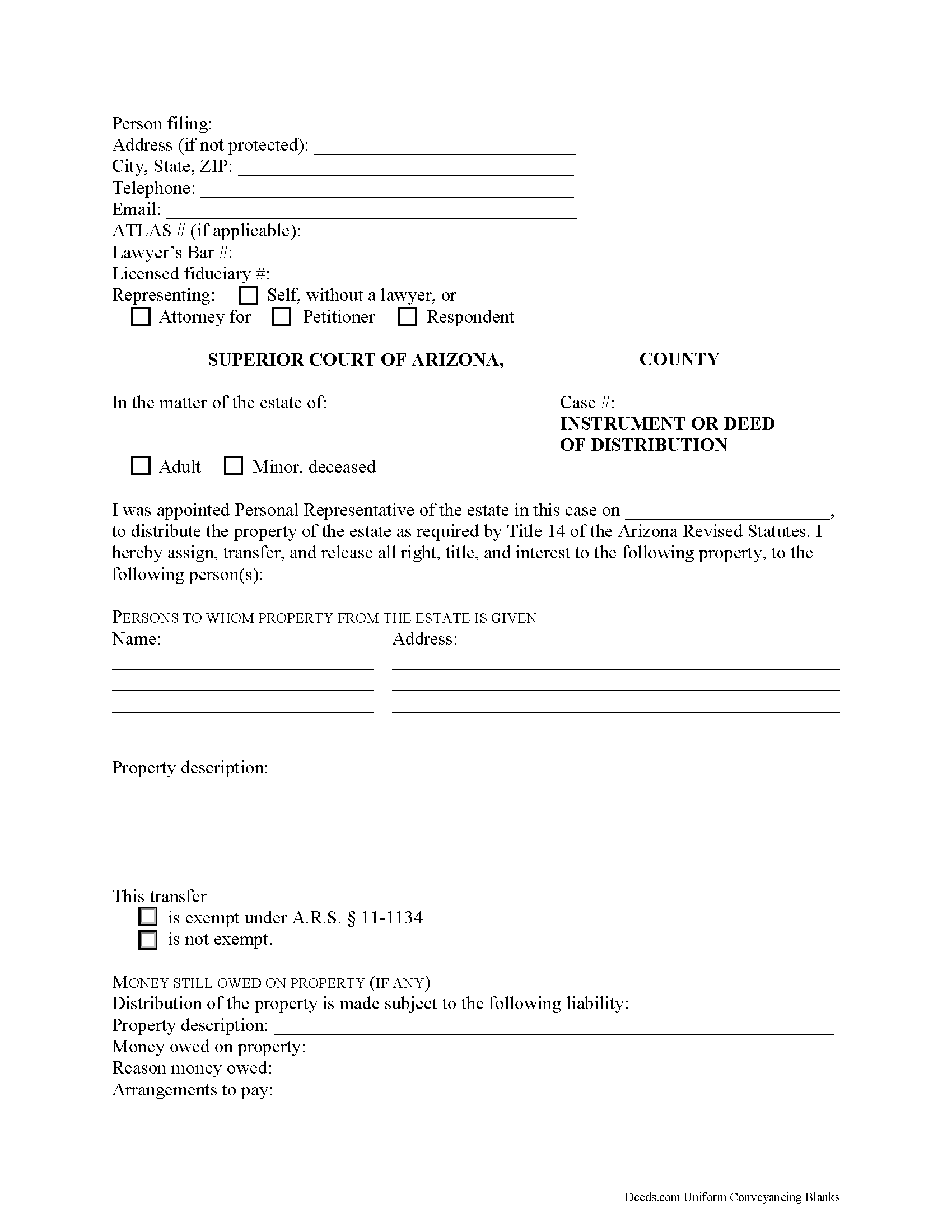
About the Arizona Personal Representative Deed
How to Use This Form
- Select your county from the list on the left
- Download the county-specific form
- Fill in the required information
- Have the document notarized if required
- Record with your county recorder's office
What Others Like You Are Saying
"Well, When I got the question right I got the answers right from Claim Deed. In the end it all worke…"
"Service was fantastic. So helpful and they promptly get back with you. No reason to drive if you are…"
"The product I needed was available, easy to download, access and complete. The instructions were ver…"
"This service and company are THE best. We are out of State and needed to efile, and we got it done f…"
"The deed form I downloaded was easy to use and just what i needed."
The Arizona Personal Representative Deed is the instrument used during probate administration to transfer real property out of a decedent's estate to the heir, devisee, or purchaser entitled to receive it. Arizona's probate code at ARS 14-3101 et seq. uses the term "personal representative" to describe the fiduciary who serves in the role that other states call executor (when appointed under a will) or administrator (when appointed in an intestate estate). The personal representative has broad statutory authority under ARS 14-3715 to sell, mortgage, lease, and distribute estate property without additional court authorization in most cases, and the personal representative's deed is how that authority is exercised for real property. The deed's effectiveness depends on proper probate appointment of the signing personal representative and on the deed's compliance with Arizona's recording, affidavit, and exemption requirements — all of which are consequential details that routinely trip up informal probate administration.
When the Arizona Personal Representative Deed Is Used
A personal representative deed is used throughout Arizona probate administration whenever real property needs to move out of a decedent's estate. Typical scenarios include distribution of a residence to the specific beneficiary named in the will, distribution to multiple beneficiaries as tenants in common when the will devises the property jointly, sale of estate real estate to a third-party buyer when the estate needs to generate liquidity to pay debts or expenses, sale to a family member who is purchasing rather than inheriting the property, distribution to the decedent's intestate heirs in the proportions established by Arizona's intestacy statute at ARS 14-2101 et seq. when the decedent died without a will, transfer to a testamentary trust created under the will, and transfer to the personal representative's own name as a distributee when the personal representative is also an heir or devisee of the property. The deed is the working instrument for all of these scenarios; the specific recitals and warranty level are adapted to the type of transaction, but the personal-representative-as-grantor structure remains constant.
The Personal Representative's Authority
The personal representative derives authority from the letters issued by the probate court at appointment. Under ARS 14-3103, Arizona probate has two modes: informal and formal. In informal probate, the registrar of the probate court appoints the personal representative without a hearing upon the filing of appropriate paperwork, and the letters issue administratively. In formal probate, the court holds a hearing and issues letters after adjudicating any contested issues. Both forms of letters authorize the personal representative to act on behalf of the estate, including transferring real property, although formal probate may be required when title companies or buyers need additional certainty about the estate's administration or when contested issues need judicial resolution.
The letters are time-limited and can be superseded by subsequent court orders. A personal representative signing a deed after the estate has been closed and letters have been discharged has no authority, and the deed is ineffective. Title companies insuring property transferred by personal representative deed routinely require current letters (typically dated within a specified period, often sixty or ninety days) as evidence that the appointment is still in effect.
ARS 14-3715 — The Powers of the Personal Representative
ARS 14-3715 grants personal representatives sweeping default authority over estate assets, including the specific power to sell, mortgage, or lease real and personal property at public or private sale. The authority extends to acquiring, selling, and managing property and exercising any power, right, or privilege a sole owner could exercise. This broad grant eliminates the need for a court order authorizing specific transactions in most administrations — the personal representative can act on the strength of the letters alone. The scope of this authority is one of the reasons Arizona probate is generally faster and less expensive than probate in states requiring court orders for each major transaction.
Limitations on the authority arise in specific situations. The will may restrict the personal representative's powers, and a restriction in the will controls over the statutory default. Formal probate may have been opened specifically to obtain court supervision, in which case court orders may be required for major transactions. A personal representative who is also a beneficiary of the estate faces particular scrutiny when entering transactions that involve self-dealing — a sale of estate property to the personal representative individually, for example, is typically permitted only with either express authorization in the will, consent of all affected beneficiaries, or court approval under ARS 14-3713. Ignoring self-dealing constraints can result in the transaction being voidable and the personal representative being surcharged.
Testate Versus Intestate Administration
The nature of the administration affects who takes the property and the recitals in the deed. In a testate estate (one with a probated will), the personal representative distributes property according to the will's terms — typically to the specific devisee named, with the will's recording in the probate file establishing the basis for the distribution. The deed recites the will, the date of probate, and the provision directing the transfer. In an intestate estate (one without a will), distribution follows Arizona's intestacy statute at ARS 14-2101 et seq., which prioritizes the surviving spouse and descendants. The deed recites the intestate character of the estate and the heirs' entitlement under the statute. In both scenarios, the probate proceeding itself — identified by its case number and the court in which it was filed — should be referenced in the deed as the source of the personal representative's authority.
Warranty Level
Personal representative deeds are typically executed with limited or no warranty of title. The personal representative is a fiduciary administering someone else's estate, not an owner in the ordinary sense, and personal representatives do not provide general warranties covering the decedent's historical chain of title — they have no personal knowledge and no economic incentive to take on liability for defects that predated the decedent's ownership. The common choices are a special warranty (covering only acts during the personal representative's administration of the estate) or no warranty (a quitclaim or bargain and sale form). When estate property is being sold to a third-party buyer in an arm's-length transaction, the buyer typically relies on owner's title insurance for title protection, and a special warranty personal representative deed plus title insurance provides effectively the same protection as a general warranty deed would have. When property is being distributed to a beneficiary under the will, a minimal-warranty or no-warranty instrument is standard — the beneficiary is taking whatever the decedent held, and the personal representative is not making representations beyond the fact of the estate administration.
Community Property Considerations
Arizona's community property framework creates particular complexity in probate. When a married decedent owned property as community property, only the decedent's half-interest passes through the estate; the surviving spouse's half-interest is not part of the probate estate and passes outside of probate by operation of community property law. This means the personal representative has authority to convey only the decedent's half, not the whole property, and a deed that purports to convey the whole is effective only to the extent of the decedent's interest. When the surviving spouse is also the beneficiary of the decedent's half, the practical result is that the survivor ends up owning the whole, but through two different mechanisms (half by operation of law, half by probate distribution). When the surviving spouse is not the beneficiary of the decedent's half — a blended-family situation, for example — the property ends up owned in fractional interests between the survivor and the estate beneficiary, which can create awkward co-ownership that the parties typically resolve through a buyout or sale.
When property was held as community property with right of survivorship or as joint tenancy with right of survivorship, the survivorship feature controls and the property does not pass through probate — the survivor takes the whole by operation of law, and the personal representative has no authority over it. This is one of the primary reasons Arizona married couples use survivorship vesting for their homes: the house passes outside probate, and the personal representative's work is limited to property that is actually in the estate.
Who the Personal Representative Is
The personal representative is the person or entity appointed by the probate court to serve in that role. Under ARS 14-3203, priority for appointment runs first to the personal representative named in the will, then to the surviving spouse who is a devisee, then to other devisees, then to the surviving spouse who is not a devisee, then to other heirs, and then to creditors and other parties. When the named executor in the will has died, declined to serve, or been removed, a successor named in the will takes over, or the court appoints a personal representative following the statutory priority. The deed's grantor identification and signature block should match the name of the currently acting personal representative as reflected in the current letters.
Reference to the Probate Case
The deed should identify the probate proceeding that is the source of the personal representative's authority. Typical recitals include the name of the decedent, the date of death, the county and court in which the probate was opened, the case number, the date of appointment of the personal representative, and the date the letters were issued. These recitals establish on the face of the deed that an Arizona probate is pending or has been administered and that the signer has authority to convey. Title examiners reviewing the deed will look for these recitals and may require additional documentation — certified copies of letters, certified copies of the will, certified copies of court orders — depending on the specific transaction and the title insurer's standards.
Recording Requirements — Both the Probate Registrar and the County Recorder
A personal representative deed typically needs to be recorded in two places, which is one of the distinctive features of Arizona probate real estate practice. The deed itself is recorded with the county recorder in the county where the property is located, following the standard real property recording rules. The deed or evidence of the transfer also typically needs to be filed or reflected in the probate case file with the registrar or clerk of the superior court handling the probate, as part of the record of the estate administration. The specific requirements depend on the type of probate (supervised versus unsupervised), whether the transaction was a sale or a distribution, and any court orders entered in the case. Personal representatives handling real estate transfers should coordinate with probate counsel to ensure both recording tracks are completed correctly — a deed recorded only with the county recorder may still be valid, but the probate file may need additional filings to reflect the transaction for purposes of the final accounting and closing of the estate.
Execution and Acknowledgment
Under ARS 33-401, the deed must be in writing, subscribed by the personal representative in fiduciary capacity, and acknowledged before a notary public or other officer authorized to take acknowledgments. Arizona does not require subscribing witnesses. The acknowledgment should reflect the representative capacity — the notarial certificate should identify the signer as the "personal representative of the Estate of [Decedent]" rather than individually. Personal representatives frequently live outside Arizona, particularly for estates where the decedent retired to Arizona while family remained elsewhere, and out-of-state acknowledgments must comply with ARS 33-501.
Affidavit of Property Value and Exemptions
Arizona generally requires an Affidavit of Property Value to accompany instruments transferring an interest in real property (ARS 11-1133), but personal representative deeds frequently qualify for exemptions under ARS 11-1134. Distributions to beneficiaries without consideration typically fall within the specific exemption for transfers from a personal representative to a beneficiary; sales to third parties for full consideration, by contrast, are not exempt and the affidavit must be filed. The exemption, when applicable, must be claimed on the face of the deed with a statement that the transfer is exempt and a citation to the specific exemption subsection, placed below the legal description. Deeds that omit the exemption recital are routinely rejected at the recorder's window even when the transaction plainly qualifies.
Formatting and Recording Priority
ARS 11-480 sets the formatting requirements for every recordable instrument: legible type of at least ten points, white paper no larger than 8.5 by 14 inches, a caption identifying the document (for example, "Personal Representative Deed of Distribution" or "Personal Representative Deed"), a top margin of at least two inches on the first page reserved for the recorder's stamp, and minimum half-inch margins elsewhere. Record the deed in the county where the property is located. Arizona's race-notice rule at ARS 33-412 applies to personal representative deeds as to any other conveyance — an unrecorded deed is void as against a subsequent purchaser for value who records first without notice — and ARS 33-411.01 imposes an affirmative duty to record within sixty days of the transfer.
What's Included in the Download Package
The Arizona Personal Representative Deed package includes the deed form drafted with the personal-representative-as-grantor structure, fiduciary capacity recitals, and flexible warranty language suitable for distributions to beneficiaries and sales to third parties, detailed guidelines covering the Arizona-specific drafting and recording requirements and the interaction with the Arizona probate code and the dual-recording practice, and a completed example showing how the form should look for a typical probate conveyance. All files are available for instant download after purchase.
How to Use This Form
- Select your county from the list above
- Download the county-specific form
- Fill in the required information
- Have the document notarized if required
- Record with your county recorder's office
What Others Like You Are Saying
"Well, When I got the question right I got the answers right from Claim Deed. In the end it all worke…"
"Service was fantastic. So helpful and they promptly get back with you. No reason to drive if you are…"
"The product I needed was available, easy to download, access and complete. The instructions were ver…"
"This service and company are THE best. We are out of State and needed to efile, and we got it done f…"
"The deed form I downloaded was easy to use and just what i needed."
Common Uses for Personal Representative Deed
- Satisfy title company requirements for trust-held property
- Provide evidence that a trustee has authority to transact
- Transfer property from a trust to a beneficiary
- Record a trust's ownership interest with the county
Compare other Arizona deed forms and documents
Important: County-Specific Forms
Our personal representative deed forms are specifically formatted for each county in Arizona.
After selecting your county, you'll receive forms that meet all local recording requirements, ensuring your documents will be accepted without delays or rejection fees.