Arkansas Warranty Deed
County Specific Legal Forms Validated as recently as September 28, 2026 by our Forms Development Team
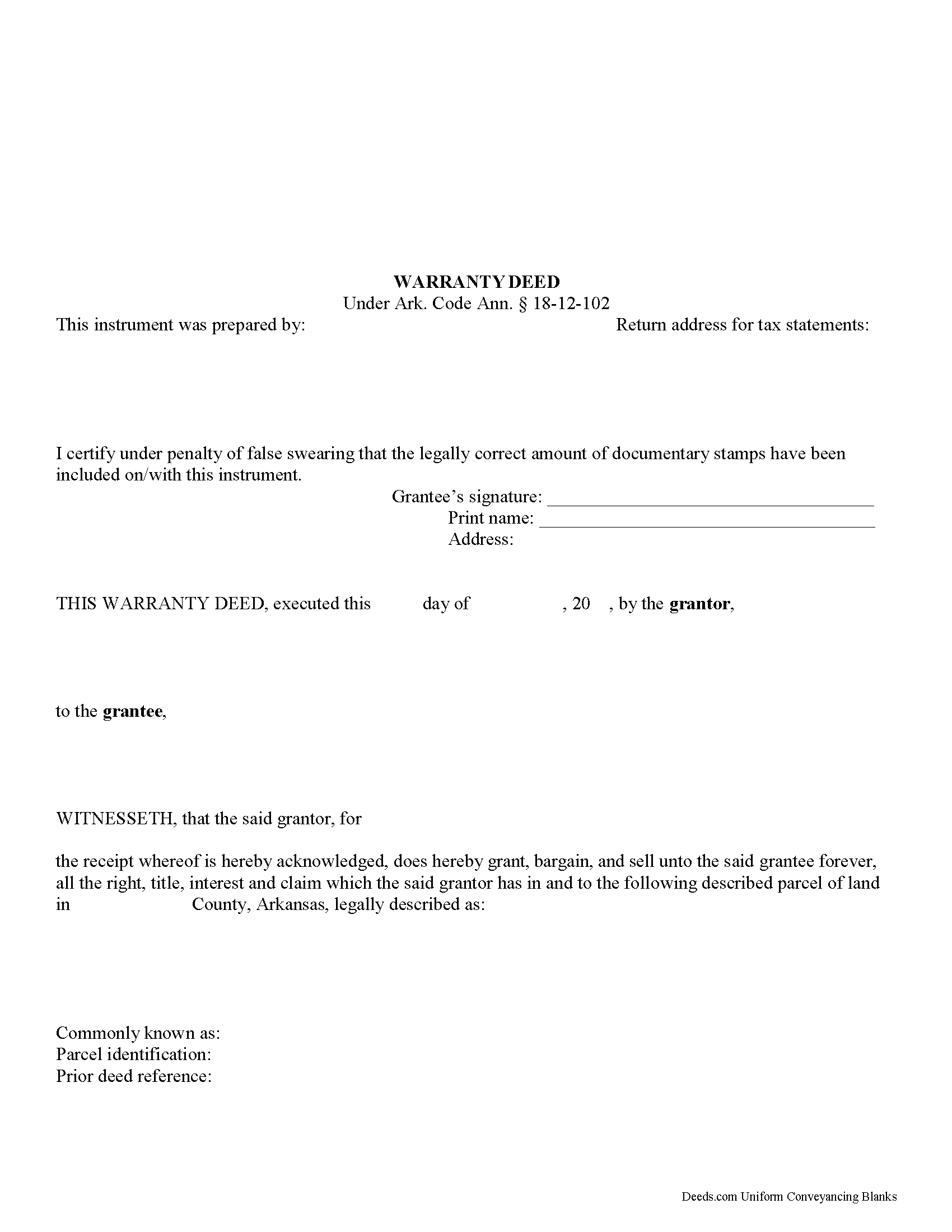
About the Arkansas Warranty Deed
How to Use This Form
- Select your county from the list
- Download the county-specific form
- Fill in the required information
- Have the document notarized if required
- Record with your county recorder's office
What Others Like You Are Saying
"I recomemed this webside"
"Very easy to fill out and understand. Thank You!!"
"Excellent forms but the instructions are not to clear."
"I asked for a letter of testamentary form and this is what I got. Not at all what I was hoping for. …"
"Was very easy to use with the information and samples supplied."
4.8/5 from 4,825 reviews. Read all
An Arkansas warranty deed does its legal work in two places. The granting clause carries words the legislature loaded with covenants of title, and the blanks carry what the people at the table say about themselves and about how the new owners will hold. This is the general configuration of the Arkansas warranty deed: one or two grantors conveying to one or two grantees, every party a natural person signing in his or her own name, and no ownership or marital wording printed anywhere on the instrument.
Covenants the code attaches to a phrase
Ark. Code Ann. Section 18-12-102(b) treats the phrase grant, bargain and sell as an express covenant that the grantor holds an indefeasible fee simple estate, that no encumbrance was done or suffered by the grantor apart from rents or services the deed reserves, and that the grantee will enjoy the property quietly. Arkansas courts read that list closely, and a granting clause that reaches for grander wording can miss it, so this deed prints the phrase in the statutory order and then states in its own words a covenant to warrant and defend the title against the lawful claims of all persons. Section 18-12-105 supplies the rest of the estate: a deed passes the complete fee simple interest without the word heirs unless it expressly says less. One carve-out survives every covenant on the page, because subsection (d) keeps improvement district assessments running with the land for the grantee to pay.
One or two names on each side
The grantor block and the grantee block are open, multi-line entries rather than preprinted recitals, and the form provides a GRANTOR signature block, a SECOND GRANTOR block, and a separate notarial certificate for each. An owner conveying alone, two record owners conveying together, and an owner joined by a spouse who releases marital rights all fit the same printed layout; where a single grantor conveys, the second signature block and its certificate stay blank. Section 10 does part of that work in advance, releasing the dower, curtesy, and homestead rights of every person who signs as a grantor, the relinquishment Sections 28-11-301 and 18-12-403 contemplate when a spouse joins a conveyance. The form recites natural persons signing personally, so a conveyance by a company, by a trustee or executor, or by an agent under a power of attorney belongs with a different signature block and a different statutory acknowledgment, and three or more owners on either side exceed the blocks printed here.
What the grantee line decides
Because nothing about co-ownership is preprinted, the words typed after the grantee names control the result. Two grantees who state nothing further take as tenants in common under Section 18-12-603, each with an undivided share that passes through an estate rather than to the other owner. Section 18-12-106 lets two or more people, married to each other or not, take as joint tenants with right of survivorship when the deed declares it. Spouses can land in a tenancy by the entirety by force of the marital relationship itself, the common law rule stated in Weir v. Brigham. The guide walks through each form of ownership and the words that create it.
Signing, stamps, and the recorder's counter
Arkansas execution runs formal. Section 18-12-104 describes execution before two disinterested witnesses, and Sections 18-12-201 and 18-12-206 make acknowledgment or proof the condition of recording, so the deed carries both witness lines and full notarial certificates. Below them sits the transfer tax certification of Section 26-60-110, signed by the grantee rather than the grantor, matching a tax that runs $3.30 per $1,000 of consideration above $100. The preparer statement required by Section 14-15-403 rides on the face of the first page, that same section since Act 752 of 2025 conditions counter and mail filings on the grantor's photo identification, and the page geometry follows Section 14-15-402(b)(1) down to the two and one half inches reserved at the top of page one and at the foot of the last page. Recording is also where priority is decided under Section 14-15-404.
The download delivers the warranty deed as a fillable PDF, a completed example filled in for a realistic Benton County sale, and a plain language guide covering each numbered section, the witness and notary blocks, the ways Arkansas grantees may hold title, and the stamp, certification, and identification steps at the recorder's window. These materials describe Arkansas law in general terms and are not legal advice.
Important: County-Specific Forms
Our warranty deed forms are specifically formatted for each of the 75 counties in Arkansas.
After selecting your county, you'll receive forms that meet all local recording requirements, ensuring your documents will be accepted without delays or rejection fees.