Colorado Beneficiary Deed (Unmarried Sole Owner)
County Specific Legal Forms Validated as recently as November 8, 2026 by our Forms Development Team
About the Colorado Beneficiary Deed (Unmarried Sole Owner)
How to Use This Form
- Select your county from the list
- Download the county-specific form
- Fill in the required information
- Have the document notarized if required
- Record with your county recorder's office
What Others Like You Are Saying
"easy to use"
"The website made it easy to find and print out the documents I needed. The whole process was straigh…"
"Deeds.com has been a lifesaver for my house buying business. Excellent support!"
"Good instructions and example"
"Very east process. Good job!"
4.8/5 from 4,847 reviews. Read all
One owner, one signature, one acknowledgment certificate: this Colorado beneficiary deed recites that the grantor is an unmarried person and the sole owner of the described property, and it names who takes that property at the owner's death. The recital is printed as deed text, so the instrument reads the owner's configuration on its face rather than leaving status and ownership to a blank or a checkbox.
A deed that recites the owner's standing
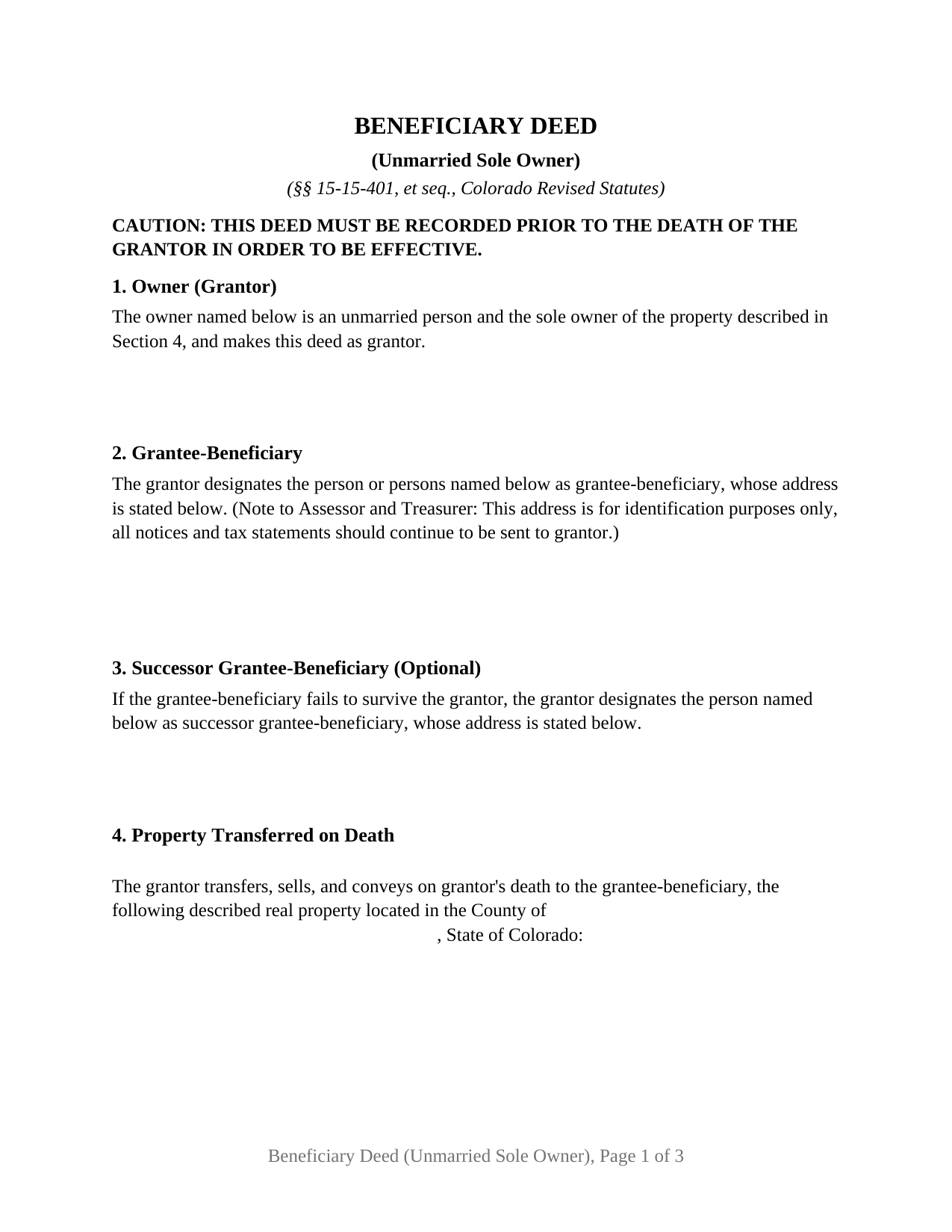
Section 1 of the form carries a fixed sentence: the owner named below is an unmarried person and the sole owner of the property described in Section 4, and makes this deed as grantor. The only entries in that section are the owner's name and mailing address. There is no second owner block, no marital-status selector, and no spouse signature line, because the configuration the deed recites has none of those. The signature section carries one block under the heading OWNER / GRANTOR, and the notarial officer completes one acknowledgment certificate.
That pattern matches how C.R.S. 15-15-402(1) frames the instrument: the owner of the interest signs as grantor, and the deed conveys that owner's interest on that owner's death. A record owner holding title alone, with no spouse of record, is the ownership pattern this form recites. Where a co-owner, a trustee, or a married grantor appears in the record, the deed reads differently, and this form is not set up as that configuration.
The statutory form, carried word for word
Colorado prints a form for the beneficiary deed in C.R.S. 15-15-404(1) and provides that a deed may be in substantially that form. This product keeps the statute's own sentences intact inside numbered sections. The caution under the title states that the deed must be recorded prior to the death of the grantor in order to be effective. The grantee-beneficiary section carries the form's note to the assessor and treasurer, which keeps tax statements flowing to the grantor during life. The property section opens with the operative sentence by which the grantor transfers, sells, and conveys on grantor's death to the grantee-beneficiary the described real property, followed by the county, the legal description, and the Known and numbered as street-address line. Section 6 prints the three statutory warnings in capital letters: that the deed is revocable and revokes all prior beneficiary deeds by this grantor for this property, that execution may affect Medicaid eligibility under title 25.5, and that execution may not avoid probate.
The optional successor clause of the statutory form is Section 3. Where the grantee-beneficiary fails to survive the grantor, the successor grantee-beneficiary named there takes instead; where no successor is named, the completed example shows the entry None designated.
Nothing moves until death
A Colorado beneficiary deed, the instrument other states call a transfer on death deed or TOD deed, transfers no present interest. Under C.R.S. 15-15-402 the grantee-beneficiary has no right, title, or interest while the owner lives, the owner keeps full power to sell, mortgage, or lease without the grantee-beneficiary's joinder or notice, and the deed needs no consideration. The owner may revoke it under C.R.S. 15-15-405 by recording, before death, a revocation instrument or a later beneficiary deed, each a separate instrument recorded on its own and not included in this package, and a will cannot revoke it. At death, C.R.S. 15-15-407 vests title in the grantee-beneficiary subject to every mortgage, lien, and other interest affecting the property, and persons holding unrecorded interests have four months after the death to record notice of them. Unless the owner designates otherwise, the deed carries no warranties of title and has the force and effect of a bargain and sale deed under C.R.S. 15-15-404(2); this form designates nothing to the contrary.
Recording is what makes it work
The caution on the deed is the statute's rule: a beneficiary deed takes effect only if it is recorded, before the owner's death, with the clerk and recorder of the county where the property is located. Colorado's flat recording fee, set by C.R.S. 30-1-103 with the surcharges of 30-10-421, is published on county fee schedules at forty-three dollars per document since July 1, 2025, and C.R.S. 30-10-406(3)(a) asks for a one inch top margin and half inch side and bottom margins, which this form meets. Because the deed needs no consideration, no state documentary fee arises where none is paid, and the guide explains how the real property transfer declaration rule of C.R.S. 39-14-102 reads against a deed on which no fee is imposed. The grantee-beneficiary's address in Section 2 satisfies C.R.S. 38-35-109(2), the rule under which a clerk returns a deed that lacks the grantee's address.
Signing in Colorado or elsewhere
The owner signs before a notarial officer, who completes a certificate in the Colorado short form of C.R.S. 24-21-516(1)(a). The form reserves an open area for the rectangular official stamp a Colorado notary public affixes to a paper certificate under C.R.S. 24-21-515(2); Colorado notaries use an inked stamp, not an embosser. An owner who signs while in another state appears before an officer of that state, and C.R.S. 24-21-511 gives that act the same effect in Colorado.
What the configuration section recites
The form is built around exactly one natural-person owner signing in an individual capacity, with the unmarried and sole-owner status fixed in the text, one or more grantee-beneficiaries named by full name and mailing address, an optional successor, and one acknowledgment. A single owner who took title alone by a recorded deed, whether by purchase, gift, or inheritance, and who has never married or whose marriage has ended, presents the pattern this deed recites. An owner who holds with a co-owner, who holds as trustee, or who is married presents a different pattern that this form does not recite.
The package includes the fillable beneficiary deed, a completed example filled in for a Larimer County fact pattern, and the guide that walks through every numbered section, the signing and recording steps, and the statutes behind them. This description and the guide describe the form and the governing Colorado statutes in general terms; they are not legal advice.
Important: County-Specific Forms
Our beneficiary deed (unmarried sole owner) forms are specifically formatted for each of the 64 counties in Colorado.
After selecting your county, you'll receive forms that meet all local recording requirements, ensuring your documents will be accepted without delays or rejection fees.