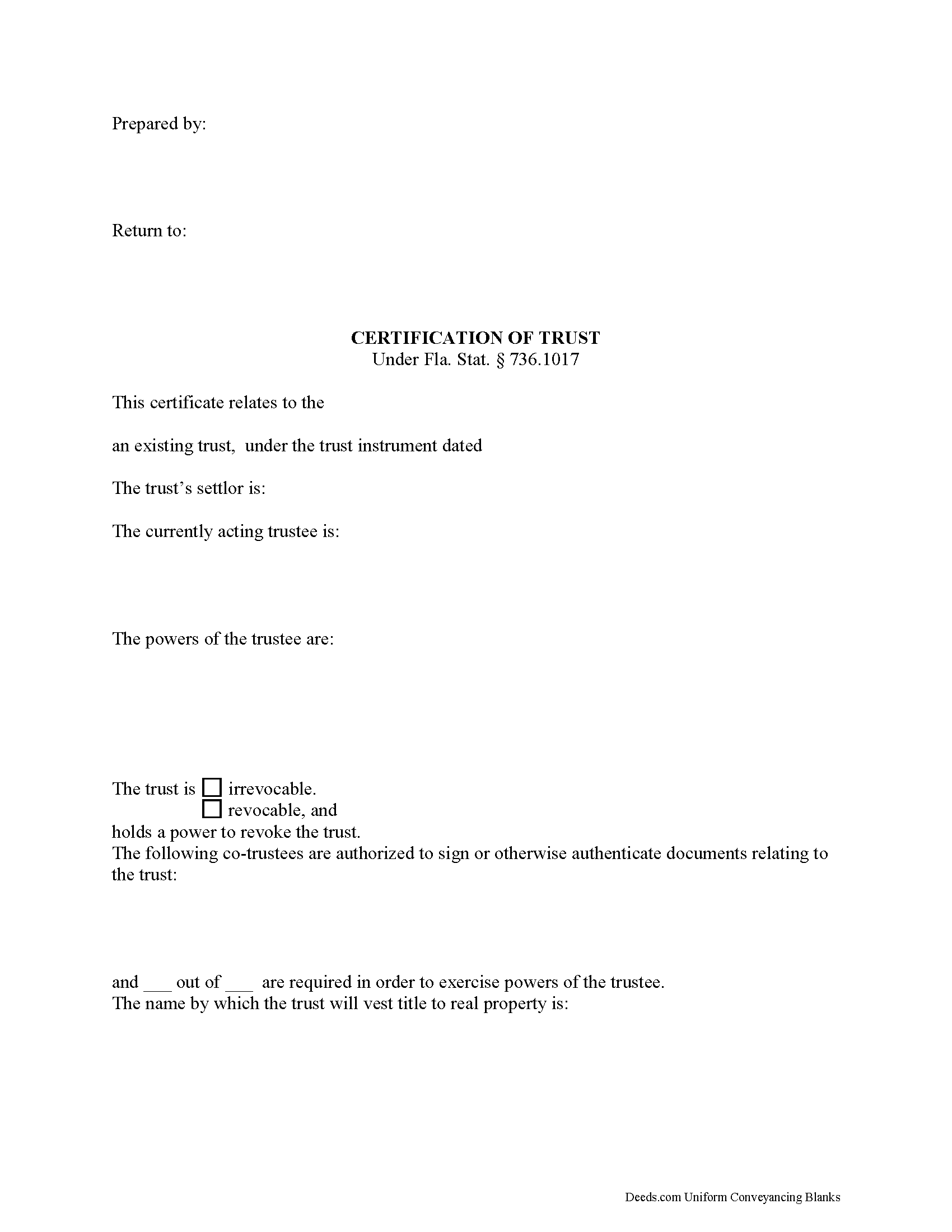
Florida Certificate of Trust

County Specific Legal Forms Validated as recently as April 24, 2026 by our Forms Development Team

About the Florida Certificate of Trust

Florida Certificate of Trust
Select County from List

How to Use This Form

  1. Select your county from the list on the left
  2. Download the county-specific form
  3. Fill in the required information
  4. Have the document notarized if required
  5. Record with your county recorder's office

What Others Like You Are Saying

— Marilyn O.

"Good resource. Got what I needed easily"

— Ute P.

"Thank you it was hard for me to pull these documents online you been a big help since I am in a diff…"

— Michael S.

"Recording a Warranty Deed with Mohave County AZ was easy and efficient by using Deeds.com. I will be…"

— Tammie S.

"No review provided."

— GLENN B.

"Great affordable quick service"

A Florida Certificate of Trust is useful in real estate transactions because Florida lets a trustee prove trust authority without handing over the entire trust agreement, while still requiring details that are not always part of other states’ forms, including powers of direction and current trust directors when they affect the proposed transaction. In Florida, this document is especially helpful when a lender, title company, closing agent, or county recording office needs evidence that the trustee can sign for the trust, but the trust’s private dispositive terms and beneficiary information do not need to be placed in the public record.

What a Florida Certificate of Trust Does

A Florida Certificate of Trust, called a certification of trust in the Florida Trust Code, is commonly used when trust-owned real property is being bought, sold, mortgaged, refinanced, transferred, or titled in the name of a trustee. Instead of providing the full trust instrument to a person other than a beneficiary, the trustee may provide a certificate showing the trust exists, identifying who can act for it, and stating the trustee powers relevant to the pending Florida real estate transaction (Fla. Stat. § 736.1017).

Florida Trust Code Requirements for a Certificate of Trust

Florida’s certificate statute is detailed. A valid certificate should include the information needed for the specific transaction without disclosing the trust’s dispositive terms (Fla. Stat. § 736.1017(4)). The certificate should state:

  • That the trust exists and the date the trust instrument was executed.
  • The identity of the settlor.
  • The identity and address of the currently acting trustee.
  • The trustee powers relevant to the Florida transaction.
  • Whether the trust contains powers of direction, and if so, the identity of the current trust directors, the trustee powers subject to direction, and whether the trust directors have directed or authorized the proposed transaction.
  • Whether the trust is revocable or irrevocable, and the identity of any person holding a power to revoke it.
  • The authority of cotrustees to sign or otherwise authenticate documents, including whether all cotrustees or fewer than all are required.
  • The manner of taking title to trust property.
  • A statement that the trust has not been revoked, modified, or amended in a way that makes the certificate’s representations incorrect.

A recipient may require excerpts from the original trust instrument and later amendments that designate the trustee and confer the trustee’s power to act in the pending transaction, but the full trust instrument is not required merely because a certificate is used (Fla. Stat. § 736.1017(5)).

Signing, Notarization, and Recording Format in Florida

Florida law allows a certification of trust to be signed or otherwise authenticated by any trustee (Fla. Stat. § 736.1017(2)). For a certificate used in a Florida real estate closing or submitted for recording, the trustee’s signature is commonly acknowledged before a notary so the instrument can be accepted as a recordable real property document. Florida notarial certificates must identify the venue, type of notarial act, whether the signer appeared by physical presence or online notarization, the date, the signer, the identification method, the notary’s signature, the notary’s printed or stamped name, and the notary seal (Fla. Stat. § 117.05).

Florida deeds and other instruments that create, transfer, release, assign, or surrender real property interests generally must be signed in the presence of two subscribing witnesses, except for lease-related instruments covered by the statutory exception (Fla. Stat. § 689.01). A certificate of trust does not itself convey title, but when it is recorded with or in support of a conveyance, Florida recording requirements should be followed carefully. For instruments affecting real property, the clerk may reject the document unless required names and addresses appear in the proper places, including the printed or stamped name and post office address of each person who signs, the natural person who prepared the instrument, each witness, and each grantee where applicable (Fla. Stat. § 695.26).

Recording a Certificate of Trust in Florida

Florida does not require every certificate of trust to be recorded. When the certificate is recorded because it supports a deed, mortgage, or other real property transaction, it is submitted to the clerk of the circuit court in the county where the Florida property is located. An instrument concerning real property must be acknowledged, proved by a subscribing witness, or otherwise authenticated in a form Florida law recognizes before it is entitled to recording (Fla. Stat. § 695.03).

Prompt recording matters most for the related deed, mortgage, transfer, or lease for a term of one year or longer, because Florida’s recording statute protects later creditors and purchasers without notice unless the earlier instrument is recorded according to law (Fla. Stat. § 695.01). If the certificate is recorded, it should match the related deed or mortgage, including the trust name, trustee name, property description, and the trustee capacity used in the transaction.

Florida-Specific Issues That Can Delay a Trust Real Estate Transaction

  • Powers of direction: Florida’s certificate statute specifically asks whether the trust has powers of direction and current trust directors. If the trust director must authorize a sale, mortgage, or transfer, the certificate should address that authority clearly (Fla. Stat. § 736.1017(1)(e)).
  • Cotrustee signatures: The certificate should say whether all cotrustees must sign or whether fewer than all can act. This is often a title-company issue in Florida closings because the certificate statute requires the cotrustee signing authority to be stated (Fla. Stat. § 736.1017(1)(g)).
  • Homestead property: Florida homestead rules can affect deeds involving trust property. A married owner’s homestead may generally be alienated by mortgage, sale, or gift only with the spouse joining, and a lifetime transfer in trust is treated separately from a devise for probate homestead purposes (Art. X, § 4(c), Fla. Const.; Fla. Stat. § 732.4017).
  • Marital status and spouse joinder questions: The certificate of trust is not a marital status affidavit, but a related deed involving Florida homestead can draw questions if the grantor’s marital status or spouse’s joinder is unclear. This is separate from the trustee authority shown in the certificate.
  • Recording names and addresses: Florida’s recording statute requires printed, typed, or stamped names and post office addresses for signers and witnesses on covered real property instruments. Since January 1, 2024, witness address omissions have been a common reason for rejection under the current wording of Fla. Stat. § 695.26.
  • Preparer identification: Florida requires the name and post office address of the natural person who prepared the instrument, or under whose supervision it was prepared, to appear on covered real property instruments (Fla. Stat. § 695.26(1)(b)).
  • Documentary stamp tax: A certificate of trust by itself does not transfer title, but deeds and other writings that grant, assign, transfer, or otherwise convey an interest in Florida real property are subject to documentary stamp tax based on consideration, including certain mortgage debt or other encumbrances (Fla. Stat. § 201.02).
  • Legal descriptions and plat references: If the certificate identifies Florida real property, the description should match the related deed, including subdivision, lot, block, plat book, page, section, township, range, condominium, or parcel language used in the county records.
  • Notary wording: Florida notarial certificates for real estate documents should show whether the appearance was by physical presence or online notarization, and a trustee signing in a representative capacity should be identified as trustee for the trust (Fla. Stat. § 117.05).

Title, Trust Identity, and Survivorship Language in Florida

Florida trust real estate documents should identify the trust consistently. A deed that names a grantee only as “trustee” or “as trustee” without naming beneficiaries, stating the nature and purposes of the trust, or identifying the trust by title or date can have specific title consequences under Florida law (Fla. Stat. § 689.07). A certificate of trust can help confirm the trust title, execution date, trustee authority, and manner of taking title while keeping private trust terms out of the public record.

Florida also does not automatically treat a conveyance to two or more persons as creating survivorship rights, except for estates by the entirety. Unless the instrument expressly provides for survivorship, Florida generally treats the ownership as a tenancy in common (Fla. Stat. § 689.15). A certificate of trust should not change vesting language in a deed, but it should state the trust’s manner of taking title so the trustee’s authority and the recorded vesting are consistent.

Florida Certificate of Trust Download Package

The Florida Certificate of Trust package includes:

  • Florida Certificate of Trust form for use with Florida trust and real property transactions.
  • Guidelines explaining how to complete the form and address Florida-specific certificate, signing, notarization, and recording issues.
  • Completed example showing how a Florida certificate of trust may be filled out for a typical real estate transaction.

How to Use This Form

  1. Select your county from the list above
  2. Download the county-specific form
  3. Fill in the required information
  4. Have the document notarized if required
  5. Record with your county recorder's office

What Others Like You Are Saying

— Marilyn O.

"Good resource. Got what I needed easily"

— Ute P.

"Thank you it was hard for me to pull these documents online you been a big help since I am in a diff…"

— Michael S.

"Recording a Warranty Deed with Mohave County AZ was easy and efficient by using Deeds.com. I will be…"

— Tammie S.

"No review provided."

— GLENN B.

"Great affordable quick service"

Common Uses for Certificate of Trust

  • Facilitate the sale of trust-held real estate
  • Satisfy title company requirements for trust-held property
  • Provide evidence that a trustee has authority to transact
  • Sell estate property to satisfy debts or obligations
  • Establish a trust's interest in real property for public record
  • Notify third parties of a trust's interest in real property

Important: County-Specific Forms

Our certificate of trust forms are specifically formatted for each county in Florida.

After selecting your county, you'll receive forms that meet all local recording requirements, ensuring your documents will be accepted without delays or rejection fees.