Pinellas County Notice of Lien Prohibition Form
Last validated October 15, 2026 by our Forms Development TeamFormatted for recording in Pinellas County, for property anywhere in the county: rural and unincorporated areas as well as Bay Pines, Belleair Beach, Clearwater, Clearwater Beach, Crystal Beach, Dunedin, Indian Rocks Beach, Largo and 8 more.
- 3 documents included
- Immediate PDF download
- Formatting guarantee
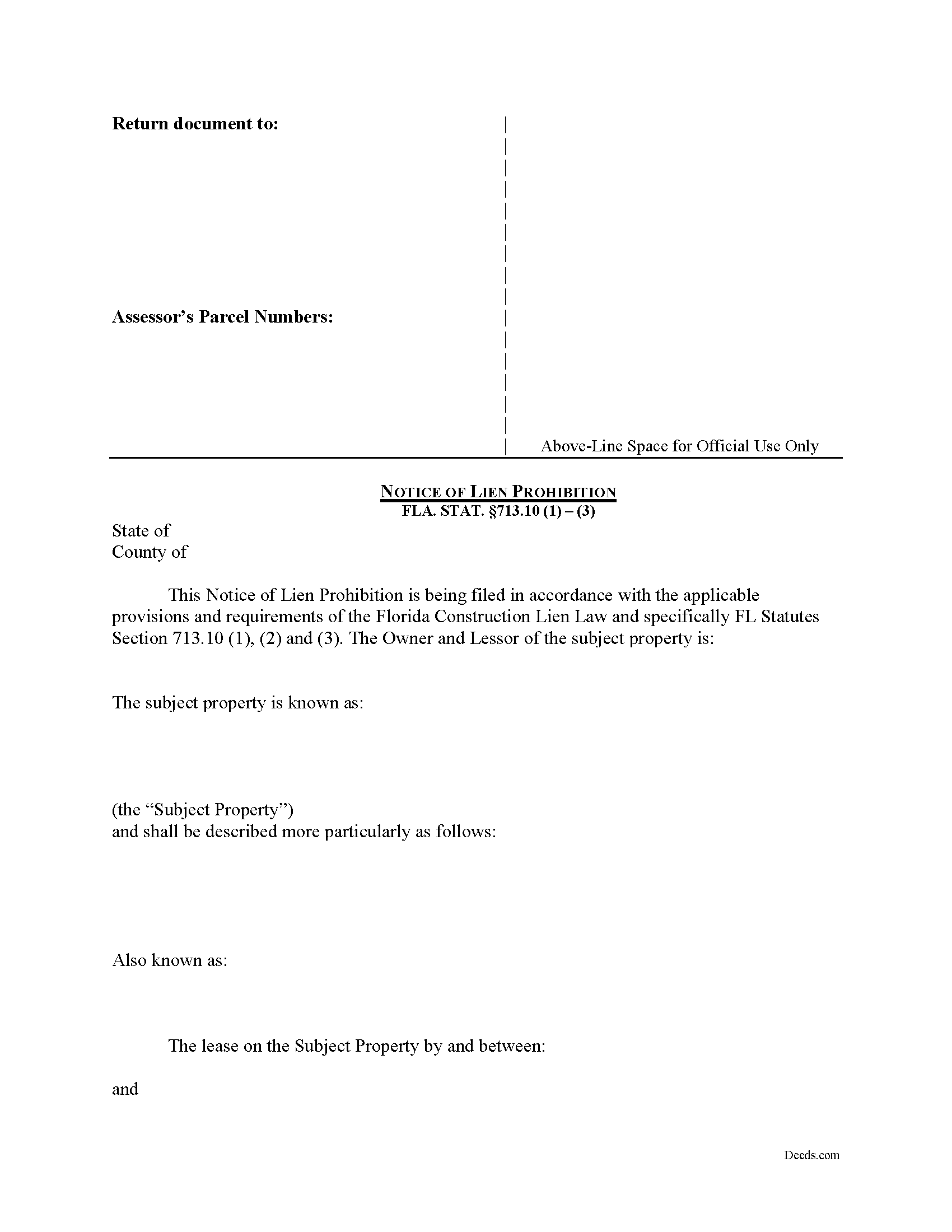
Pinellas County Notice of Lien Prohibition Form
Fill in the blank form formatted to comply with all recording and content requirements.
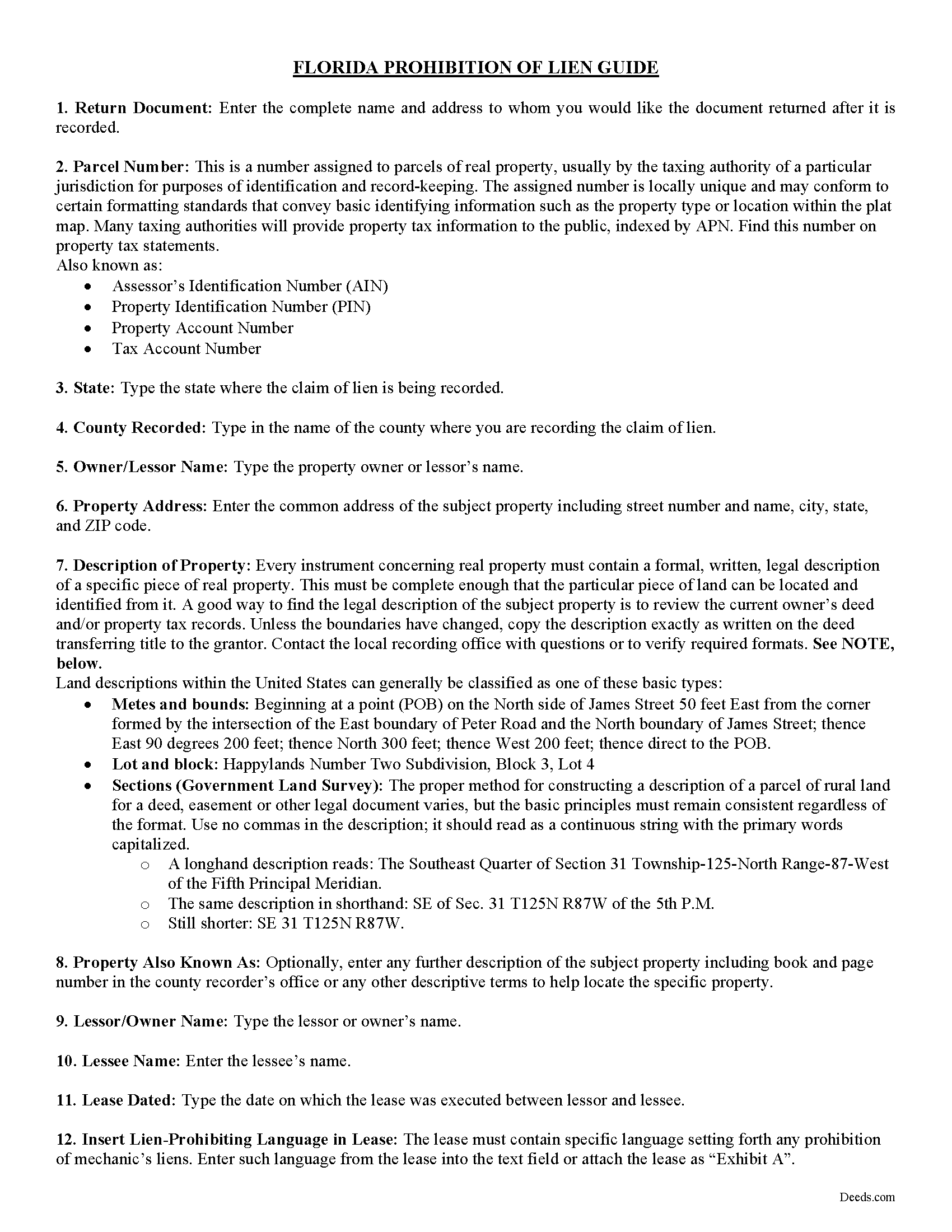
Pinellas County Notice of Lien Prohibition Guide
Line by line guide explaining every blank on the form.
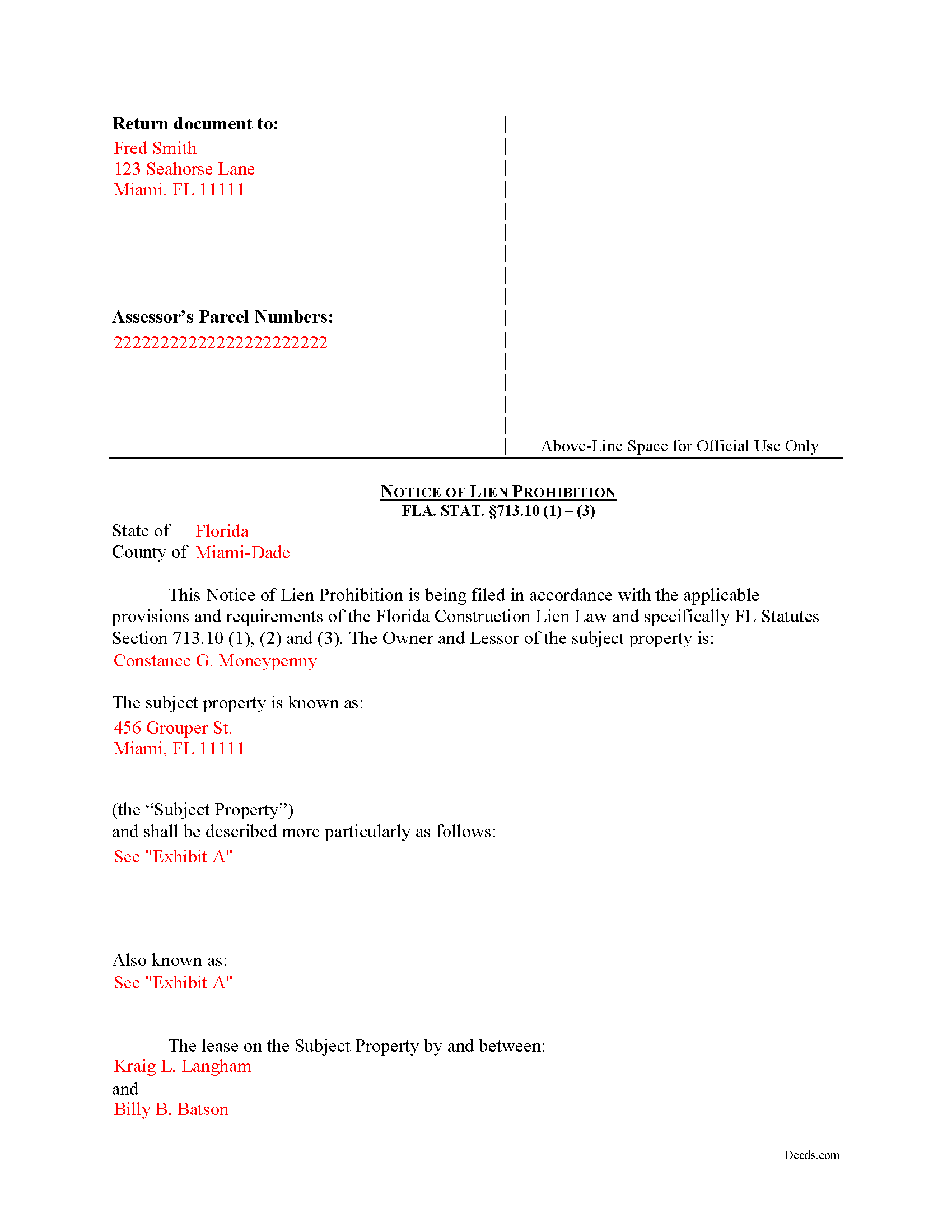
Pinellas County Completed Example of the Notice of Lien Prohibition Document
Example of a properly completed form for reference.
All 3 documents above included • One-time purchase • No recurring fees
Immediate Download • Secure Checkout
Additional Florida and Pinellas County documents included at no extra charge:
Where to Record Your Documents
Recording Services Dept - Clearwater Courthouse
Clearwater, Florida 33756
Hours: 8:30 to 4:30 M-F
Phone: (727) 464-7000
St. Petersburg Branch Office
St. Petersburg, Florida 33701
Hours: 8:30 to 4:30 M-F
Phone: (727) 464-7000
North County Branch Office
Clearwater, Florida 33761
Hours: 8:30 to 4:30 M-F / Document drop-off only
Phone: (727) 464-7000
Clerk's Tyrone Branch Office
St. Petersburg, Florida 33710
Hours: 8:30 - 4:30 M-F / Document drop-off only
Phone: (727) 464-7000
Recording Tips for Pinellas County:
- Bring your driver's license or state-issued photo ID
- Ensure all signatures are in blue or black ink
- Ask about accepted payment methods when you call ahead
- Ask for certified copies if you need them for other transactions
- Ask if they accept credit cards - many offices are cash/check only
Cities and Jurisdictions in Pinellas County
Properties in any of these areas use Pinellas County forms:
- Bay Pines
- Belleair Beach
- Clearwater
- Clearwater Beach
- Crystal Beach
- Dunedin
- Indian Rocks Beach
- Largo
- Oldsmar
- Ozona
- Palm Harbor
- Pinellas Park
- Safety Harbor
- Saint Petersburg
- Seminole
- Tarpon Springs
Hours, fees, requirements, and more for Pinellas County
How do I get my forms?
Forms are available for immediate download after payment. The Pinellas County forms will be in your account ready to download to your computer. An account is created for you during checkout if you don't have one. Forms are NOT emailed.
Are these forms guaranteed to be recordable in Pinellas County?
Yes. Our form blanks are guaranteed to meet or exceed the applicable formatting requirements used for recording in Pinellas County, including margin requirements, font requirements, and other layout standards. This guarantee applies to formatting, not to the legal sufficiency of information entered by the user or the suitability of a form for a particular transaction.
Can I reuse these forms?
Yes. You can reuse the forms for your personal use. For example, if you have multiple properties in Pinellas County you only need to order once.
What do I need to use these forms?
The forms are PDFs that you fill out on your computer. The free Adobe Acrobat Reader is recommended, and most PDF apps also work. You do NOT enter your property information online - you download the blank forms and complete them privately on your own computer.
Are there any recurring fees?
No. This is a one-time purchase. Nothing to cancel, no memberships, no recurring fees.
How much does it cost to record in Pinellas County?
Recording fees in Pinellas County vary. Contact the recorder's office at (727) 464-7000 for current fees.
Questions answered? Let's get started!
The Florida Notice of Lien Prohibition is a recorded instrument that shields a lessor's interest from mechanic's liens arising out of tenant-funded improvements. Florida's construction lien statute, Chapter 713, gives lessors a specific opt-out mechanism that does not exist in most other states: by recording the right notice or lease language in the official records before any notice of commencement is filed for the parcel, a lessor can publicly establish that leasehold improvements made by tenants will not encumber the underlying fee. Without that recording, the lessor's interest can be reached when an improvement is made by a lessee in accordance with an agreement between the lessee and the lessor (Fla. Stat. 713.10(1)), even when the lease itself prohibits liens.
What the Florida Notice of Lien Prohibition Does
The notice is filed by a landlord whose tenants will, or may, contract for improvements to leased premises. Florida law treats work performed at a tenant's direction as potentially extending to the lessor's interest whenever there is an agreement requiring the improvement, so a written lease prohibition alone does not always insulate the lessor's title. The recorded notice converts a private contract term into a matter of public record, giving contractors and material suppliers constructive notice that they cannot encumber the lessor's estate. It is most often used by owners of office and retail centers, ground lessors, mobile home park owners, and any landlord whose tenants are likely to undertake build-outs, tenant improvements, or trade-fixture installations.
Two Methods of Protection Under Fla. Stat. 713.10
Florida lessors have two routes to insulate their interest from liens for tenant-ordered improvements (Fla. Stat. 713.10(2)(b)):
- Record the lease itself, or a short form or memorandum that contains the specific lien-prohibition language, in the official records of the county where the property is located before the notice of commencement is recorded.
- Record a single notice covering the parcel that meets the statutory content requirements before the notice of commencement is recorded, when the lease terms expressly prohibit liability and a majority of the leases on the parcel contain that prohibition.
The blanket-notice option is the more efficient route for landlords with multiple tenants on a single parcel because it avoids recording each individual lease.
What the Notice Must Contain
To be effective, the recorded notice must include the four items specified by Fla. Stat. 713.10(2)(b)(2):
- The name of the lessor.
- The legal description of the parcel of land to which the notice applies.
- The specific language contained in the various leases prohibiting liability for improvements.
- A statement that all or a majority of the leases entered into for premises on the parcel expressly prohibit such liability.
The "all or a majority" representation is unique to the Florida statute. A notice that omits this statement, or that is recorded for a parcel where most leases lack the prohibition language, will not deliver the protection the lessor expects.
Timing: Record Before the Notice of Commencement
Florida's lien framework runs on the notice of commencement under Fla. Stat. 713.13. The lien-prohibition notice must reach the official records before any notice of commencement is recorded for improvements to the premises. A notice filed after work begins, or after a notice of commencement is already on file, does not retroactively protect the lessor's interest from contractors who relied on the public record at the start of the project. Landlords who acquire property mid-project, or who execute new leases after a tenant's build-out has started, should treat the timing requirement as a hard deadline rather than a formality.
The Mobile Home Park Exception
Fla. Stat. 713.10(2)(b)(3) carves out a separate rule for mobile home park lessors. When the lessee is a mobile home owner leasing a lot in a mobile home park, the lessor's interest is automatically not subject to liens for improvements made by the lessee, and no recorded notice is required to obtain that protection. Many mobile home park operators still record the notice for clarity and for a clean public record, but the statutory baseline is more generous than in other landlord-tenant settings.
Tenant's Duty to Notify the Contractor
When a lease prohibits liens against the lessor's interest, the lessee must inform any contractor performing improvements of that prohibition (Fla. Stat. 713.10(2)(a)). A knowing or willful failure to provide that notice makes the contract between the lessee and the contractor voidable at the contractor's option. The recorded notice does not eliminate this tenant duty. It operates alongside the lease prohibition by providing constructive notice through the public record, while the tenant retains the obligation to give actual notice to anyone the tenant hires.
The 30-Day Demand Procedure
Any contractor or lienor furnishing labor, services, or materials to a lessee may serve a written demand on the lessor for a copy of the lease provision prohibiting liability (Fla. Stat. 713.10(3)). The demand must identify the lessee and the premises being improved, and it must be a separate document from any notice to owner. The lessor has 30 days to respond with a verified copy of the lease provision. A lessor who ignores the demand, responds late, or serves a false or fraudulent copy loses the lien protection, and the contractor's lien can then attach to the lessor's interest. Any demand letter should be routed to the right person on receipt and treated as a hard deadline.
Execution and Recording in Florida
The notice is signed by the lessor and acknowledged before a notary public for recording in the official records of the county where the property is located. Florida recording statutes require the instrument to identify the parties, include the name and post office address of the person who prepared it, print or type names beneath each signature, and reserve a three-inch by three-inch blank space at the top right of the first page for the clerk's recording stamp (Fla. Stat. 695.26). A notice that omits these elements can be rejected at the recording counter. Recording fees in Florida are set by Fla. Stat. 28.24 and vary with page count. Documentary stamp tax under Fla. Stat. 201.02 does not apply to a notice of lien prohibition because no real property interest is being conveyed.
What's Included in the Download Package
The Florida Notice of Lien Prohibition package includes a fillable PDF form drafted to meet the content requirements of Fla. Stat. 713.10(2)(b)(2), a completed example showing how each section should be filled in, and a guide explaining the statutory framework, the timing rule tied to the notice of commencement, and the demand-response procedure under Fla. Stat. 713.10(3). The forms are prepared by the Deeds.com forms development team and formatted to satisfy Florida recording requirements, including the clerk's space and preparer identification under Fla. Stat. 695.26.
Important: Your property must be located in Pinellas County to use these forms. Documents should be recorded at the county recording office listed above.
This Notice of Lien Prohibition meets all recording requirements specific to Pinellas County.
Our Promise
The documents you receive here are guaranteed to meet or exceed the applicable Pinellas County recording format requirements. If there is a rejection caused by our formatting, we will correct the issue or refund your payment. This guarantee applies to document formatting only and does not extend to information entered by the user, the selection of the form, or the legal effect of the completed document.
Save Time and Money
Get your Pinellas County Notice of Lien Prohibition form done right the first time with Deeds.com Uniform Conveyancing Blanks. At Deeds.com, we understand that your time and money are valuable resources, and we don't want you to face a penalty fee or rejection imposed by a county recorder for submitting nonstandard documents. We constantly review and update our forms to meet rapidly changing state and county recording requirements for roughly 3,500 counties and local jurisdictions.
4.8 out of 5 - ( 4,828 Reviews )
Paula P. 2 out of 5 stars
Important: Click Download to save each PDF to your device. Open and complete the PDFs using Adobe Acrobat Reader (free). Get Adobe Acrobat Reader Browser PDF viewers (Chrome, Edge, Firefox, Mac Preview) may display fillable fields incorrectly. This information should be shared with the potential buyer BEFORE purchase. Messy formatting and a deeds.com advertisement on each page. I will not purchase from deeds.com again.
Paula, thank you for taking the time to leave feedback. As the product wasn’t a good fit for you, we’ve canceled your order and provided a full refund so there’s no need for you to use the documents.
Christine L. 5 out of 5 stars
User friendly!
Thank you!
David C. 5 out of 5 stars
I got what I expected. Thank you
Thank you for your feedback. We really appreciate it. Have a great day!
Patricia P. 5 out of 5 stars
Easy to use and super convenient.
Thank you for your feedback. We really appreciate it. Have a great day!
Bobbi W. 5 out of 5 stars
Site was super easy to use. After frustrating search for the item I needed I found it here!
We appreciate your business and value your feedback. Thank you. Have a wonderful day!
Frazer W. 5 out of 5 stars
The great part about Deeds.com is that the staff works with filers to get the job done.
Thank you, Frazer! We appreciate your kind words and are glad our team could help get the job done.
randy j. 1 out of 5 stars
the deed format and fill-in language are very specific to one type of easement and are not generally applicable to any other type; in other words it is not useful in a majority of situations and i would recommend against purchase unless you are creating an easement for an appurtenant landowner ONLY
Thank you for your feedback. We really appreciate it. Have a great day!
Gina B. 5 out of 5 stars
Super easy to use! Thanks!
We appreciate your business and value your feedback. Thank you. Have a wonderful day!
Geoffrey M. 5 out of 5 stars
Very convenient online document recording with great and quick service. Thank you!
Thank you!
Kathryn C. 5 out of 5 stars
The process to get my needed documents worked easily. I was pleased how quickly I was able to access the documents.
Your positive feedback is a testament to our efforts, and it truly made our day. We are committed to keeping up this level of service and making your future interactions with us equally, if not more, pleasing.
Thank you once again for taking the time to share your positive experience. We look forward to serving you again soon!
Charles S. 4 out of 5 stars
It's useful to have forms specific to the County as well as the State. The examples are also helpful, but it would be even more helpful to see an example of a complete and successfully filed package. I will go the County Recorder's Office to see if I can find an example there.
Your insights are invaluable to us and help us strive for better service. Thank you for taking the time to share your thoughts.
Margaret L. 1 out of 5 stars
I was not able to use the form after paying for it. The words in red would not let me type over them and I could not get a blank document. Useless.
Each forms package includes a blank form, a guide, and a completed example. The red text appears in the completed example to show how a finished document may look; the blank form is the editable document intended for customer use. Because our products are do-it-yourself legal forms, we canceled the order and payment when it was clear the customer was not able to identify and use the blank form included in the package.
Paula B. 4 out of 5 stars
I'm transferring a property into a trust and ordered the QuitClaim Deed. Everything was pretty straight forward and user friendly. However, the Additional Information/Instructions for the Preliminary Change of Ownership Report skips from Section "I" to "M" and does not address "K". It would have been very helpful to have an explanation of the difference between the three options in that section. Thank you.
Thank you for your feedback. We really appreciate it. Have a great day!
Rose C. 5 out of 5 stars
easy breezy *****
We appreciate your business and value your feedback. Thank you. Have a wonderful day!
Lourdes O. 5 out of 5 stars
Extremely efficient website. Beats going to Court House to record documents. My document was recorded in less then 24 hours! Amazing! I will be using deeds.com from now on.
We appreciate your business and value your feedback. Thank you. Have a wonderful day!