Florida Special Warranty Deed
County Specific Legal Forms Validated as recently as October 11, 2026 by our Forms Development Team
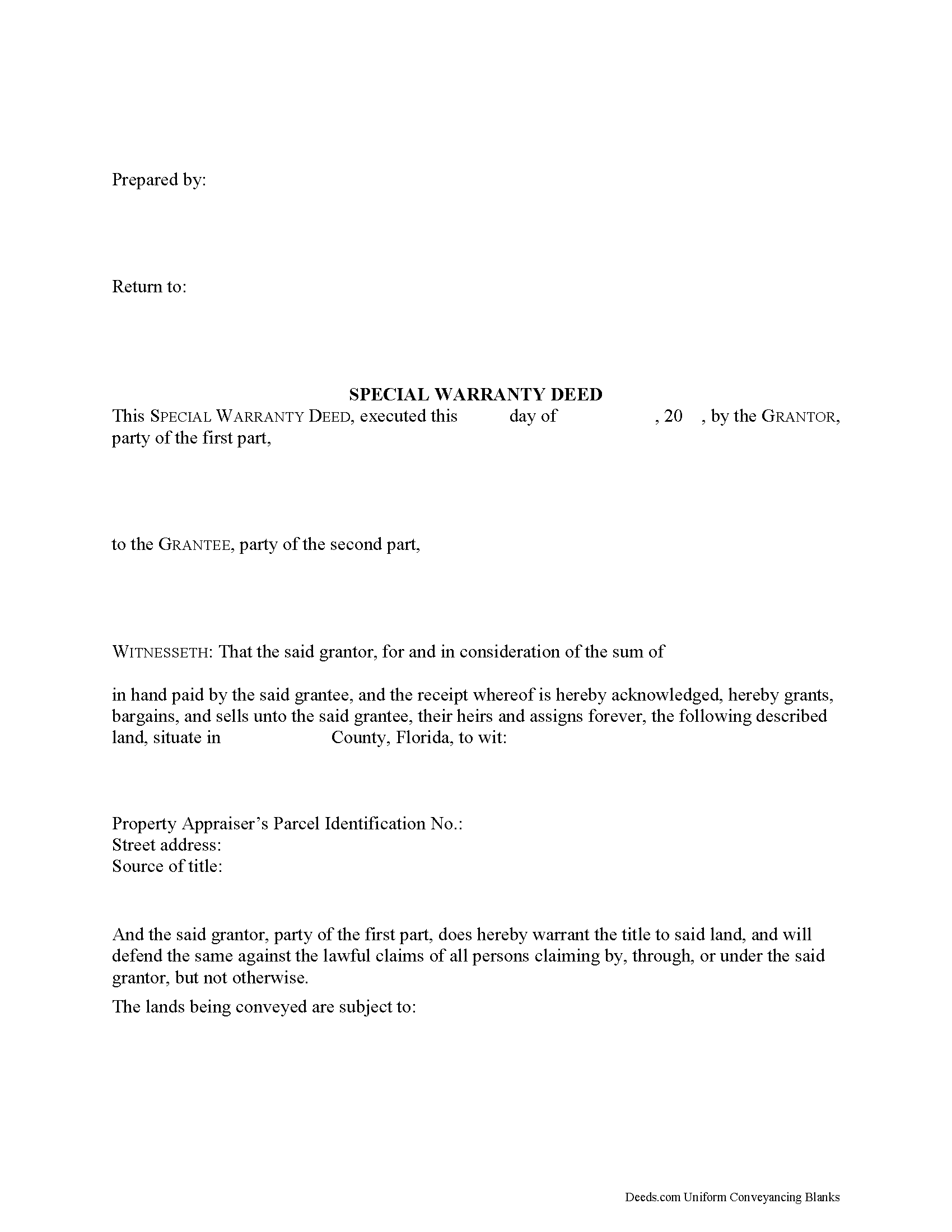
About the Florida Special Warranty Deed
How to Use This Form
- Select your county from the list
- Download the county-specific form
- Fill in the required information
- Have the document notarized if required
- Record with your county recorder's office
What Others Like You Are Saying
"Excellent, invaluable and reasonable!"
"Great! Received documents to download immediately and was able to do the needed with the information…"
"Very easy to find what I was looking for and the cost was reasonable. The documents saved me a lot o…"
"Easy and can add our own additional language in spaces provided. Thank you!"
"I am happy I can record this this way."
4.8/5 from 4,828 reviews. Read all
Every Florida deed answers one question in its own words: how far back does the grantor stand behind the title? A special warranty deed answers with the day the grantor's own ownership began. This Florida special warranty deed conveys the property in fee simple and covenants to defend the title against the lawful claims of all persons claiming by, through, or under the grantor, but against none other. The form is prepared for one or two grantors, natural persons signing in their own right, conveying to one or two grantees.
The covenant Florida law leaves to the deed itself
Florida writes two deed forms into statute, and this is neither. Section 689.02 of the Florida Statutes prescribes a statutory warranty deed, and section 689.03 gives a conveyance substantially in that form full common-law covenants reaching the whole chain of title. Section 689.025 prescribes a statutory quitclaim deed with no covenant at all. The special warranty deed exists only through its express language, so this form does three things in its operative section: it states the covenant in the by, through, or under formula, it states that no other covenant of title arises from the deed, and it states that the deed is not made under the section 689.02 form, so the full statutory covenants do not attach by implication. A matter the conveyance remains subject to, a recorded declaration or a platted easement, is listed in its own section as an exception to the warranty, and the deed says the listing creates no additional covenant.
Where the promise begins
The by, through, or under limit makes the source of title a working part of the deed. The form identifies the instrument by which the grantor acquired the property, with its recording reference, and the covenant runs from that acquisition forward. A judgment lien recorded against the grantor during those years is inside the covenant unless the deed lists it; an unreleased mortgage from an owner three transfers back is outside it and belongs to the title search and the buyer's title insurance.
One or two grantors, with the vesting left to the parties
The form preprints nothing about marital status, existing vesting, or how the grantees will hold title. Section 1 receives one or two grantors with whatever statement of status the parties supply, and Section 2 receives one or two grantees followed by any designation of the estate they take: as tenants in common, as joint tenants with right of survivorship, or, for grantees married to each other, as tenants by the entirety, the forms section 689.15 and Florida case law recognize. Two co-owners who inherited a parcel conveying it to one buyer, a married couple selling a second home to another couple, and one owner conveying to a parent and an adult child each present a count pattern this deed receives. The execution architecture is fixed: a signature block headed GRANTOR and a second headed SECOND GRANTOR, two subscribing witness blocks for each grantor's signature, and a separate acknowledgment certificate for each grantor, so two grantors may acknowledge on different dates or before different notaries. On a deed by one grantor, the second grantor's blocks stay blank. The form is not set up as a deed from a corporation, limited liability company, partnership, trustee, or attorney-in-fact, each of which acknowledges on a representative short form, and it carries no life estate reservation or trust powers language.
Florida's two formalities on the page
Section 689.01 requires the grantor's signature in the presence of two subscribing witnesses, and since January 1, 2024, section 695.26 has required each witness's printed name and post-office address on the instrument; the witness blocks carry both lines. The acknowledgment certificates reproduce the section 695.25(1) statutory short form, including the two boxes the notary marks for physical presence or online notarization, and each reserves a labeled area for the rubber-stamp seal section 117.05 places beside or below the notary's signature. The first page keeps the 3 inch by 3 inch space section 695.26 sets aside for the clerk of the circuit court, and documentary stamp tax under section 201.02 is paid at recording.
The download includes the deed as a fillable PDF, a completed example worked through a Hillsborough County sale by two grantors to two grantees, and a plain-language guide that treats every numbered section, the forms of co-ownership Florida recognizes, and the signing and recording steps. The materials describe Florida law in general terms and are not legal advice.
Important: County-Specific Forms
Our special warranty deed forms are specifically formatted for each of the 67 counties in Florida.
After selecting your county, you'll receive forms that meet all local recording requirements, ensuring your documents will be accepted without delays or rejection fees.