Georgia Quitclaim Deed (Corrective)
County Specific Legal Forms Validated as recently as October 23, 2026 by our Forms Development Team
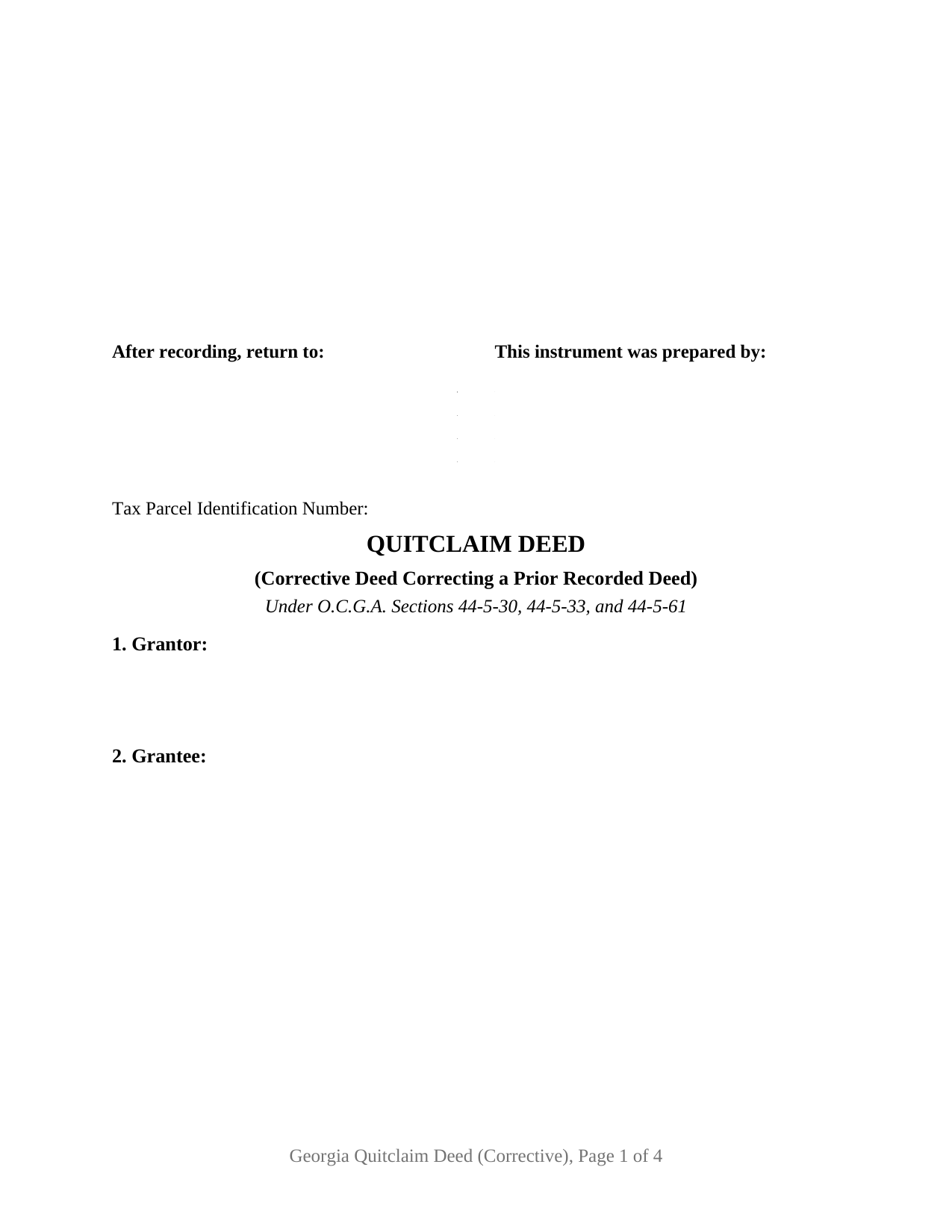
About the Georgia Quitclaim Deed (Corrective)
How to Use This Form
- Select your county from the list
- Download the county-specific form
- Fill in the required information
- Have the document notarized if required
- Record with your county recorder's office
What Others Like You Are Saying
"good forms thanks, irene"
"Awesome! Quick service and well worth the very minimal fee for the convenience of being able to quic…"
"Very easy to use - the completed sample was super useful"
"They didn't have what I was looking for so they refunded my money immediately. Very easy to work wit…"
"Had used website while working as Land Rep for major oil company (retired 2.5 years ago). Recently h…"
4.8/5 from 4,832 reviews. Read all
Nothing already written into the Georgia deed records can be erased. A deed filed with a transposed lot number or a misspelled grantor stays in the book exactly as it went in, and the fix is a second instrument that names the first, says what is wrong with it, and puts the corrected language on record over the original grantor's signature. This form prepares that second instrument as a quitclaim deed: one individual grantor, one grantee, and a correction the clerk of superior court indexes in its own right.
Three sections do the correcting
Section 3 identifies the deed being corrected by type, date, recording date, recording reference, and county, so an examiner holding this instrument can pull the earlier one from the book and page it names. Section 4 states the error in the words of that deed, Section 5 states the corrected language meant to replace it, and Section 6 carries the legal description in corrected form. Georgia regulation applies the same drafting standard nearby: for the intangible recording tax, an instrument given to correct a previously recorded one earns its exemption only where the body identifies the existing instrument and specifically states its purpose (Ga. Comp. R. and Regs. r. 560-11-8-.14(c)).
One grantor, signing a second time
The form recites exactly one grantor, the natural person who granted the deed being corrected, signing again in an individual capacity, and it carries a single execution set: one signature block, one unofficial witness line, one officer certificate. Two owners correcting a deed they both granted, or a company officer correcting a corporate release, present signature patterns this form does not recite. The single-grantor correction turns up in familiar shapes: a family transfer whose description carried the wrong lot, a release whose grantee name lost a middle initial, a title examiner's letter that stops a closing until the record reads correctly.
A release with no warranty, and no prescribed form to fill
The operative words remise, release, and forever quitclaim the grantor's right, title, interest, claim, and demand, and the correction language follows in the same section: the deed corrects and confirms the earlier instrument and conveys no interest beyond what that instrument purported to convey. Because O.C.G.A. Section 44-5-61 reads no warranty into any Georgia deed, the instrument states in capital letters that it gives none, so every security deed and easement of record rides through untouched. Georgia prescribes no statutory deed form at all (O.C.G.A. Section 44-5-33), so a Georgia correction deed is drafted rather than filled into a template; buyers search it as a corrective deed, a deed of correction, a quit claim deed, or a non-warranty deed.
Where the correction stops
Errors that live in the words of the earlier deed are what a later deed can reach. Changing who takes the property is a fresh conveyance rather than a correction, and Georgia treats it as the conveyance it is. A record problem that is a fact rather than deed language belongs instead to a recorded affidavit under O.C.G.A. Section 44-2-20, which makes such affidavits notice of matters like the identity of parties whose names appear differently in a chain of title, and which is prepared and recorded separately. Where the grantor cannot be found or will not sign, the Georgia answer is reformation in equity under O.C.G.A. Sections 23-2-21 and 23-2-25, a court proceeding no recorded form can perform.
Attested again, filed on its own date
Georgia's execution pattern reaches the correction exactly as it reached the original: the grantor's signature is attested by an officer named in O.C.G.A. Section 44-2-15, ordinarily a notary public, and by one other witness (O.C.G.A. Section 44-5-30), under a certificate captioned as an attestation. The corrected instrument takes effect against third parties from the moment it is filed (O.C.G.A. Section 44-2-2(c)), and a PT-61 real estate transfer tax filing travels with it even though a nominal recital leaves nothing to pay, transfer tax being measured on consideration or value above one hundred dollars (O.C.G.A. Section 48-6-1). The completed example corrects a transposed lot number on a Forsyth County parcel, signed three months after the deed it corrects.
Three files arrive with the purchase: the corrective quitclaim deed as a fillable PDF, that completed Forsyth County example, and a plain language guide covering every numbered section, the attestation and witness formalities, the grantee vesting forms Georgia recognizes, and the PT-61 and electronic filing path. The materials describe Georgia law in general terms and are not legal advice.
Important: County-Specific Forms
Our quitclaim deed (corrective) forms are specifically formatted for each of the 159 counties in Georgia.
After selecting your county, you'll receive forms that meet all local recording requirements, ensuring your documents will be accepted without delays or rejection fees.