Georgia Quitclaim Deed (Married Grantor with Non-Owner Spouse Joinder)
County Specific Legal Forms Validated as recently as October 13, 2026 by our Forms Development Team
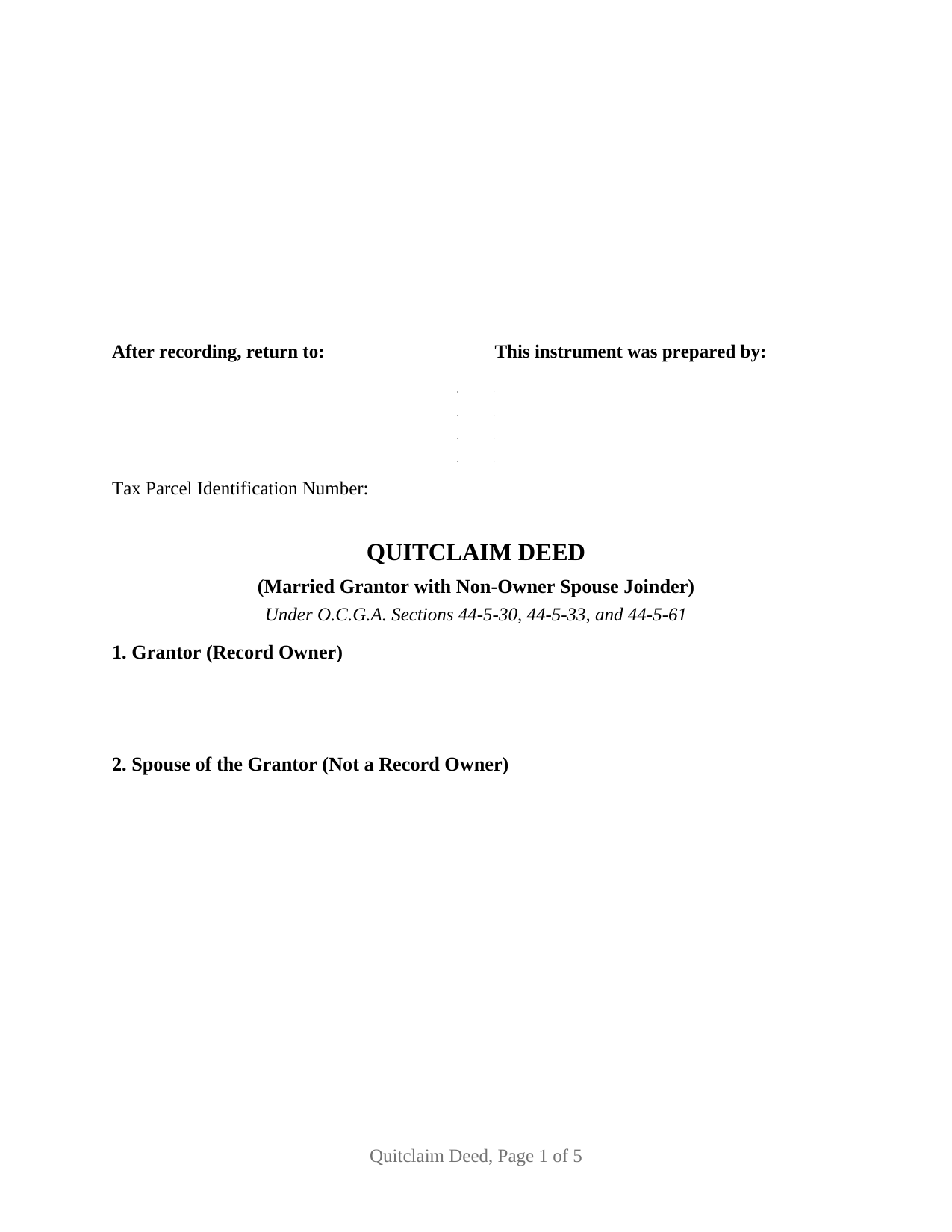
About the Georgia Quitclaim Deed (Married Grantor with Non-Owner Spouse Joinder)
How to Use This Form
- Select your county from the list
- Download the county-specific form
- Fill in the required information
- Have the document notarized if required
- Record with your county recorder's office
What Others Like You Are Saying
"Amazing! Very helpful. Very specific."
"Great site !! Very easy to navigate and explanations are clear and simple to understand. Thank You!"
"So far so good"
"The form was exactly what we needed and the directions were spot on and perfectly clear. Filling out…"
"Very helpful. Easy to use. Able to avoid the cost of having an attorney prepare the document I neede…"
4.8/5 from 4,830 reviews. Read all
One person holds the record title here, and two people sign. This Georgia quitclaim deed recites a single Grantor, a married natural person who is the record owner, and it carries a separate joinder block in which that owner's spouse, who is not on title, releases whatever interest that spouse may have in the same property. The grantee takes the release with no warranty of title, and the record shows both signatures.
A signature Georgia law does not ask for
Nothing in Georgia law makes a spouse a party to the other spouse's deed. Dower and curtesy were abolished by O.C.G.A. Section 53-1-3, the state recognizes neither a community regime nor an entireties estate, and no statute located for this form conditions the recording of a lifetime deed on the signature of a spouse who holds no record title. The joinder is deliberate rather than compelled: it puts a recorded release into the chain from the one person whose possible claim the record cannot display. The question surfaces where a marital residence, an inherited house, or a rental parcel stands in one spouse's name alone.
What the joinder reaches, and what it leaves alone
The joinder section is drafted as its own quitclaim: the spouse remises, releases, and forever quitclaims any right, title, interest, claim, and demand the spouse may have, joins in and consents to the conveyance, and warrants nothing. Two construction sentences matter as much. The spouse's signature does not enlarge the estate the Grantor conveys, and it operates whether or not the spouse turns out to hold anything. The limits belong in the same breath. This is not a property settlement between the spouses, it does not resolve equitable division in a divorce, where O.C.G.A. Section 19-3-9 leaves the separate property of each spouse separate, and no Georgia authority found for this build treats a joinder in a lifetime deed as a waiver of year's support, the probate right O.C.G.A. Section 53-3-1 gives a surviving spouse out of a decedent's estate. Because no warranty is implied in any Georgia deed under O.C.G.A. Section 44-5-61, both releases are expressly stated to carry none, and every security deed and lien of record rides through untouched.
One record owner, two complete execution sets
Georgia deeds are attested rather than acknowledged. O.C.G.A. Section 44-5-30 has the maker's signature attested by an officer drawn from the list in O.C.G.A. Section 44-2-15, ordinarily a Georgia notary public, and by one more witness, called the unofficial witness. This form gives each signer a full set, so the finished quit claim deed carries the Grantor's signature and the spouse's, an unofficial witness line beneath each, and two officer certificates captioned as attestations, each reciting that the instrument was signed, sealed, and delivered in the officer's presence. O.C.G.A. Section 44-14-33 explains the caption: where the officer attests, a formal certificate of acknowledgment is not necessary. Independent sets let the two signatures be attested on different days or in different counties, though the example shows both finished at one sitting.
Recording a gift in Georgia
The example is a deed of gift, so no transfer tax falls due: deeds of gift sit among the exemptions listed in O.C.G.A. Section 48-6-2. The exemption is claimed on the PT-61 rather than by skipping it, because Georgia Rule 560-11-2-.17 makes a properly completed PT-61 a condition of eligibility for recording wherever one is called for, and O.C.G.A. Section 48-6-4 makes payment of any tax due a filing prerequisite the clerk certifies. Where value does change hands, O.C.G.A. Section 48-6-1 measures the tax against consideration or value above one hundred dollars. Filing runs twenty five dollars statewide under O.C.G.A. Section 15-6-77. A party filing without an attorney or other professional filer submits through the state clerks' authority portal with verified government identification, the self-filer rule in force since 2025. Page one keeps its top three inches open for the clerk under O.C.G.A. Section 15-6-61(a)(10), then opens with the return-to name and address that O.C.G.A. Section 44-2-14(b) places there, followed by a tax parcel line that satisfies DeKalb County's local first page requirement.
Three files arrive with the purchase: the fillable non-warranty deed itself, a completed example set in Chatham County, where a married sole owner gifts an inherited Savannah house to her brother while her husband joins in the release, and a plain language guide covering every numbered section, both attestation sets, the grantee's vesting choices, and the recording path. These materials describe Georgia law generally and are not legal advice.
Important: County-Specific Forms
Our quitclaim deed (married grantor with non-owner spouse joinder) forms are specifically formatted for each of the 159 counties in Georgia.
After selecting your county, you'll receive forms that meet all local recording requirements, ensuring your documents will be accepted without delays or rejection fees.