Georgia Warranty Deed
County Specific Legal Forms Validated as recently as September 21, 2026 by our Forms Development Team
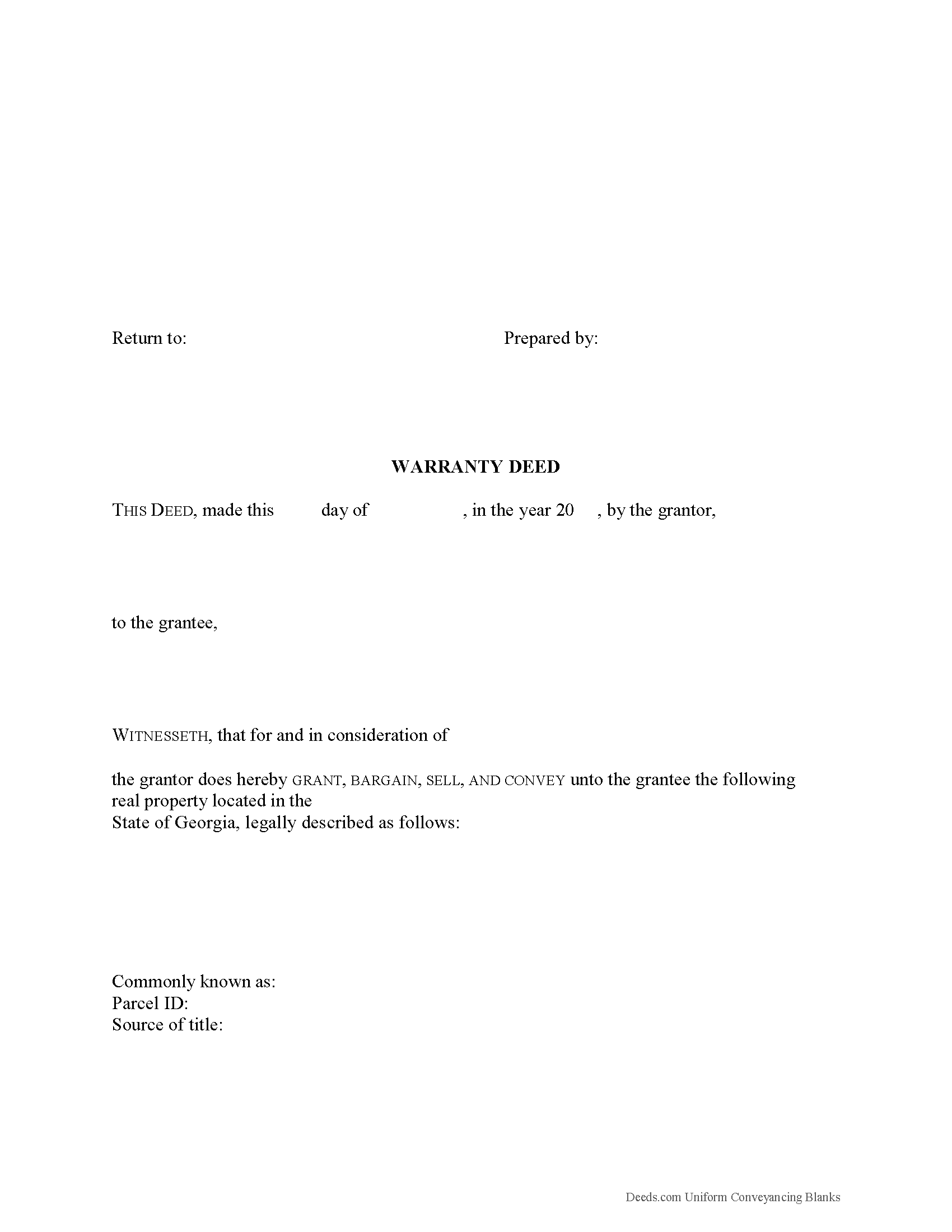
About the Georgia Warranty Deed
How to Use This Form
- Select your county from the list
- Download the county-specific form
- Fill in the required information
- Have the document notarized if required
- Record with your county recorder's office
What Others Like You Are Saying
"So far so good, I did not know the convenience I would have from my seat to file a legal document! A…"
"This was pretty easy especially for a old guy like me."
"So far I am having a good experience."
"Thank-you for your excellent services"
"I think this is going to be a very resourceful website, really have not had a chance to fully naviga…"
4.8/5 from 4,808 reviews. Read all
Georgia prescribes no deed form at all. O.C.G.A. Section 44-5-33 provides that no prescribed form is essential to the validity of a deed to lands, and O.C.G.A. Section 44-5-61 leaves no warranty of title implied in one. Between those two rules sits everything a Georgia warranty deed is: an instrument that does exactly what its own words do, and promises exactly what its own words promise. This general warranty deed is the base form of that instrument, drafted for natural persons conveying in their own names.
The covenant the deed writes down
What makes this a warranty deed is the express covenant on its face, a general warranty against the claims of all persons whomsoever. O.C.G.A. Section 44-5-62 supplies the statutory reach of that phrase: a right to sell, quiet enjoyment, and freedom from encumbrances. O.C.G.A. Section 44-5-63 pushes it further, reaching title defects the purchaser already knew about, which is why the deed's own list of exceptions marks the outer edge of the promise rather than anything the buyer happened to learn. Section 7 holds that list. Section 8, which has no blanks in it, carries the granting words, the habendum in fee simple forever, and the warranty itself.
Open party blocks, one or two people a side
Section 1 takes one or two natural persons as grantors, in the names their vesting deed uses, and Section 2 takes one or two grantees together with any designation for the way they hold. Nothing about marital status, capacity, or co-ownership is printed anywhere on the instrument; those words are the filler's, and the guide teaches them. Georgia's default for two grantees is tenancy in common under O.C.G.A. Section 44-6-120, and survivorship comes only from express statutory wording in O.C.G.A. Section 44-6-190. All four count patterns, one grantor or two conveying to one grantee or two, run through the same page furniture. Conveyances signed by a company, by a trustee or executor, or by an agent under a power of attorney turn on authority language this form does not carry, and three or more owners on a side pass the capacity of its party blocks.
An execution page the record has to read
Georgia executes deeds by attestation rather than by acknowledgment alone. O.C.G.A. Section 44-5-30 asks for three signatures: the maker's, an officer's under O.C.G.A. Section 44-2-15, in most closings a notary public, and one other witness's. Officer and witness both watch the signing and then sign the paper themselves. The form doubles that set, giving each of two grantors a signature block, an unofficial witness block, and an officer certificate, and the second of each is left blank when a single grantor conveys. Each certificate is captioned as an attestation and states that the deed was signed, sealed, and delivered in the officer's presence, naming the notarial act O.C.G.A. Section 45-17-1 defines. Georgia decisions treat a deed that was never properly attested as giving no constructive notice at all, even once the clerk has recorded it.
What the first page has to carry
The top three inches of page one stay clear for the clerk's notation under O.C.G.A. Section 15-6-61(a)(10), and the first thing printed below that reserve is the return block that O.C.G.A. Section 44-2-14(b) places at the top of the first page. A tax parcel identification line sits beside it, answering DeKalb County's local first page parcel rule and speeding indexing elsewhere. The finished deed goes to the clerk of superior court in the county where the land lies, at the flat statutory filing fee of O.C.G.A. Section 15-6-77(f), which does not vary with page count, and a conveyance for value travels with an electronic PT-61 return and transfer tax figured under O.C.G.A. Section 48-6-1. Filers outside the listed professional categories now record through the self filer electronic channel with identity verification.
The package holds three things: this warranty deed as a fillable PDF, a completed example filled in for a Fulton County transfer by two grantors to two grantees taking with survivorship, and a plain language guide covering each numbered section, the attestation formalities, the ways Georgia lets grantees hold title, and the run from PT-61 to file stamp. Everything here describes Georgia law in general terms for information, and none of it is legal advice.
Important: County-Specific Forms
Our warranty deed forms are specifically formatted for each of the 159 counties in Georgia.
After selecting your county, you'll receive forms that meet all local recording requirements, ensuring your documents will be accepted without delays or rejection fees.