Hawaii Transfer on Death Deed (Individual Transferor)
County Specific Legal Forms Validated as recently as October 22, 2026 by our Forms Development Team
About the Hawaii Transfer on Death Deed (Individual Transferor)
How to Use This Form
- Select your county from the list
- Download the county-specific form
- Fill in the required information
- Have the document notarized if required
- Record with your county recorder's office
What Others Like You Are Saying
"I found the documents I needed and so many more that I will utilize for business, personal and famil…"
"I just now downloaded the forms. So far, so good."
"Everything that I needed was included. I appreciate that there was a sample as well as the step-by-s…"
"Wonderful forms, been coming here for years (since 2012) for my deed forms and they have never faile…"
"Thanks. So easy to navigate. Also very useful. I recommend."
4.8/5 from 4,829 reviews. Read all
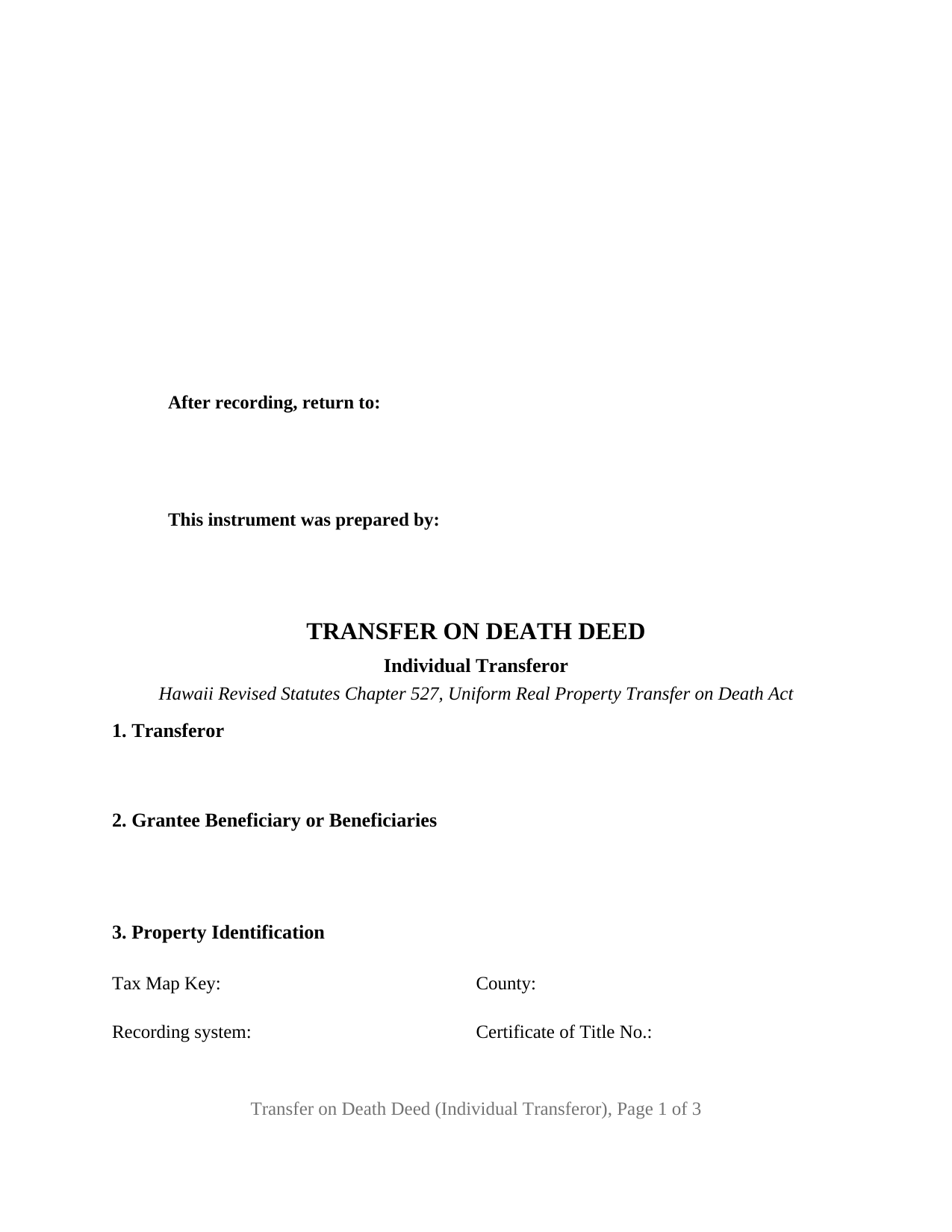
One transferor, one signature line, one acknowledgment certificate. This Hawaii transfer on death deed is built for an individual owner who signs in the owner's own right and names who takes the owner's interest in Hawaii real property at death, outside probate. The form prepares that single-transferor deed under Chapter 527 of the Hawaii Revised Statutes, and it operates only if it reaches the Bureau of Conveyances, or the Assistant Registrar of the Land Court, while the transferor is living.
What a single transferor's deed reaches
The deed transfers whatever interest the transferor holds at death and nothing more. A sole owner passes the whole parcel; a tenant in common passes an undivided share. A joint tenant, or a tenant by the entirety with a spouse, civil union partner, or reciprocal beneficiary, passes nothing at that death if another joint owner survives: Section 527-13(c) sends the property to the surviving joint owner and gives the deed effect only if the transferor is the last surviving joint owner. The spouse of a transferor who holds title alone is not a transferor and has no signature line; Hawaii has no community property regime and no dower or curtesy for estates arising after 1977, while the elective share and statutory allowances still reach the property at death under Sections 527-13(a) and 527-15.
A capacity the chapter already fixes
Section 527-2 defines a transferor as an individual who executes a transfer on death deed, and Section 527-8 sets the capacity at the capacity to make a will: eighteen or more years of age and of sound mind. The deed's operative section recites exactly that configuration, that the transferor named in Section 1 is one individual who signs in the transferor's own right, performs the transfer effective at the transferor's death, and carries the statement Section 527-9 requires, that the transfer to the beneficiary is to occur at the transferor's death. Hawaii enacted the uniform act without its optional deed form, so those words are the chapter's requirements written out.
Beneficiaries named by the owner, shares supplied by the chapter
The beneficiary block takes one or more beneficiaries with their mailing addresses; a beneficiary may be a person, a trust, or an entity under Section 527-2. Where two or more are named and the deed says nothing about shares, Section 527-13 gives them equal and undivided shares with no right of survivorship, drops a beneficiary who does not survive the transferor, and moves a lapsed share to the remaining concurrent beneficiaries in proportion to their interests. During the transferor's life the beneficiary holds no interest and the transferor keeps every right to sell, mortgage, or revoke.
The configuration this form recites
The form carries one transferor block, one signature block headed TRANSFEROR, and one acknowledgment certificate in the Hawaii statutory form for a person acting in the person's own right under Section 502-41. It preprints no marital status and no statement of how title is held; the transferor's name, any status recital, and address go into one open block. A widowed parent passing a Maui home to adult children, a single owner naming a living trust as beneficiary, and a married owner whose spouse is not on the title present the one-transferor pattern this deed recites. The form is not set up as a deed for two transferors, for an entity or trustee holding title, or for an attorney-in-fact.
One state office, two record systems
Hawaii records every real property instrument at the Bureau of Conveyances, in the Regular System or the Land Court, and the deed identifies the system and any certificate of title number on its first page beside the tax map key, as Hawaii Administrative Rules Section 13-16-4 requires. Recording before the transferor's death is the chapter's effectiveness condition, stated on the deed in capital letters above the signature. Section 247-3 exempts a conforming transfer on death deed from the conveyance tax. For land court property, a petition for a new certificate of title in the beneficiary's name follows the transferor's death under Section 527-13(a)(1); that petition is prepared and filed separately and is not part of this package.
The package includes the fillable Hawaii transfer on death deed for an individual transferor, a completed example filled in for a Maui County fact pattern, and a guide covering every section and the recording path in each system. The description and guide treat the form and the statutes in general terms and are not legal advice.
Important: County-Specific Forms
Our transfer on death deed (individual transferor) forms are specifically formatted for each of the 4 counties in Hawaii.
After selecting your county, you'll receive forms that meet all local recording requirements, ensuring your documents will be accepted without delays or rejection fees.