Hawaii Transfer on Death Deed (Trust Beneficiary)
County Specific Legal Forms Validated as recently as October 22, 2026 by our Forms Development Team
About the Hawaii Transfer on Death Deed (Trust Beneficiary)
How to Use This Form
- Select your county from the list
- Download the county-specific form
- Fill in the required information
- Have the document notarized if required
- Record with your county recorder's office
What Others Like You Are Saying
"Not knowing I could down load these forms, I first went to the local recording office thinking I cou…"
"The documents worked perfectly! Thanks"
"5 stars."
"Pretty good forms, they would probably be better if I read the directions but..."
"Great service and so quick at responding!"
4.8/5 from 4,829 reviews. Read all
This Hawaii transfer on death deed carries real property into a trust at the owner's death without a lifetime deed to the trustee and without probate. One owner, signing in the owner's own capacity, designates the trustee of a named trust as the beneficiary under Chapter 527 of the Hawaii Revised Statutes, and the property stays in the owner's name, fully under the owner's control, until the owner dies.
A deed that lands in the trust at death
Many Hawaii owners with a revocable living trust leave the home in their own name during life; a transfer on death deed to the trustee moves it into the trust at death. Under Section 527-12 the recorded deed changes nothing while the owner lives; under Section 527-13 the owner's interest passes at death to the designated beneficiary, subject to any mortgage or other interest then affecting title and without covenant or warranty. Section 527-2 defines person to include a trust, so a trust is a beneficiary the chapter itself names, and the trust instrument then governs what the trustee does with the property.
The trustee serving at death takes, not a named individual
The form's operative section directs the transfer to the trustee of the trust identified on the deed, to hold under the trust's terms, and provides that the designation runs to whoever is serving as trustee at the transferor's death, including any successor trustee, in that fiduciary capacity and not individually. An owner who serves as trustee of the owner's own trust is succeeded at death by the successor trustee the trust instrument names, and a change of trustee after recording does not call for a new deed. The deed also carries the one statement Section 527-9 requires on its face, that the transfer to the beneficiary is to occur at the transferor's death.
What the trust entries identify
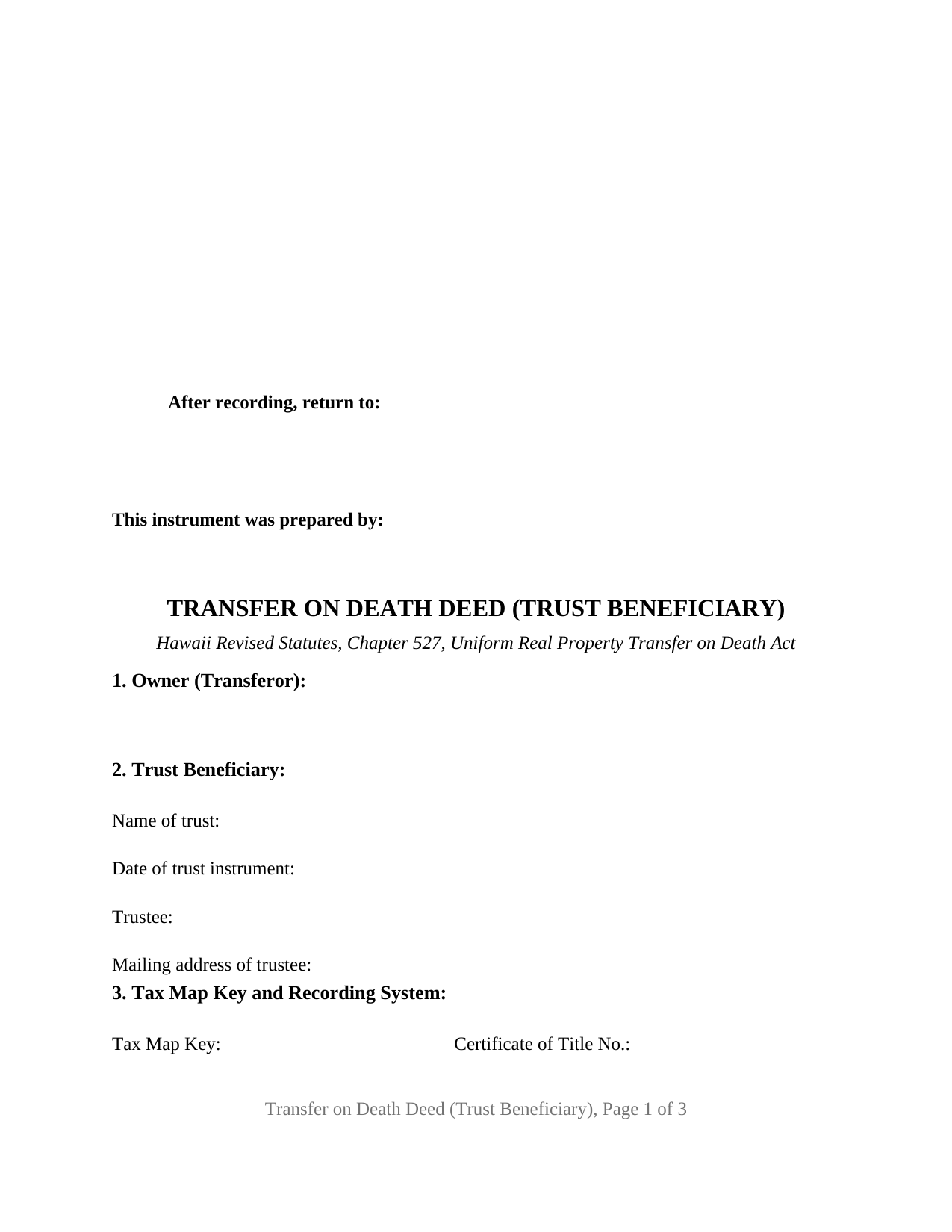
Section 2 of the deed holds four entries: the name of the trust exactly as the trust instrument states it, the date of the trust instrument, the trustee or co-trustees now serving, and the trustee's mailing address. The date and the trustee are the same items a certification of trust states under Section 554D-1013 of Hawaii's Uniform Trust Code, the document a trustee commonly furnishes after the owner's death in place of the full trust instrument. The trustee's address satisfies the Bureau of Conveyances rule that a recorded document carry the grantee's address.
Recording in a two-system state
The deed is effective only if it is recorded with the Bureau of Conveyances, or filed with the Assistant Registrar of the Land Court, before the owner's death; Section 527-9 makes recording a condition of validity, not merely notice. The deed carries the tax map key and a line for the Land Court certificate of title number, which reads None for Regular System property. For Land Court property, Section 501-131 notes a transfer in trust on the certificate by a memorandum referring to the trust instrument, and at death Section 527-13(a)(1) requires a petition to the Land Court for a new certificate in the beneficiary's name, a filing made separately and not part of this package. A conforming transfer on death deed is exempt from the conveyance tax under Section 247-3.
One owner, one trust
The deed recites exactly one transferor, a natural person signing in the owner's own capacity, and exactly one beneficiary, the trustee of the identified trust; it carries one signature block and one acknowledgment certificate in the Hawaii statutory form, with a reserved space for the notary seal. Nothing about the owner's marital status or manner of holding title is preprinted. A sole owner of a house or condominium, and a tenant in common passing an undivided share to the family trust, present the pattern this deed recites. An owner who holds as a joint tenant or tenant by the entirety and is survived by the co-owner transfers nothing under Section 527-13(c), because the property belongs to the survivor; two owners on one deed, an individual or company beneficiary, and several beneficiaries taking shares are configurations this form is not set up as.
The package contains the fillable Hawaii transfer on death deed with a trust beneficiary, a completed example on a Hawaii County fact pattern, and a guide that walks through each section, notarization, and recording in the Regular System or the Land Court. The description and the guide are general accounts of the form and the statutes, not legal advice.
Important: County-Specific Forms
Our transfer on death deed (trust beneficiary) forms are specifically formatted for each of the 4 counties in Hawaii.
After selecting your county, you'll receive forms that meet all local recording requirements, ensuring your documents will be accepted without delays or rejection fees.