Hawaii Transfer on Death Deed (Married Couple as Tenants by the Entirety)
County Specific Legal Forms Validated as recently as October 22, 2026 by our Forms Development Team
About the Hawaii Transfer on Death Deed (Married Couple as Tenants by the Entirety)
How to Use This Form
- Select your county from the list
- Download the county-specific form
- Fill in the required information
- Have the document notarized if required
- Record with your county recorder's office
What Others Like You Are Saying
"Quick download, hassle-free, no forced membership-just a straight-forward transaction. Thank you!"
"The filled out form could have been placed on the real form then deleted with current info. Form qui…"
"was good choice for me but did not realize notary had to witness all 3 signatures at the same luckil…"
"Easy to use and fully comprehensive."
"The DEEDs website is very easy to navigate and find the required documents. I have not yet had an op…"
4.8/5 from 4,829 reviews. Read all
Two Hawaii spouses who hold their home as tenants by the entirety can name, in one recorded deed, who takes the property after both of them have died. This transfer on death deed is built for that pair: both spouses sign as transferors, and the deed waits, by its own terms and by the statute, for the second death.
A deed that waits for the second death
Hawaii's transfer on death statute, Chapter 527 of the Hawaii Revised Statutes, counts a tenant by the entirety as a joint owner under Section 527-2. Section 527-13(c) then does the work: when a joint owner dies survived by another joint owner, the property belongs to the survivor and the transfer on death deed has no effect at that death; when the last surviving joint owner dies, the deed takes effect. This form prints that sequence in its operative section, so the record itself states that the transfer to the beneficiary is to occur at the death of the surviving transferor, beside the one statement Section 527-9 requires of every Hawaii TOD deed.
Both spouses sign, and both stay in control
The deed recites that the two transferors are married to each other and hold the property as tenants by the entirety, with each spouse's name entered in its own blank and a signature block and acknowledgment certificate for each. Nothing passes during either life: Section 527-12 leaves the spouses free to sell, mortgage, or lease together as before, and the deed neither severs the entireties estate nor changes the position of any creditor, which Section 527-12 leaves untouched. Under the joint-owner rule of Section 527-11(b), a deed executed by joint owners is revoked only by all living joint owners, so neither spouse undoes the designation alone while both live; the survivor, as the last living joint owner, may revoke or replace it by a later acknowledged and recorded instrument.
The beneficiaries and the survival measure
The beneficiary blank takes one or more individuals, a trust, or an entity, each with a mailing address; the chapter's defaults supply equal undivided shares with no survivorship among concurrent beneficiaries and pass a lapsed share to the others in proportion. Because Section 527-13 is subject to Section 560:2-702 of the Probate Code, a beneficiary takes only by surviving the second death by 120 hours unless the deed expressly provides otherwise, and this form sets no period of its own. The beneficiary takes what the surviving spouse owned at death, subject to every interest then affecting title and without covenant or warranty.
Recording in Hawaii's two systems
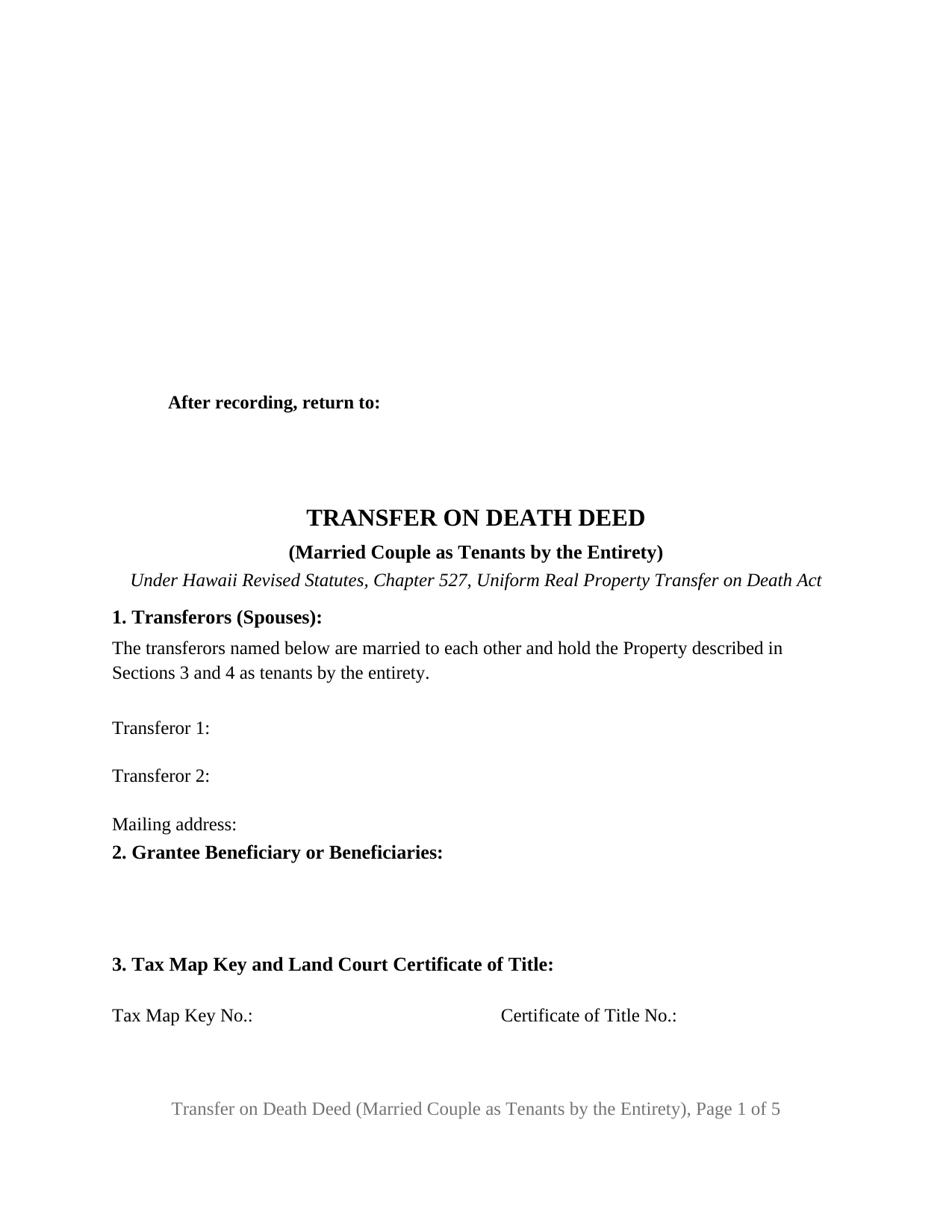
A Hawaii TOD deed is effective only if recorded with the Bureau of Conveyances or filed with the Assistant Registrar of the Land Court before the transferor's death, and recording while both spouses are living places this deed of record before either death. The first page follows the Bureau's rule: the registrars' band at the top, the return address in the strip beneath it, and the spouses' names, the beneficiaries with their addresses, the title, and the tax map key on page one, beside a line for the Land Court certificate of title number. Each acknowledgment certificate follows the Hawaii statutory form and reserves space for the notary's seal, and a conforming Chapter 527 deed is exempt from the conveyance tax under Section 247-3.
Exactly two spouses holding by the entirety
The configuration is fixed in the deed text rather than left to a blank: marital status, the entireties estate, the second-death trigger, two signature blocks, and two certificates. A married couple who bought a house or condominium together and took title as tenants by the entirety, and spouses who hold a home one of them conveyed to both of them by the entirety under Section 509-2, present the pattern this deed recites. A sole owner, two owners holding as tenants in common or as joint tenants, civil union partners or reciprocal beneficiaries holding by the entirety, an attorney-in-fact, a trustee, and an entity owner are configurations this form is not set up as. A beneficiary deed, as some states call the instrument, is the same device under the Hawaii chapter.
The package contains the fillable Hawaii transfer on death deed for spouses holding by the entirety, a completed example on a Maui County fact pattern, and a guide that walks through each section, notarization, and recording in either system. The description and the guide describe the form and the statutes in general terms; they are not legal advice.
Important: County-Specific Forms
Our transfer on death deed (married couple as tenants by the entirety) forms are specifically formatted for each of the 4 counties in Hawaii.
After selecting your county, you'll receive forms that meet all local recording requirements, ensuring your documents will be accepted without delays or rejection fees.