Hawaii Transfer on Death Deed (Tenant in Common Conveying Undivided Interest)
County Specific Legal Forms Validated as recently as October 22, 2026 by our Forms Development Team
About the Hawaii Transfer on Death Deed (Tenant in Common Conveying Undivided Interest)
How to Use This Form
- Select your county from the list
- Download the county-specific form
- Fill in the required information
- Have the document notarized if required
- Record with your county recorder's office
What Others Like You Are Saying
"Very helpful!!! Thanks again."
"VERY GOOD INFORMATION ESPECIALLY FOR ME WHO IS IN CALIFORNIA AND OWN PROPERTY IN FLORIDA."
"I was looking for realty transfer or deed in the name of ***** **** and could never find the list of…"
"My first experience with deeds.com was excellent. My task was handled promptly and efficiently. Coun…"
"Very fast and smooth process, thank you for your quick answers and follow up."
4.8/5 from 4,829 reviews. Read all
One tenant in common can name who takes that owner's undivided interest in Hawaii real property at death, without the other co-owners signing and without probate. This Hawaii transfer on death deed is built for that owner alone: a single transferor holding a fractional interest as a tenant in common, naming a beneficiary for it under Chapter 527 of the Hawaii Revised Statutes.
A deed for one co-owner's share alone
Hawaii land is often held in fractions: siblings who inherited a parent's house, or cousins sharing family land on the island of Hawaii, hold as tenants in common. Section 509-2 makes that the default whenever a conveyance to two or more people does not expressly declare a joint tenancy or a tenancy by the entirety, and each tenant in common owns an undivided interest that Chapter 527 lets that owner direct by deed.
Why a tenant in common is not a joint owner under Chapter 527
Under Section 527-13(c), when a joint owner dies survived by another joint owner, the property belongs to the survivor and the deed waits for the last joint owner's death. That rule never reaches this deed: Section 527-2 defines a joint owner as someone who owns concurrently with a right of survivorship, includes a joint tenant and a tenant by the entirety, and excludes a tenant in common. A tenant in common's deed therefore operates at that transferor's own death under Section 527-13(a), whether or not the co-owners are living, and the beneficiary steps into the fraction as a tenant in common beside them.
The other owners do not sign and are not affected
The deed carries one transferor block and one signature line because the other tenants in common are not transferors. Section 527-12(1) provides that during the transferor's life the deed affects no interest or right of any other owner, including the right to transfer or encumber the property, and Section 527-13(a) transfers at death only what the transferor owned. The deed says so on its face, transferring all of the transferor's undivided interest as a tenant in common at the transferor's death and no interest of any other owner. A co-owner's own designation takes a separate deed, and under Section 527-11(b) a revocation by one transferor never disturbs another's.
The fraction of record and the interest at death
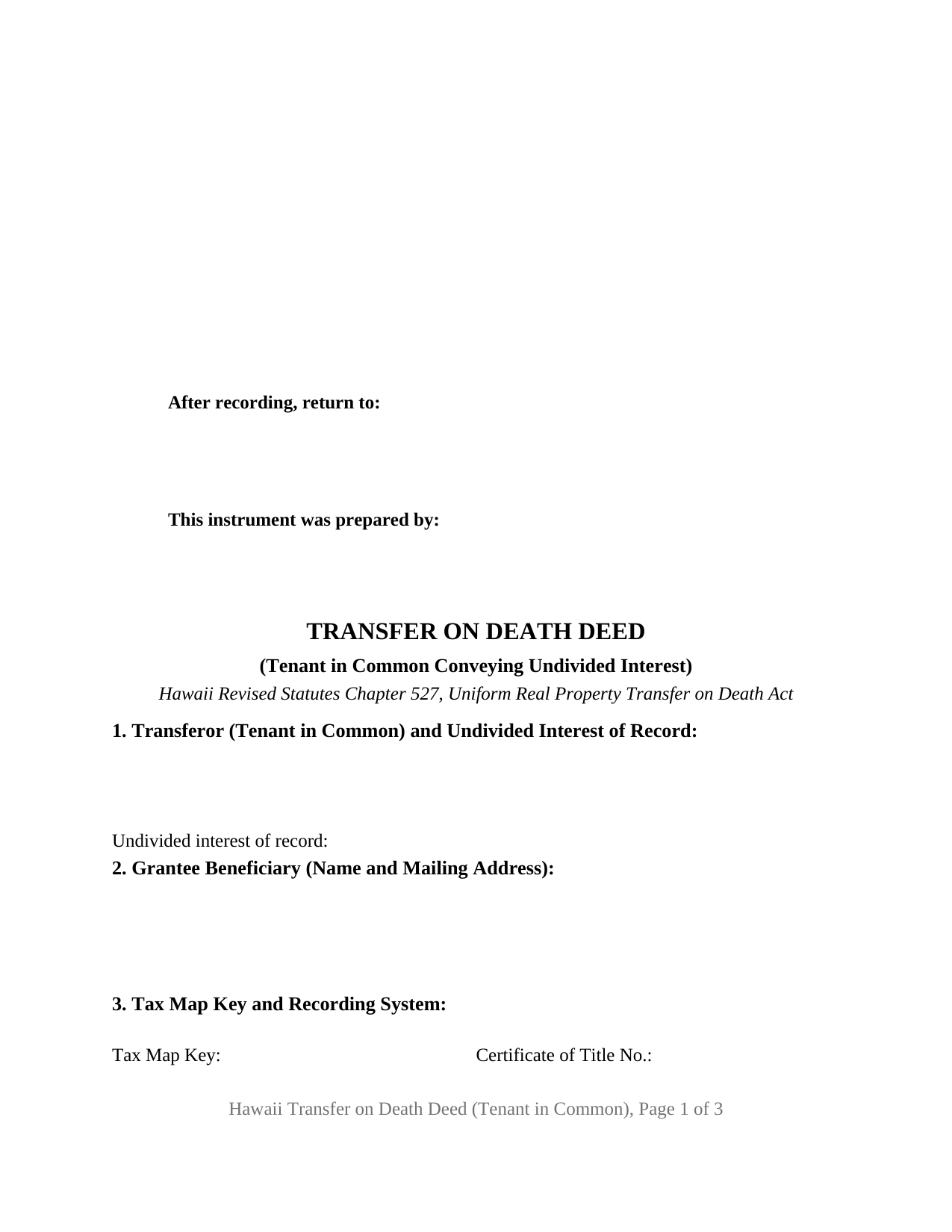
Section 1 takes the transferor's name and address together with the undivided interest of record, such as an undivided one-half interest, as the vesting deed states it. The operative section provides that this entry identifies the interest at the date of the deed and does not limit the transfer, because the chapter moves whatever the transferor owns at death. The tax map key sits on the first page, where Hawaii Administrative Rules Section 13-16-4 places it, beside the Land Court certificate number, and the deed carries the sentence Section 527-9 requires, that the transfer to the beneficiary is to occur at the transferor's death, beside a notice that it is effective only if recorded or filed while the transferor lives.
One transferor, one certificate, one undivided interest
The configuration is fixed in the deed text: one individual who holds an undivided interest as a tenant in common with one or more other owners and signs in the transferor's own right, with no other owner as a transferor. Marital status is not preprinted; a married transferor who holds the fraction alone signs alone. The beneficiary blank takes one or more people, a trust, or an entity, each with a mailing address, and the acknowledgment certificate follows the Hawaii statutory form for a person acting in the person's own right. Co-heirs each designating their own children for their own inherited shares, and a co-investor directing a one-third interest to a spouse who is not on the title, present the pattern this deed recites. Two transferors on one deed, a joint tenant, a tenant by the entirety, a trustee, an entity owner, and an attorney-in-fact are configurations this form is not set up as. A beneficiary deed or TOD deed, as it is also called, is the same device under the Hawaii chapter.
The package contains the fillable Hawaii transfer on death deed for a tenant in common, a completed example drawn on a City and County of Honolulu fact pattern, and a guide to every section, notarization, and recording in both Hawaii systems. This description and the guide explain the form and the statutes in general terms and are not legal advice.
Important: County-Specific Forms
Our transfer on death deed (tenant in common conveying undivided interest) forms are specifically formatted for each of the 4 counties in Hawaii.
After selecting your county, you'll receive forms that meet all local recording requirements, ensuring your documents will be accepted without delays or rejection fees.