Hawaii Transfer on Death Deed (Two Joint Tenants with Right of Survivorship)
County Specific Legal Forms Validated as recently as October 22, 2026 by our Forms Development Team
About the Hawaii Transfer on Death Deed (Two Joint Tenants with Right of Survivorship)
How to Use This Form
- Select your county from the list
- Download the county-specific form
- Fill in the required information
- Have the document notarized if required
- Record with your county recorder's office
What Others Like You Are Saying
"Excellent product! Easy to fill out, complete directions. I highly recommend."
"You made it easy to attain the documents I needed. The cost was very reasonable...thanks"
"This process could not have been made any easier!! Very easy instructions to follow and the response…"
"Deeds.com worked very well for me. Very Simple packet. And my County uses the same website"
"Good organization and guidance."
4.8/5 from 4,829 reviews. Read all
Two Hawaii co-owners who hold title as joint tenants with right of survivorship can name, in one recorded deed, who receives the property after the second of them dies. This transfer on death deed is built for exactly that pair: both joint tenants sign as transferors, the deed recites the joint tenancy, and the transfer is fixed to the death of the surviving transferor under Chapter 527 of the Hawaii Revised Statutes.
Survivorship first, then the beneficiary
A Hawaii joint tenancy carries the right of survivorship: when one joint tenant dies, the whole property belongs to the other. Section 527-2 counts a joint tenant as a joint owner, and Section 527-13(c) gives a deed made by a joint owner no effect at a death the other joint owner survives, while making it effective when the transferor is the last surviving joint owner. The operative section states that sequence beside the one sentence Section 527-9(2) requires of every Hawaii TOD deed.
Joint tenants are not always spouses
Hawaii keeps the joint tenancy and the tenancy by the entirety as separate estates under Section 509-2, and only the joint tenancy is open to any two individuals. Siblings who inherited a house as joint tenants, unmarried partners who bought a condominium as joint tenants, and a parent who added an adult child to title as a joint tenant present the pattern this deed recites, as do spouses whose vesting deed names them as joint tenants rather than as tenants by the entirety. The deed preprints nothing about marital status; both names go into one blank, and a source-of-title blank identifies the recorded deed that created the joint tenancy.
Two signatures to make it, two to unmake it
Both joint tenants sign; the deed carries a signature block and an acknowledgment certificate for each, so they can acknowledge on different days or before different notaries. Section 527-11(b) fixes the revocation rule: a deed made by joint owners is revoked only by all living joint owners, so neither joint tenant alone can undo the designation while both live, and the survivor, as the last living joint owner, revokes or replaces it by a later acknowledged and recorded instrument. During both lives, Section 527-12 leaves every right of both owners untouched: the deed does not sever the joint tenancy, does not limit a sale or mortgage, and gives the beneficiary no present interest.
What the beneficiaries take at the survivor's death
The beneficiary blank takes one or more individuals, a trust, or an entity, each with a mailing address, and Section 527-13(a) supplies the shares: equal undivided interests with no survivorship among concurrent beneficiaries, a lapse for one who does not survive, and the lapsed share passing to the others in proportion. Survival is measured against the surviving transferor's death by the one hundred twenty hour rule of Section 560:2-702, which the form does not vary. The property passes subject to every mortgage, lien, and other interest then affecting it, without covenant or warranty of title.
Recorded in Honolulu, in either system
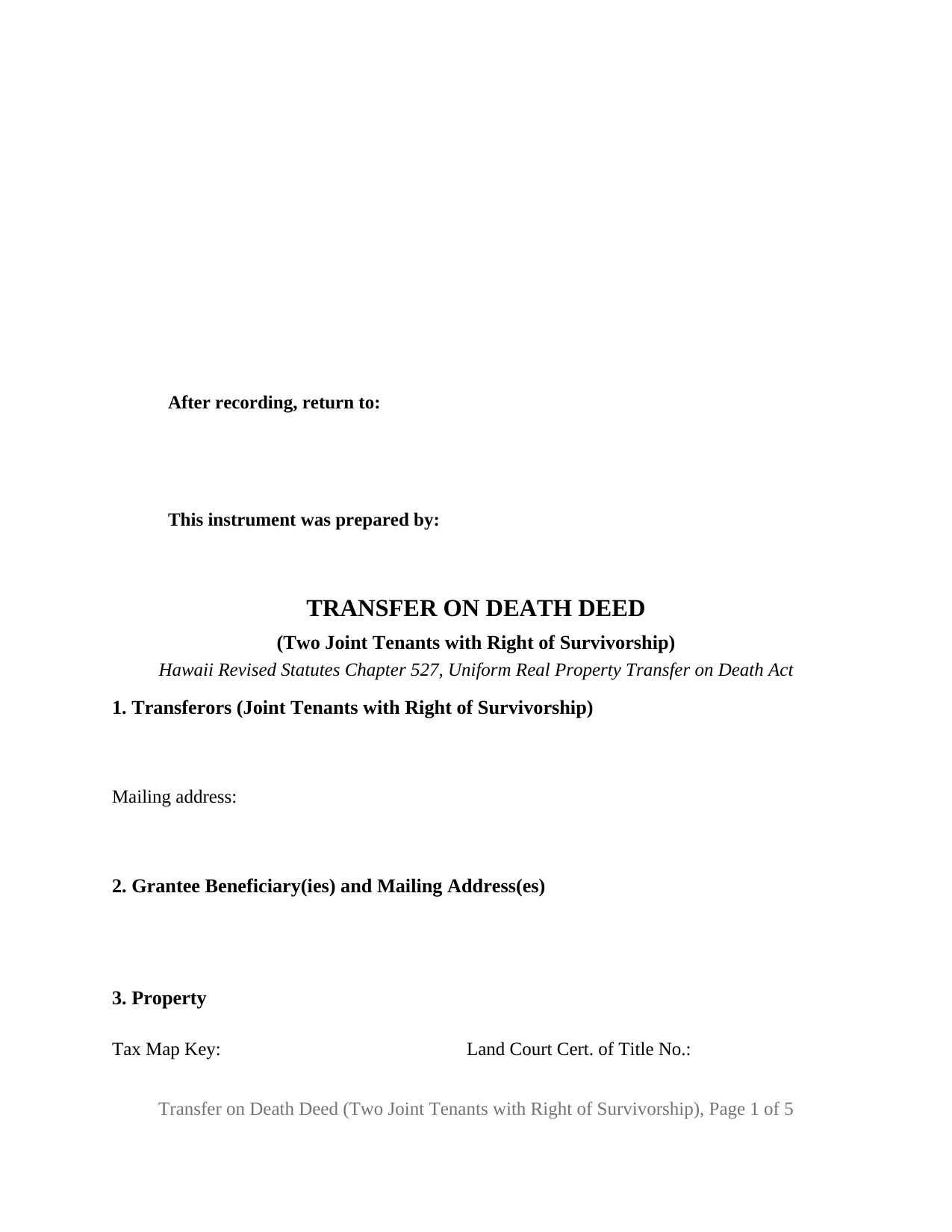
A Hawaii TOD deed takes effect only if it reaches the record, at the Bureau of Conveyances or in the office of the Assistant Registrar of the Land Court, before the transferor dies. The first page carries the registrars' band, the return address, the transferors' names, the beneficiaries with their addresses, the title, and the tax map key, with a Land Court certificate of title blank that reads None for Regular System property. Each certificate reserves an area for the notary seal, and Section 247-3 exempts a conforming Chapter 527 deed from the conveyance tax.
Exactly two joint tenants, both signing
The configuration is fixed in the deed text: two natural-person transferors holding as joint tenants with right of survivorship, the surviving-transferor trigger, two signature blocks, and two certificates. A sole owner, two owners holding as tenants in common, spouses holding as tenants by the entirety, three or more joint tenants, a trustee, an entity, and an attorney-in-fact are configurations this form is not set up as. A beneficiary deed, as some states call it, is the same instrument under the Hawaii chapter.
The package contains the fillable Hawaii transfer on death deed for two joint tenants with right of survivorship, a completed example on a Kauai County fact pattern, and a guide to each section, the notary certificates, and recording in both systems. This description and the guide treat the form and the statutes in general terms and are not legal advice.
Important: County-Specific Forms
Our transfer on death deed (two joint tenants with right of survivorship) forms are specifically formatted for each of the 4 counties in Hawaii.
After selecting your county, you'll receive forms that meet all local recording requirements, ensuring your documents will be accepted without delays or rejection fees.