Iowa Quitclaim Deed
County Specific Legal Forms Validated as recently as October 9, 2026 by our Forms Development Team
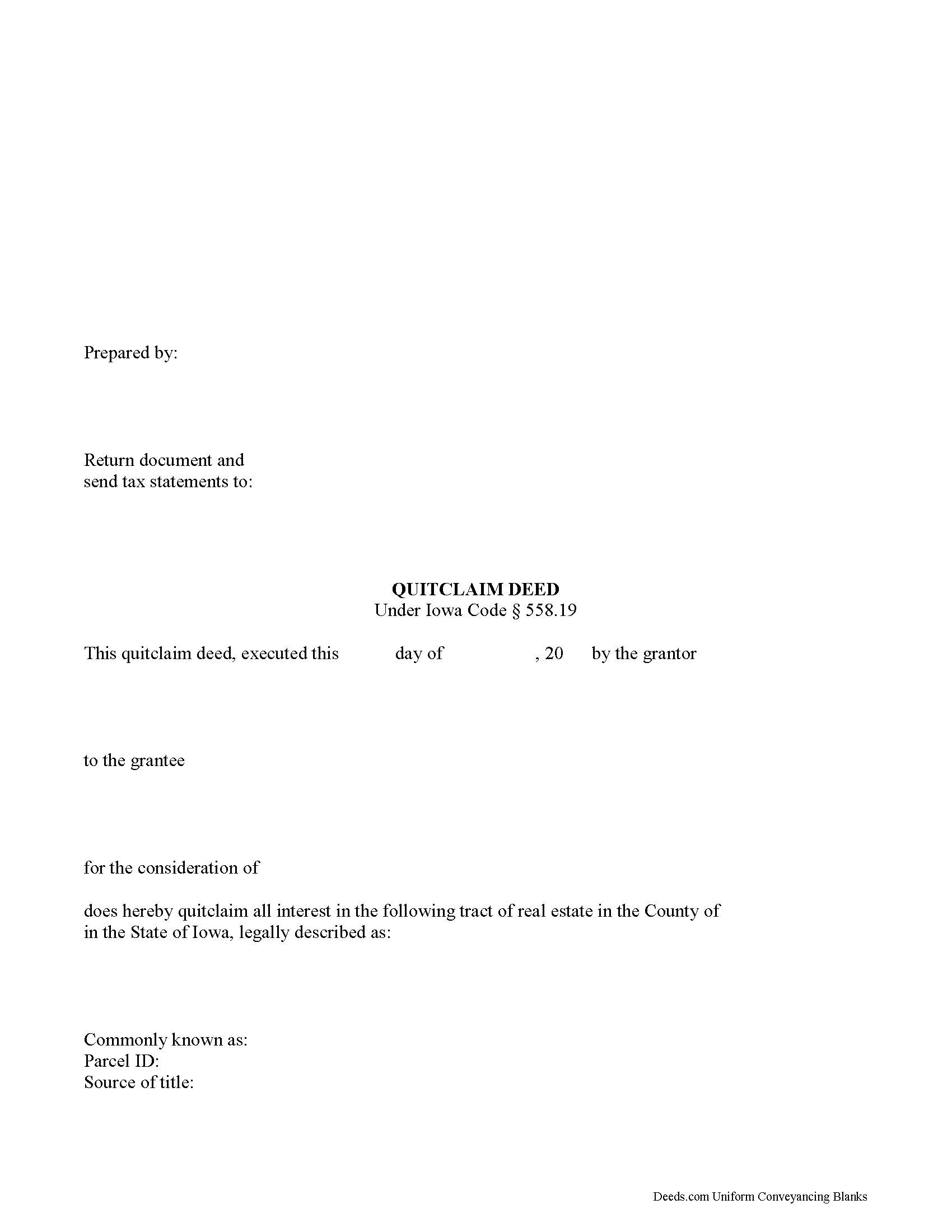
About the Iowa Quitclaim Deed
How to Use This Form
- Select your county from the list
- Download the county-specific form
- Fill in the required information
- Have the document notarized if required
- Record with your county recorder's office
What Others Like You Are Saying
"I had my doubts going in but was pleasantly surprised at the thoroughness of the documents and infor…"
"Very pleased. I spent a fair amount of time chasing a blank form only to be told it couldn't be give…"
"It was very easy to use the website. I wish there was an option to pay for multiple documents at onc…"
"Excellent response and all went well with downloading documents. Thank you for offering this importa…"
"I got a blank, a sample and detailed instructions, I'm happy. If the recorder's office had a form as…"
4.8/5 from 4,828 reviews. Read all
Iowa's conveyance chapter opens with an invitation rather than a command: Iowa Code section 558.19 prints four forms of conveyance and provides that these, or other equivalent forms varied to suit circumstances, are sufficient. This Iowa quitclaim deed is the first of the four, drawn so the circumstances go into the blanks: one or two individual grantors, one or two grantees, and the describing words supplied by the people who sign.
A release measured by what the grantor turns out to hold
The statutory sentence is short: for a recited consideration, the grantor quitclaims every interest the grantor has in a described tract. What passes is whatever that person owns, a whole fee, an undivided share, or nothing, and quality goes unaddressed. Iowa Code section 557.3 confirms that reach: a conveyance passes all the interest of the grantor unless a contrary intent appears in the terms used. Nothing here cleans the parcel: mortgages, judgments, easements, assessments, and unpaid taxes stay put. A quit claim deed releases a position rather than promising a title.
One or two names on either side
Nothing about status, capacity, or co-ownership is preprinted. The grantor entry is four open lines taking one name or two as the record describes them, with the mailing address beneath, and the grantee entry does the same, with room for the co-ownership words the grantees choose. Four count patterns live inside it: one grantor to one grantee, one to two, two to one, two to two. Two signature blocks follow, headed GRANTOR and SECOND GRANTOR, each with a printed name and date line and its own certificate in the individual capacity short form of Iowa Code section 9B.16, so signers may appear separately. Where one grantor conveys, the second block and its certificate stay blank. The form is not set up for an entity grantor, a signer acting under a power of attorney, a fiduciary signer, or a conveyance by or to three or more people.
The grantee words, and the presumption behind them
Iowa Code section 557.15 decides how co-grantees hold. Two or more people taking in their own right hold as tenants in common unless a contrary intent is expressed, and joint tenancy with right of survivorship is presumed where the deed calls the grantees joint tenants, refers to them or their survivor, or identifies two grantees as married to each other at execution. The example takes that third route.
Homestead, and the second signature
Iowa Code section 561.13 withholds validity from a married owner's homestead conveyance until the owner's spouse executes the same or a like instrument, a condition the Iowa Supreme Court enforced against both spouses in Martin v. Martin, 720 N.W.2d 732 (Iowa 2006). Two blocks answer it either way: two spouses on the record title each sign as grantors, and a sole owner's spouse signs the second block. The relinquishment of dower, homestead, and distributive share printed in the conveyance section is also the express written relinquishment of right that Iowa Code section 633.238(1)(a) measures an elective share against.
Tax, declaration of value, and the line under the title
Iowa computes its transfer tax under Iowa Code section 428A.1 in five hundred dollar increments, eighty cents apiece above the first five hundred, so the example's price of $185,000.00 carries $295.20. Where an exception in Iowa Code section 428A.2 applies, the tax section holds the ground claimed and the signatures sign the statement Iowa Code section 428A.4 takes in place of payment. Section 428A.1(2) submits a declaration of value with the conveyance, then excuses the instruments described in subsections 2 through 5, 7 through 13, and 16 through 21. A declaration brings the groundwater question with it, and the sentence beneath the title is the language section 558.69(8A) supplies where no listed condition exists.
Built to what the county recorder measures
Three inches at the head of page one belong to the recording stamp under Iowa Code section 331.606B, and the items that section places below them print there in labeled blocks: the preparer with a telephone number, the taxpayer name and complete mailing address, the return address, the title, the grantor and grantee entries, and a page reference to the legal description in Section 4. The guide covers the counter itself: the per page recording fee, the auditor's transfer fee, the rejection grounds, and submission through Iowa Land Records.
The download carries three files: the fillable Iowa quitclaim deed, a completed example worked as a Linn County transfer of a platted Cedar Rapids lot, and a plain language guide to the sections, signing, tax, and recording. The materials are informational and are not legal advice.
Important: County-Specific Forms
Our quitclaim deed forms are specifically formatted for each of the 99 counties in Iowa.
After selecting your county, you'll receive forms that meet all local recording requirements, ensuring your documents will be accepted without delays or rejection fees.