Kansas Warranty Deed
County Specific Legal Forms Validated as recently as September 22, 2026 by our Forms Development Team
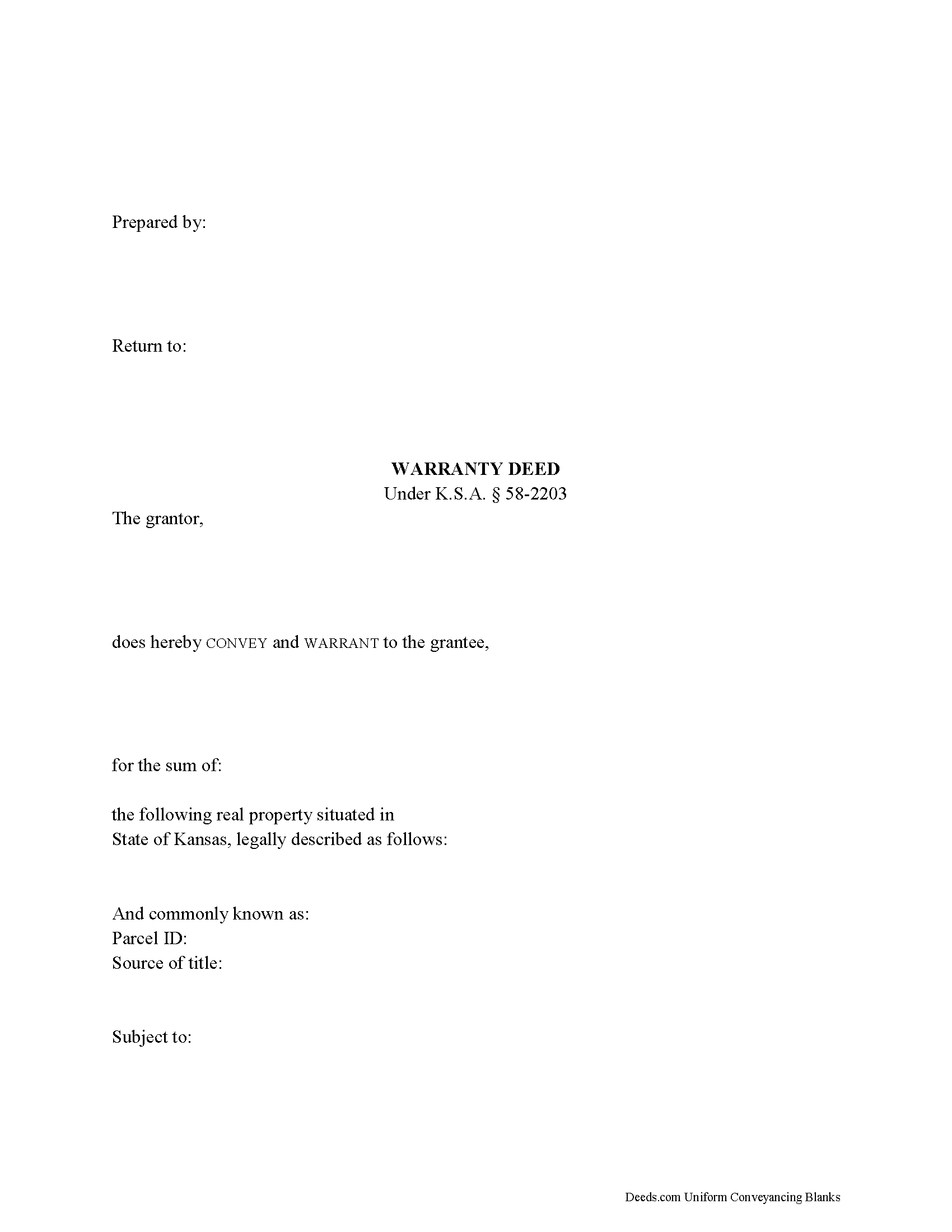
About the Kansas Warranty Deed
How to Use This Form
- Select your county from the list
- Download the county-specific form
- Fill in the required information
- Have the document notarized if required
- Record with your county recorder's office
What Others Like You Are Saying
"I am really impressed by this website. Not only is it affordable, but they give a detailed descripti…"
"No review provided."
"very easy to use !!!"
"Fantastic service. I purchased the form one day, had it filled out, notarized and e-filed the next d…"
"You were very helpful and patient with me in learning your portal. I now understand your process."
4.8/5 from 4,828 reviews. Read all
Kansas keeps its warranty deed short. The granting words that carry the covenants have been fixed by statute since 1887, so what changes from one Kansas deed to the next is the party record: how many owners sign, what each of them recites, and the words that settle how the new owners hold what they receive. This Kansas warranty deed is the base form for that variation. Its party blocks are free-form, and nothing about marital status, capacity, or co-ownership is printed on the page before the parties write it there.
Party blocks the parties fill themselves
The deed is arranged for natural persons signing in their own capacity, in any of four count patterns: one grantor to one grantee, one grantor to two grantees, two grantors to one grantee, and two grantors to two grantees. The grantor block holds one or two names with any status the parties state; the grantee block holds one or two names followed by the words that describe how they take title. Two signature blocks follow, headed GRANTOR and SECOND GRANTOR, each with a printed name line answering K.S.A. 28-115(c), and each with its own acknowledgment certificate; a conveyance by a single owner simply leaves the second block and the second certificate empty. A sole owner deeding to a couple, two co-owners conveying the whole parcel to one buyer, and two sellers conveying to two buyers all present count patterns this form recites. What it does not recite is a representative signer: an entity grantor acting through an officer or manager, a trustee or executor conveying under a trust instrument or a court order, and a signer acting under a power of attorney each need capacity recitals and a representative certificate that this deed does not preprint.
The blank that settles survivorship
K.S.A. 58-501 is what makes the grantee blank consequential. A grant to two or more people, a married couple included, creates a tenancy in common unless the language of the instrument makes clear that a joint tenancy was intended, and because Kansas abolished estates by the entirety in 1891, marriage by itself adds no survivorship at all. The Kansas cases police that margin closely: bare survivor wording failed in Swingle, while the fuller designation used in Spresser v. Langmade was held sufficient even though later language in the deed pointed elsewhere. Where the statute reads silence as a tenancy in common, the words typed after the grantee names are the entire survivorship decision, and the guide walks through every form Kansas recognizes.
How far the warranty reaches
A general warranty deed is the strongest of the Kansas deed forms because its covenants are not limited to the grantor's own years of ownership. K.S.A. 58-2203 attaches seisin, the right to convey, quiet possession, freedom from encumbrances, and the promise to warrant and defend against all lawful claims, and those promises answer for defects that entered the chain long before the grantor took title. Kansas publishes no separate statutory form for a limited or special warranty, so narrowing that reach takes express restraining words inside the instrument. The exceptions section is where recorded easements, restrictive covenants, mineral reservations, and current taxes are carved out, so the encumbrance covenant reads as the parties mean it to read.
From the notarial officer to the courthouse
Kansas asks for no subscribing witnesses; under K.S.A. 58-2205 an executed, acknowledged, and recorded deed passes title without any other act or ceremony, and the certificates on this form follow the short form adopted by K.A.R. 7-43-17. A Kansas deed does not reach the counter alone, either. A completed sales validation questionnaire travels with it under K.S.A. 79-1437c, while a transfer inside one of the K.S.A. 79-1437e exemptions states its exemption number on the face of the deed, and the form carries that blank. The grantee name and mailing address for tax statements answer K.S.A. 58-2221, the statutory fee under K.S.A. 28-115 runs twenty-one dollars for a first page and seventeen for each page after it, and Kansas charges no transfer tax at all. The first page reserves three full inches for the recording stamp, matching the deepest reserve any large Kansas county publishes.
The package delivers the fillable Kansas warranty deed, a completed example filled to capacity with two grantors and two grantees on a Johnson County sale, and a plain language guide covering each entry, the signing formalities, and county recording practice. These materials describe Kansas law in general terms and are informational; they are not legal advice.
Important: County-Specific Forms
Our warranty deed forms are specifically formatted for each of the 105 counties in Kansas.
After selecting your county, you'll receive forms that meet all local recording requirements, ensuring your documents will be accepted without delays or rejection fees.