Louisiana Warranty Deed
Parish Specific Legal Forms Validated as recently as September 28, 2026 by our Forms Development Team
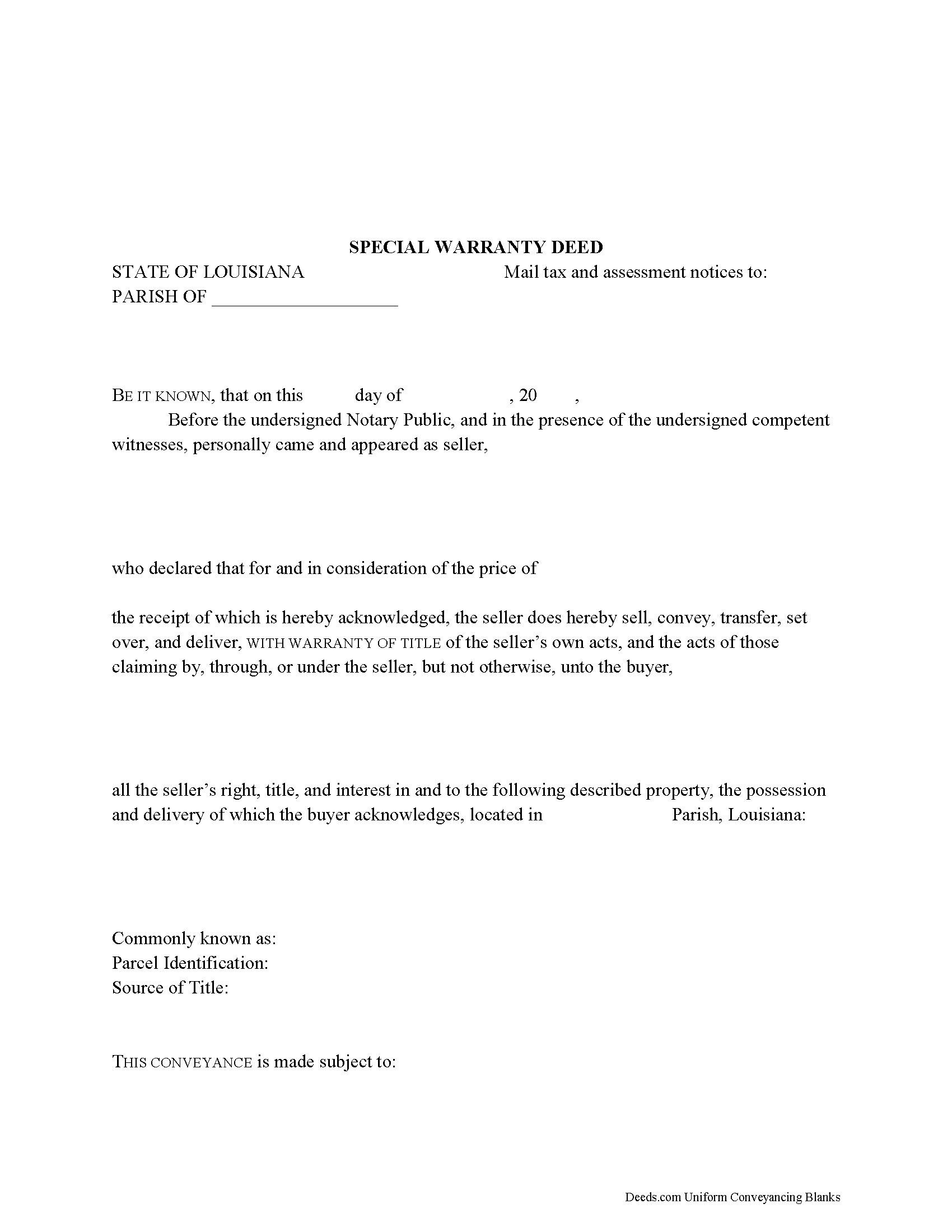
About the Louisiana Warranty Deed
How to Use This Form
- Select your parish from the list
- Download the parish-specific form
- Fill in the required information
- Have the document notarized if required
- Record with your parish recorder's office
What Others Like You Are Saying
"Ordered a 'Gift Deed' form The 'Example' form was most helpful. The actual form was very detailed, a…"
"I was excited because I really wanted to see and get a copy of the Deed to my property. The personal…"
"Oh my that was so easy. I love it. Awesome. If someone needs help use the deeds.com"
"great"
"Good system fairly easy to use"
4.8/5 from 4,828 reviews. Read all
A Louisiana deed is signed in a ceremony rather than with a signature alone: an act of sale passes before a notary public and two competent witnesses, and the Civil Code lets the people who sign do so at different times, in different parishes, and before different notaries. This Louisiana warranty deed is drawn for that flexibility. One or two individual grantors convey to one or two grantees, each grantor signature carries its own witness lines and its own notarial certificate, and the party blanks stay open so the words describing each person and each acquired interest stay the parties' own.
A signing that does not have to happen all at once
Civil Code article 1833 defines the authentic act: a writing executed before a notary and two witnesses, signed by each party, each witness, and each notary, with the typed or hand printed name beneath every signature. Paragraph B adds that the writing need not be executed at one time or place, or before the same notary or the same witnesses, provided each party executes in that form. The deed follows that rule instead of working around it. A GRANTOR block and a SECOND GRANTOR block each carry two witness lines and a separate certificate headed NOTARIAL ATTESTATION that names the grantor it covers, dates the passage of the act, and carries the notary identification or attorney bar roll number that R.S. 35:12 makes recording data on a notarized instrument. Grantors appearing together before one notary use a single pair of witness lines and leave the second pair blank; grantors signing in different parishes each complete a full set. The signing happens face to face, since R.S. 35:623 keeps authentic acts outside remote online notarization.
Party blanks the form leaves open
No recorded page of this form preprints a marital status, an ownership form, or a capacity. The grantor blank takes one or two names with the status and domicile language Louisiana appearance clauses state, and the grantee blank takes one or two names followed by whatever designation the parties choose. The categories here are not the common law tenancies: two grantees who name none take in indivision in shares presumed equal under article 797, and a sale of a community immovable is a two grantor act because article 2347 calls for the concurrence of both spouses. The form recites natural persons signing in their own right; a corporation or limited liability company acting through an officer, a trustee, a mandatary under a power of attorney, and three or more owners on one side follow signature architecture this document does not draw.
What the Code puts behind the word warranty
Louisiana keeps the warranty in the Code rather than in the caption. Article 2439 makes the thing, the price in money, and consent the elements of a sale, and article 2456 transfers ownership between the parties as soon as they agree on the thing and the price. Article 2475 binds the seller to warrant ownership and peaceful possession, and article 2503 makes the warranty against eviction part of every sale unless the parties change it. The deed states that warranty at full strength, gives the matters declared under article 2500 their own numbered section, and adds the customary subrogation clause so the buyer also holds warranty claims running back to earlier owners and vendors.
Filing in the parish where the land lies
The signed act goes to the clerk of court of the parish where the immovable is located. Under articles 3338 and 3347 it has no effect as to third persons until it is filed, and its effect dates from filing, so recording is part of the closing rather than a later errand. R.S. 13:844 prices recording as a flat charge by page count, one hundred dollars for an act of one to five pages before parish add on fees, and sets the format the form follows: a first page caption, a two inch top margin there, and type above the eight point floor. Louisiana imposes no statewide transfer or documentary stamp tax on a deed, while New Orleans collects its own documentary transaction tax at recording.
The purchase delivers the fillable warranty deed, a completed example running a two grantor St. Tammany Parish sale through every blank and both certificates, and a plain language guide covering each numbered section, the authentic act signing, the ways grantees may hold title, and parish recording practice. The materials describe Louisiana law in general terms and are not legal advice.
Important: Parish-Specific Forms
Our warranty deed forms are specifically formatted for each of the 64 parishes in Louisiana.
After selecting your parish, you'll receive forms that meet all local recording requirements, ensuring your documents will be accepted without delays or rejection fees.