Montgomery County Transfer on Death Deed (Trust Beneficiary) Form
Last validated November 5, 2026 by our Forms Development TeamFormatted for recording in Montgomery County, for property anywhere in the county or independent city: rural and unincorporated areas as well as Ashton, Barnesville, Beallsville, Bethesda, Boyds, Brinklow, Brookeville, Burtonsville and 22 more.
- 3 documents included
- Immediate PDF download
- Formatting guarantee
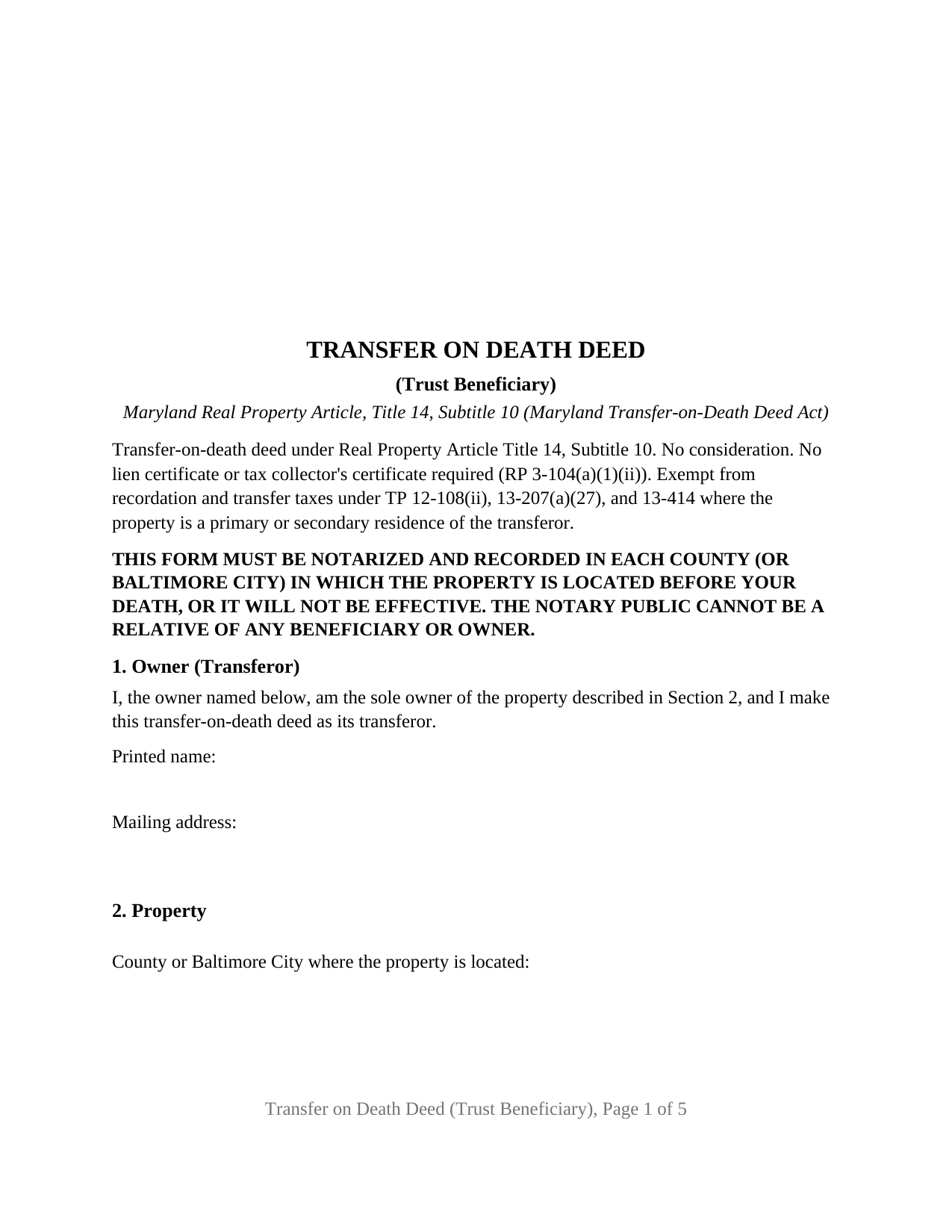
Montgomery County Transfer on Death Deed (Trust Beneficiary) Form
Fill in the blank Transfer on Death Deed (Trust Beneficiary) form formatted to comply with all Maryland recording and content requirements.
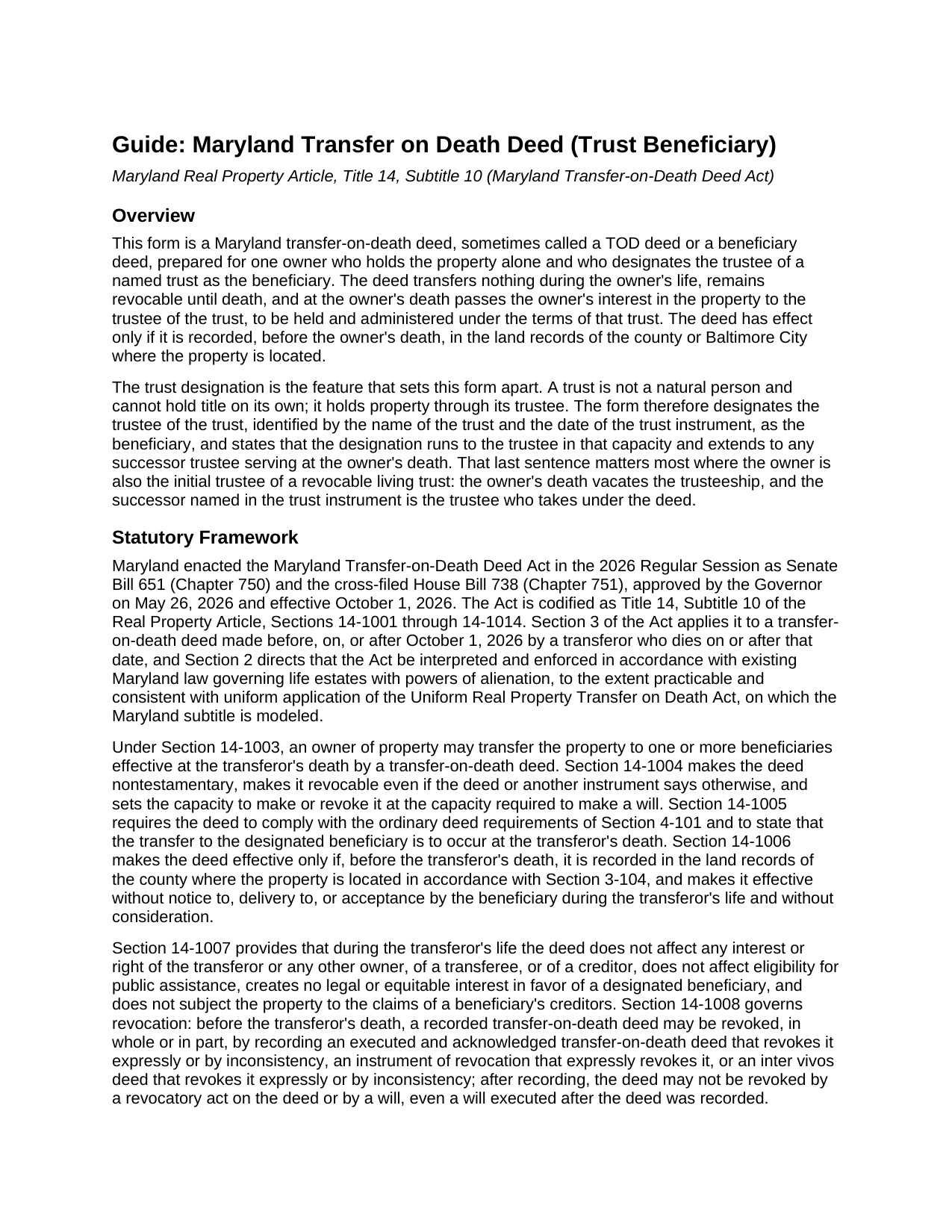
Montgomery County Transfer on Death Deed (Trust Beneficiary) Guide
Line by line guide explaining every blank on the Transfer on Death Deed (Trust Beneficiary) form.
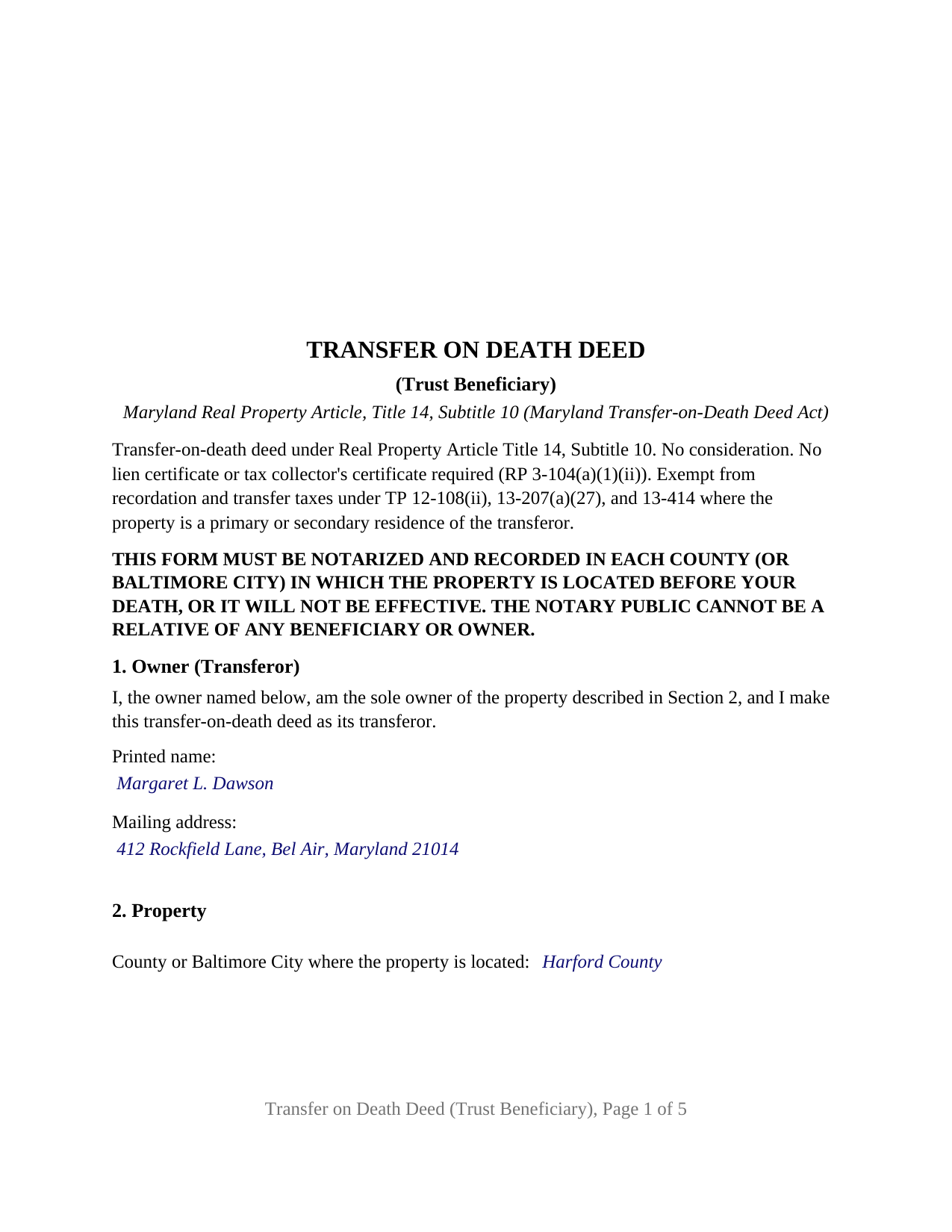
Montgomery County Completed Example of the Transfer on Death Deed (Trust Beneficiary) Document
Example of a properly completed Maryland Transfer on Death Deed (Trust Beneficiary) document for reference.
All 3 documents above included • One-time purchase • No recurring fees
Immediate Download • Secure Checkout
Additional Maryland and Montgomery County documents included at no extra charge:
Where to Record Your Documents
Montgomery County Circuit Court - Land Records
Rockville, Maryland 20850
Hours: 8:30 to 4:30 M-F / Recording until 4:00 pm
Phone: (240) 777-9470
Recording Tips for Montgomery County:
- Bring your driver's license or state-issued photo ID
- Ensure all signatures are in blue or black ink
- Double-check legal descriptions match your existing deed
- Verify all names are spelled correctly before recording
- White-out or correction fluid may cause rejection
Cities and Jurisdictions in Montgomery County
Properties in any of these areas use Montgomery County forms:
- Ashton
- Barnesville
- Beallsville
- Bethesda
- Boyds
- Brinklow
- Brookeville
- Burtonsville
- Cabin John
- Chevy Chase
- Clarksburg
- Damascus
- Derwood
- Dickerson
- Gaithersburg
- Garrett Park
- Germantown
- Glen Echo
- Kensington
- Montgomery Village
- Olney
- Poolesville
- Potomac
- Rockville
- Sandy Spring
- Silver Spring
- Spencerville
- Suburb Maryland Fac
- Takoma Park
- Washington Grove
Hours, fees, requirements, and more for Montgomery County
How do I get my forms?
Forms are available for immediate download after payment. The Montgomery County forms will be in your account ready to download to your computer. An account is created for you during checkout if you don't have one. Forms are NOT emailed.
Are these forms guaranteed to be recordable in Montgomery County?
Yes. Our form blanks are guaranteed to meet or exceed the applicable formatting requirements used for recording in Montgomery County, including margin requirements, font requirements, and other layout standards. This guarantee applies to formatting, not to the legal sufficiency of information entered by the user or the suitability of a form for a particular transaction.
Can I reuse these forms?
Yes. You can reuse the forms for your personal use. For example, if you have multiple properties in Montgomery County you only need to order once.
What do I need to use these forms?
The forms are PDFs that you fill out on your computer. The free Adobe Acrobat Reader is recommended, and most PDF apps also work. You do NOT enter your property information online - you download the blank forms and complete them privately on your own computer.
Are there any recurring fees?
No. This is a one-time purchase. Nothing to cancel, no memberships, no recurring fees.
How much does it cost to record in Montgomery County?
Recording fees in Montgomery County vary. Contact the recorder's office at (240) 777-9470 for current fees.
Questions answered? Let's get started!
A trust cannot take title to Maryland real estate in its own name; it holds property through whoever serves as its trustee. A transfer-on-death deed that names a trust therefore answers a question an ordinary beneficiary deed never faces: which trustee takes when the owner who signed the deed was also the trust's first trustee. This Maryland transfer on death deed is built around that answer under Real Property Article, Title 14, Subtitle 10: one owner holding the property alone designates the trustee of a named trust as the beneficiary at the owner's death.
A designation that follows the office of trustee
The Act defines a designated beneficiary as a person, a term Section 1-101 of the Real Property Article defines to include a trustee. The deed designates the trustee in that capacity, and its fixed text extends the designation to any successor trustee serving at the owner's death. Under Estates and Trusts Section 14.5-704, a trusteeship becomes vacant when the trustee dies, and a vacancy to be filled passes first to the person the trust instrument names as successor trustee. An owner who serves as initial trustee of a revocable living trust can record this deed naming that trust; at death the successor trustee takes, and the property passes under the trust's own terms rather than through probate.
During life, and at death
Under Section 14-1007 nothing passes while the owner is living: the recorded deed leaves the owner free to sell, mortgage, or lease the property and creates no interest in favor of the trustee. The owner keeps the full right to revoke, and a lifetime deed to anyone, including the trustee, revokes it by inconsistency under Section 14-1008. At death the trustee takes the owner's interest subject to every mortgage and lien then on the property, without covenant or warranty of title, and subject to the limits Section 14-1009 lists, the surviving spouse's elective share among them.
One owner, one trust, one certificate
The form recites exactly one record owner, the sole owner of the property, signing in that person's own capacity, with one signature block beside the statutory form's (SEAL) notation and one acknowledgment certificate in the State Government Section 18-216 short form. Maryland has no community property regime and abolished dower and curtesy, so a spouse who is not on the title has no signature line. The trustee does not sign, and the trust instrument is not recorded. The form is not set up as a deed by two or more owners, as a deed by a fractional co-owner, as a deed signed by a trustee, an entity, a personal representative, or an attorney-in-fact, or as a designation to an individual or an entity in its own name. A widowed owner who holds the home alone and has moved the estate plan into a trust, and an owner whose trust holds property for a child with a disability under an independent trustee, present the pattern this deed recites.
Recording a trust designation in Maryland
The deed is effective only if it is recorded, before the owner's death, in the land records of the county or Baltimore City where the property lies, and it travels with a Land Instrument Intake Sheet, since Section 3-104(g)(6)(ii) lets the clerk refuse a transfer-on-death deed that arrives without one. It carries the certification of preparation Section 3-104(f) requires, as a choice between the attorney and party certifications. The Act's exemption from recordation and transfer taxes for a deed of the owner's primary or secondary residence is keyed to the owner's residence, not to the beneficiary, so a trust designation of the home qualifies on the same terms; recording fees still apply.
Two elements no statute names also ride the deed, because the form Maryland Volunteer Lawyers Service publishes carries them and Maryland clerks compare a transfer on death deed against it: a tax-status line under the title and a signed Certification of Occupancy Status, where the owner marks whether the property is a principal residence, a secondary residence, or neither. The county finance office and the clerk read the marked box to apply the residence-based exemption, and in many counties the finance office sees the deed before the clerk does.
The package includes the fillable transfer on death deed as a PDF, a completed example for a Harford County owner naming her revocable living trust and an alternate, and a plain-language guide covering each section, the trust entries, signing, and recording. The materials are informational and are not legal advice.
Important: Your property must be located in Montgomery County to use these forms. Documents should be recorded at the county or independent city recording office listed above.
This Transfer on Death Deed (Trust Beneficiary) meets all recording requirements specific to Montgomery County.
Our Promise
The documents you receive here are guaranteed to meet or exceed the applicable Montgomery County recording format requirements. If there is a rejection caused by our formatting, we will correct the issue or refund your payment. This guarantee applies to document formatting only and does not extend to information entered by the user, the selection of the form, or the legal effect of the completed document.
Save Time and Money
Get your Montgomery County Transfer on Death Deed (Trust Beneficiary) form done right the first time with Deeds.com Uniform Conveyancing Blanks. At Deeds.com, we understand that your time and money are valuable resources, and we don't want you to face a penalty fee or rejection imposed by a county recorder for submitting nonstandard documents. We constantly review and update our forms to meet rapidly changing state and county recording requirements for roughly 3,500 counties and local jurisdictions.
4.8 out of 5 - ( 4,857 Reviews )
Dorien C. 5 out of 5 stars
Easy to use, thank you.
Thank you!
Doris M G. 5 out of 5 stars
Excellent. Everything has gone well and the deed guide has helped so much. Thank you.
Thank you for your feedback. We really appreciate it. Have a great day!
Tawnya B. 5 out of 5 stars
The document I needed and easy instructions!
Thank you!
Joyce S. 5 out of 5 stars
Download very easy. Forms are just what I need. Thanks
Thank you for your feedback. We really appreciate it. Have a great day!
Ron D. 3 out of 5 stars
The State form I chose was valid and accurate. However, I found the ability to enter information was inadequate and difficult. Converted the form to a Word document and was then able to enter the information I needed to.
Your feedback is valuable to us and helps us improve. Thank you for sharing your thoughts!
Donald H. 5 out of 5 stars
EXCELLENT,,super good. Quick & easy
Thank you!
Carlos T. 5 out of 5 stars
Site was easy to use and forms were exactly what I needed. Will use this in the future for other needed forms. A+
We appreciate your business and value your feedback. Thank you. Have a wonderful day!
Angel C. 5 out of 5 stars
Solid forms hitting all the marks (statutory requirements) Fairly simple to accomplish what I was looking to do with minimal research. Would certainly use again when needed.
Thank you!
Duane R. 5 out of 5 stars
Your site was very easy to use and provided all the information needed.
Thank you for your feedback. We really appreciate it. Have a great day!
Chad R. 5 out of 5 stars
a refreshing web based legal form site Thanks I will recommend to friend
Thank you!
Lisa W. 5 out of 5 stars
Great E-Service Provider!
Thank you!
Kimberly S. 4 out of 5 stars
I wasted a lot of my time because I didn't do any research to know what I needed. Nobody fault but mine.
Thank you!
Teri A S. 5 out of 5 stars
Received the quit claim form as ordered. Seemed clear and concise, easy to follow instructions and the completed example was helpful.
Thank you Teri, have a great day!
Cynthia S. 5 out of 5 stars
The staff was wonderful we needed an additional state form for Wisconsin for the transfer. They went Above And Beyond assisting it was they were just amazing. They are truly an asset and I am very grateful.
Great to hear — thank you for taking the time to write a review.
Evone A. 5 out of 5 stars
So thankful that I could just find the form and complete the estate I am working on for my parents. The forms and instructions were very helpful.
We truly value your business and appreciate your review.