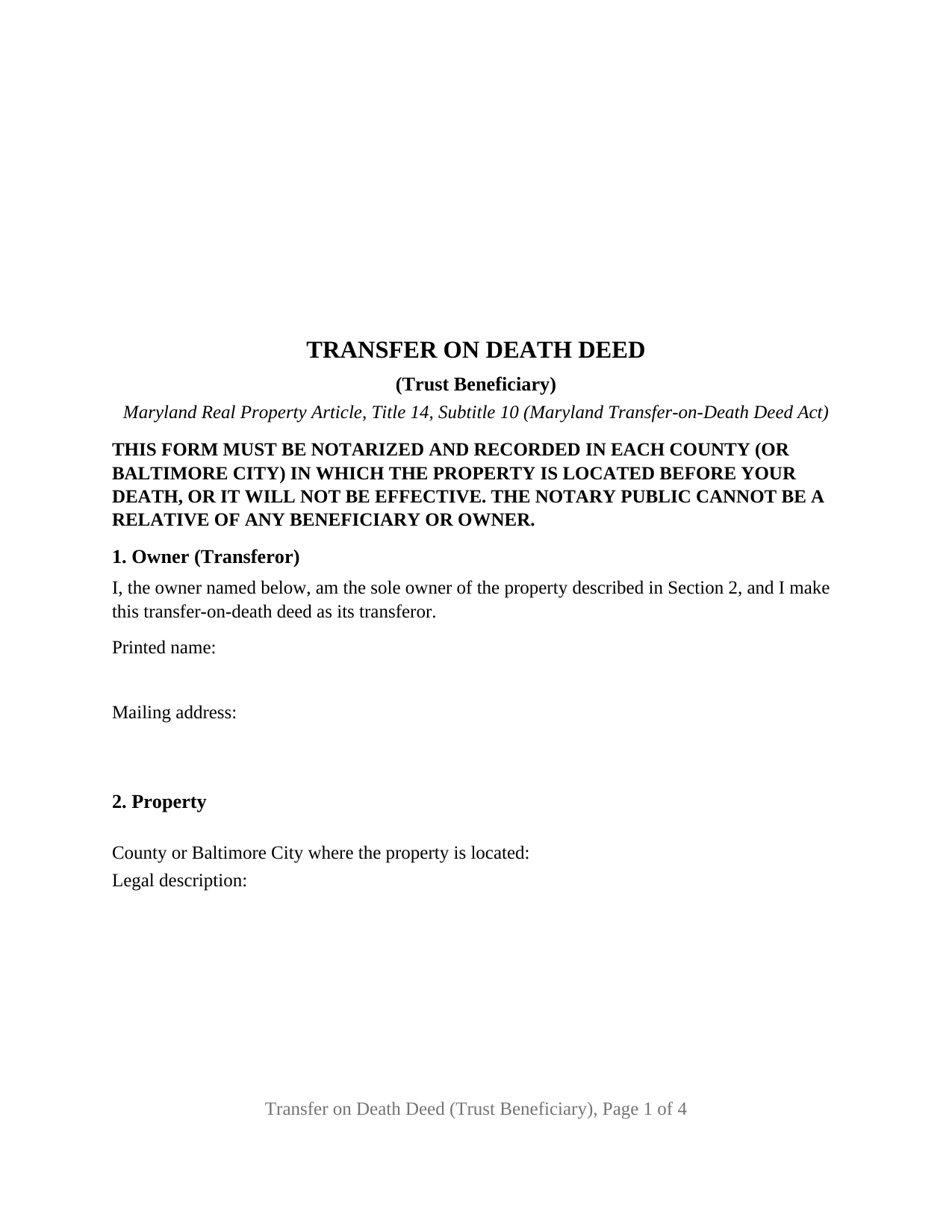
Maryland Transfer on Death Deed (Trust Beneficiary)
County or Independent City Specific Legal Forms Validated as recently as November 5, 2026 by our Forms Development Team
About the Maryland Transfer on Death Deed (Trust Beneficiary)
How to Use This Form
- Select your county or independent city from the list
- Download the county or independent city-specific form
- Fill in the required information
- Have the document notarized if required
- Record with your county or independent city recorder's office
What Others Like You Are Saying
"It would be helpful to have a joint tenant example."
"I got the right form but I waited too long to use it and Oregon changed the formatting. I should hav…"
"Everything great thank you"
"Great service especially living out of state for the documents in the state I required. Easy to use,…"
"This is an extremely helpful and very fast way to file with property recorders. It saved me time awa…"
4.8/5 from 4,857 reviews. Read all
A trust cannot take title to Maryland real estate in its own name; it holds property through whoever serves as its trustee. A transfer-on-death deed that names a trust therefore answers a question an ordinary beneficiary deed never faces: which trustee takes when the owner who signed the deed was also the trust's first trustee. This Maryland transfer on death deed is built around that answer under Real Property Article, Title 14, Subtitle 10: one owner holding the property alone designates the trustee of a named trust as the beneficiary at the owner's death.
A designation that follows the office of trustee
The Act defines a designated beneficiary as a person, a term Section 1-101 of the Real Property Article defines to include a trustee. The deed designates the trustee in that capacity, and its fixed text extends the designation to any successor trustee serving at the owner's death. Under Estates and Trusts Section 14.5-704, a trusteeship becomes vacant when the trustee dies, and a vacancy to be filled passes first to the person the trust instrument names as successor trustee. An owner who serves as initial trustee of a revocable living trust can record this deed naming that trust; at death the successor trustee takes, and the property passes under the trust's own terms rather than through probate.
During life, and at death
Under Section 14-1007 nothing passes while the owner is living: the recorded deed leaves the owner free to sell, mortgage, or lease the property and creates no interest in favor of the trustee. The owner keeps the full right to revoke, and a lifetime deed to anyone, including the trustee, revokes it by inconsistency under Section 14-1008. At death the trustee takes the owner's interest subject to every mortgage and lien then on the property, without covenant or warranty of title, and subject to the limits Section 14-1009 lists, the surviving spouse's elective share among them.
One owner, one trust, one certificate
The form recites exactly one record owner, the sole owner of the property, signing in that person's own capacity, with one signature block beside the statutory form's (SEAL) notation and one acknowledgment certificate in the State Government Section 18-216 short form. Maryland has no community property regime and abolished dower and curtesy, so a spouse who is not on the title has no signature line. The trustee does not sign, and the trust instrument is not recorded. The form is not set up as a deed by two or more owners, as a deed by a fractional co-owner, as a deed signed by a trustee, an entity, a personal representative, or an attorney-in-fact, or as a designation to an individual or an entity in its own name. A widowed owner who holds the home alone and has moved the estate plan into a trust, and an owner whose trust holds property for a child with a disability under an independent trustee, present the pattern this deed recites.
Recording a trust designation in Maryland
The deed is effective only if it is recorded, before the owner's death, in the land records of the county or Baltimore City where the property lies, and it travels with a Land Instrument Intake Sheet, since Section 3-104(g)(6)(ii) lets the clerk refuse a transfer-on-death deed that arrives without one. It carries the certification of preparation Section 3-104(f) requires, as a choice between the attorney and party certifications. The Act's exemption from recordation and transfer taxes for a deed of the owner's primary or secondary residence is keyed to the owner's residence, not to the beneficiary, so a trust designation of the home qualifies on the same terms; recording fees still apply.
Two elements no statute names also ride the deed, because the form Maryland Volunteer Lawyers Service publishes carries them and Maryland clerks compare a transfer on death deed against it: a tax-status line under the title and a signed Certification of Occupancy Status, where the owner marks whether the property is a principal residence, a secondary residence, or neither. The county finance office and the clerk read the marked box to apply the residence-based exemption, and in many counties the finance office sees the deed before the clerk does.
The package includes the fillable transfer on death deed as a PDF, a completed example for a Harford County owner naming her revocable living trust and an alternate, and a plain-language guide covering each section, the trust entries, signing, and recording. The materials are informational and are not legal advice.
Important: County or Independent City-Specific Forms
Our transfer on death deed (trust beneficiary) forms are specifically formatted for each of the 24 county or independent cities in Maryland.
After selecting your county or independent city, you'll receive forms that meet all local recording requirements, ensuring your documents will be accepted without delays or rejection fees.