Minnesota Warranty Deed (Two Grantors)
County Specific Legal Forms Validated as recently as October 5, 2026 by our Forms Development Team
About the Minnesota Warranty Deed (Two Grantors)
How to Use This Form
- Select your county from the list
- Download the county-specific form
- Fill in the required information
- Have the document notarized if required
- Record with your county recorder's office
What Others Like You Are Saying
"Super easy and efficient. One time charge for the form with no commitment to a recurring charge for …"
"quick and easy, thankyou"
"Wow, this was a breeze!! Best experience and fast. Great way to record documents in a matter of minu…"
"Easy to navigate and very concise"
"Thank you! This is very helpful"
4.8/5 from 4,828 reviews. Read all
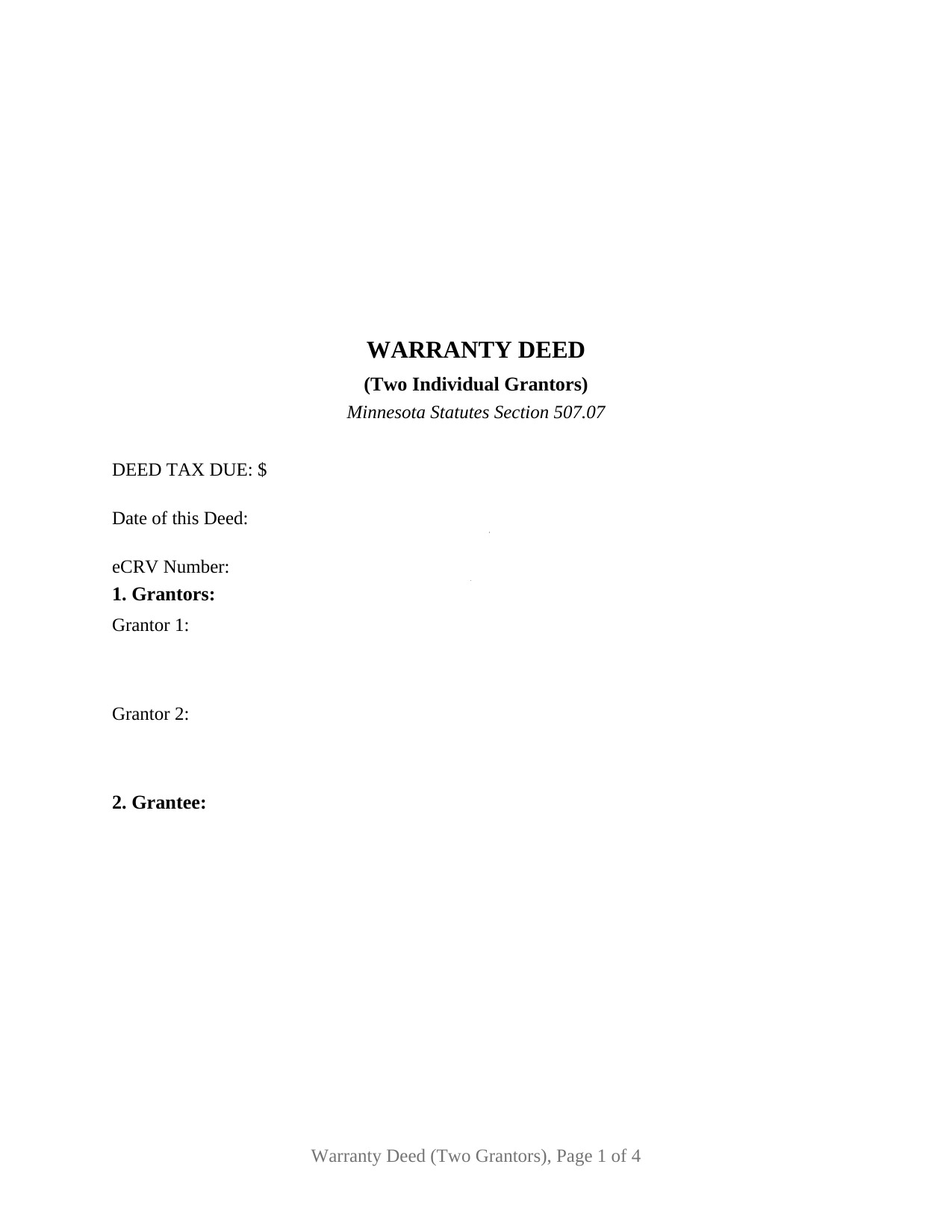
Two record owners convey together on this Minnesota warranty deed: the grantor section recites two names, each with a marital status entry, the signature section carries a line for each grantor, and a separate acknowledgment certificate follows each signature. The conveyance runs in fee simple on the statutory operative words of Minnesota Statutes section 507.07, here in the plural, as two grantors convey and warrant together.
Two grantors, two signatures, two certificates
The form recites exactly two individual grantors. Each grantor signs and dates a dedicated line, and each signature takes its own acknowledgment certificate in the Minnesota short form, so the two grantors may acknowledge on different days, before different notaries, or in different counties; the completed example shows one grantor acknowledging in Washington County and the other in Ramsey County two days later. Co-ownership patterns that present two grantors in the record include joint tenants selling a shared property, two heirs conveying a house they inherited as tenants in common, and a married couple who both hold record title. A conveyance by a sole owner, or by an entity, trustee, or attorney-in-fact, follows a different execution pattern than this deed recites.
The homestead rule that makes the second signature count
Minnesota's homestead signature statute, Minnesota Statutes section 507.02, provides that where the owner is married, a conveyance of the homestead is not valid unless both spouses sign, and the Minnesota Supreme Court reads that requirement strictly. When the two grantors on this deed are spouses who both hold record title to the home they are conveying, the two signature lines place both statutorily required signatures on the face of the instrument. The marital status recital entered with each grantor's name in the grantor section is what a title examiner reads against that statute, along with the deed tax and consideration entries. Where a grantor is married but the other spouse is not a record owner, the statute still reaches a homestead conveyance, and the form's two lines belong to the two record owners rather than to a non-owner spouse.
Covenants both grantors make, and how the grantees take
A deed on the section 507.07 statutory warranty form, the instrument searchers also call a Minnesota general warranty deed, binds each grantor, and each grantor's heirs and personal representatives, to the statutory covenants of seisin, right to convey, freedom from encumbrances, quiet possession, and defense of title. The exceptions section states what the conveyance remains subject to and so fixes the outer edge of the encumbrance covenant. On the receiving side, Minnesota Statutes section 500.19 lets the grantee entry vest one grantee in severalty or two or more grantees as tenants in common, the statutory default, or as joint tenants where the deed expressly declares it; the example's grantee clause vests a married couple expressly as joint tenants.
Entries the recording counter reads
The first page reserves the statutory three-inch top band for county recording and tax certification data, and the form carries the deed tax due figure computed under Minnesota Statutes section 287.21, the eCRV number for a sale over $3,000, the section 103I.235 well disclosure statement, an Abstract or Registered (Torrens) entry, the drafter statement, and the grantee tax-statement address. The guide walks through the county auditor's transfer entry and the remaining recording steps county by county.
What arrives with the download
The package delivers the blank warranty deed as a fillable PDF, a completed example filled in for a realistic Washington County fact pattern with two unmarried co-owner grantors, and a guide covering every numbered section, the signing and notarization formalities for both grantors, and the recording process. The materials describe Minnesota law in general terms and are informational only, not legal advice; a Minnesota attorney can address how these rules apply to a specific title or transaction.
Important: County-Specific Forms
Our warranty deed (two grantors) forms are specifically formatted for each of the 87 counties in Minnesota.
After selecting your county, you'll receive forms that meet all local recording requirements, ensuring your documents will be accepted without delays or rejection fees.