Minnesota Warranty Deed
County Specific Legal Forms Validated as recently as October 6, 2026 by our Forms Development Team
About the Minnesota Warranty Deed
How to Use This Form
- Select your county from the list
- Download the county-specific form
- Fill in the required information
- Have the document notarized if required
- Record with your county recorder's office
What Others Like You Are Saying
"great service and quick filing."
"Your site is useful but limited in scope. I could not find exactly what I was looking for and felt t…"
"The information seems complete and accurate. The form was easy to use and save. I'll let you know if…"
"Very good information. Easy access and easy to download. All the forms needed for TOD to be notarize…"
". I purchased 3 different items yesterday. Truthfully, it was a bit annoying, I could not figure out…"
4.8/5 from 4,836 reviews. Read all
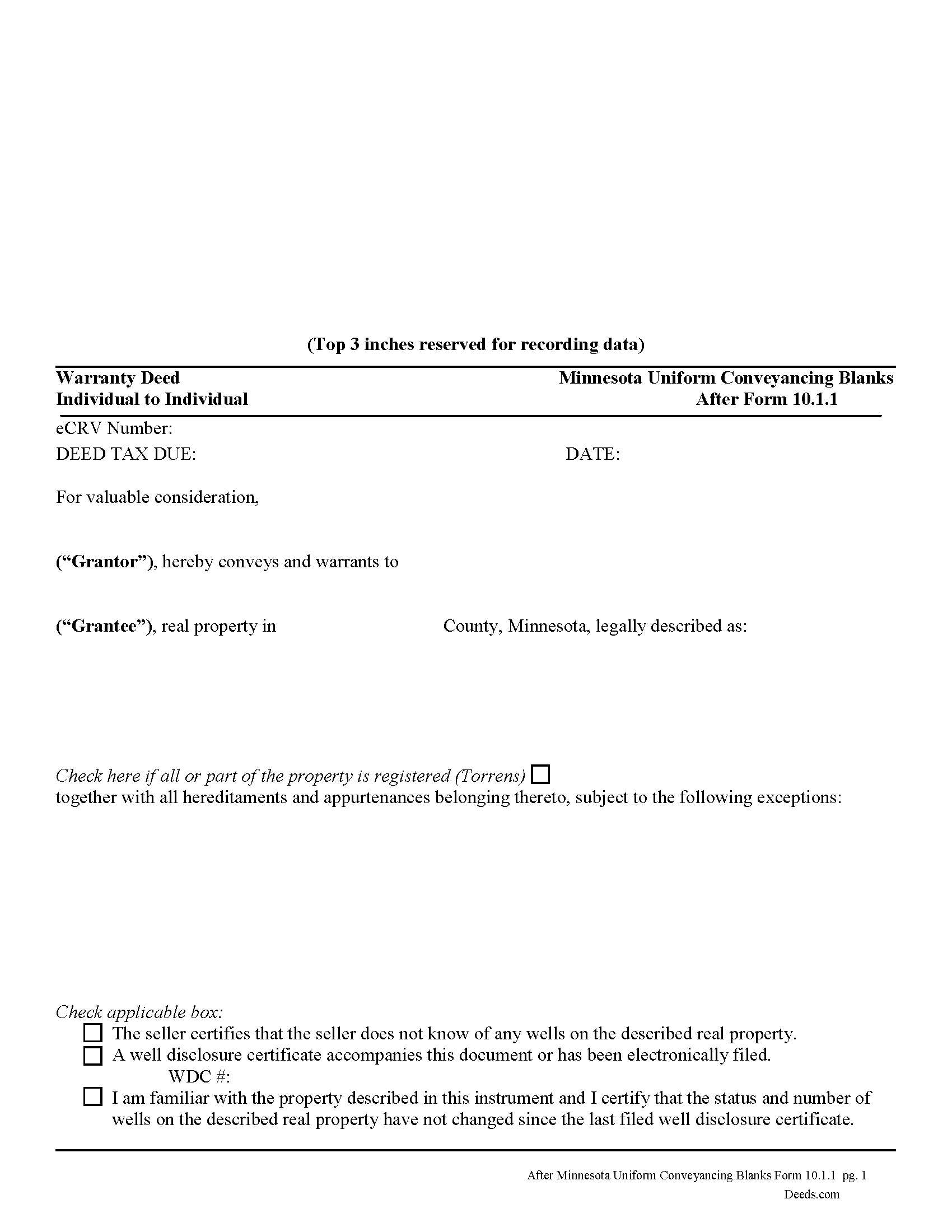
A Minnesota warranty deed reaches the county in a set order: the county auditor enters the transfer and certifies the delinquent tax status first, and only then does the county recorder, or the registrar of titles on registered land, take the instrument. This form is the general Minnesota warranty deed built for that route. One or two individual grantors convey and warrant real property to one or two grantees, and the party blocks are open blanks rather than a preprinted party count.
Two offices, in order
Minnesota Statutes section 272.12 sends a deed of land to the county auditor for transfer before recording. The auditor certifies any delinquent taxes and, on payment or a finding of none, notes on the instrument that there are no delinquent taxes and that transfer is entered; absent that statement, the recorder or registrar is directed to refuse the document. The deed then goes to the county recorder for abstract property, or to the registrar of titles for land registered under the Torrens chapters, and the form carries an entry naming which of the two systems holds the parcel. Priority follows section 507.34, Minnesota's race notice recording act, under which an unrecorded conveyance is void against a later good faith purchaser for value who records first.
What conveys and warrants commits the grantor to
Section 507.07 gives the warranty form its operative words. A deed in that form is a conveyance in fee simple carrying covenants that bind the grantor and the grantor's heirs and personal representatives as fully as if they had been written out at length, the last of them a promise to defend the title against all persons who may lawfully claim it. Defense that reaches the whole chain of title is what makes this statutory instrument the one many searchers look for as a general warranty deed. Section 507.07 prints no companion short form for a narrowed warranty, so a limited warranty in Minnesota is drafted out rather than selected.
One form, four party counts
The deed recites its parties in open multi line blocks: one grantor to one grantee, one grantor to two, two grantors to one, and two grantors to two. Nothing about marital status or co-ownership is preprinted. The marital status recital Minnesota practice places beside a grantor's name, and the designation under which two grantees take title, are entered in the blanks, and section 500.19 supplies tenancy in common as the result where a deed to two or more grantees declares nothing else. Execution is built the same way, with two signature blocks headed GRANTOR and SECOND GRANTOR (if applicable), each carrying its own acknowledgment certificate in the section 358.66 short form; a conveyance by a single grantor leaves the second block and its certificate blank. Sole owner conveyances and two owner conveyances both appear in the Minnesota record, and the homestead signature rule of section 507.02, which makes both spouses' signatures a validity requirement for a conveyance of a homestead, reaches either count. Deeds signed for a business entity, by a trustee, or under a power of attorney recite authority this form does not collect, as do conveyances by three or more owners.
The entries Minnesota law puts on the face of a deed
Section 507.093 keeps the top three inches of the first page clear for recording and tax certification data. The opening section collects the deed tax due under section 287.21, which runs at $1.65 for a transfer with net consideration of $3,000 or less and at 0.0033 of net consideration above that, alongside the eCRV number returned when an electronic certificate of real estate value is filed. Another section takes the well disclosure statement that section 103I.235 makes a condition of recording, and the guide sets out the three statutory statements and the certificate route word for word. Drafter identification under section 507.091 and the grantee address for future property tax statements under section 507.092 close the instrument.
The package includes the blank deed as a fillable PDF, a completed example drawn from an Olmsted County sale, and a guide covering every section, the signing and notarization steps, and recording. The materials describe Minnesota law in general terms and are informational only; they are not legal advice, and a Minnesota attorney can address a specific title or transaction.
Important: County-Specific Forms
Our warranty deed forms are specifically formatted for each of the 87 counties in Minnesota.
After selecting your county, you'll receive forms that meet all local recording requirements, ensuring your documents will be accepted without delays or rejection fees.