Nevada Deed Upon Death (Married Owners, Community Property with Right of Survivorship, Last Survivor)
County or Independent City Specific Legal Forms Validated as recently as November 15, 2026 by our Forms Development Team
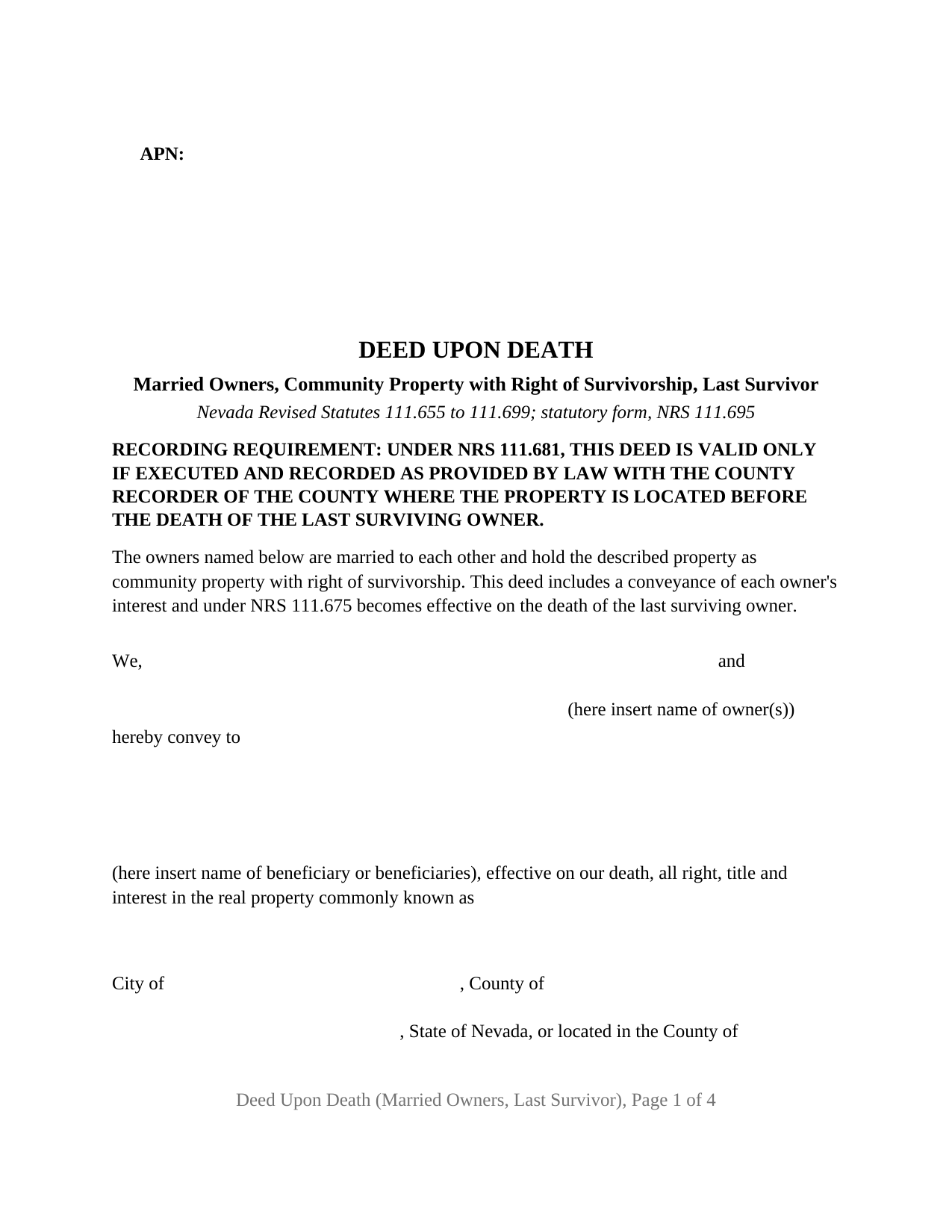
About the Nevada Deed Upon Death (Married Owners, Community Property with Right of Survivorship, Last Survivor)
How to Use This Form
- Select your county or independent city from the list
- Download the county or independent city-specific form
- Fill in the required information
- Have the document notarized if required
- Record with your county or independent city recorder's office
What Others Like You Are Saying
"Top notch service."
"Very easy to use and I appreciate the fees being charged after the submission."
"recorded deed space to small for corrective deed requirement"
"This was a seamless process. It probably took one minute to fill out my information and upload the d…"
"Worked great. Count Clerk and Recorder liked them and we got the job done."
4.8/5 from 4,858 reviews. Read all
A married couple who hold their Nevada home as community property with right of survivorship already know where the property goes when the first of them dies: to the survivor, by the survivorship feature of their own title. The open question is where it goes when the second of them dies. This form prepares a Nevada deed upon death for that moment. Both spouses sign one deed in the statutory wording of NRS 111.695, naming who receives the property after both of them are gone, and under NRS 111.675 the deed takes effect on the death of the last surviving owner.
A deed that waits for the second death
Nevada's deed upon death chapter, NRS 111.655 to 111.699, has a specific rule for owners who hold with a right of survivorship. NRS 111.675 provides that where the owner of the property holds as a joint tenant with right of survivorship or as community property with right of survivorship, a deed upon death that includes a conveyance of the interest from each of the other owners becomes effective on the date of the death of the last surviving owner. A deed that does not include that conveyance becomes effective at the signing owner's death only if that owner turns out to be the last survivor. The first rule is the one this form is built around: it recites the spouses' survivorship title, it carries a signature block for each spouse, and it states on its face that the deed includes a conveyance of each owner's interest and becomes effective on the death of the last surviving owner.
The first death changes nothing about the deed. The deceased spouse's interest passes to the survivor under the survivorship estate the couple already held, not under the deed upon death, and the recorded deed simply keeps waiting. The chapter asks for no second recording, re-signing, or amendment at that point.
What the survivor keeps
A deed upon death is close to inert during life. NRS 111.685 provides that it does not affect any interest or right of the owner, including the right to transfer or encumber the property, and that it creates no legal or equitable interest in the beneficiary. The surviving spouse therefore holds the whole property with every power an owner has. The survivor, as the last remaining owner who created the deed, may revoke it under NRS 111.697 by a revocation of deed upon death executed and recorded before death, an instrument prepared and recorded separately and not included in this package; may record a later deed upon death for the same property, which under NRS 111.677 displaces the earlier one; or may sell or give the property away during life, which voids the deed. NRS 111.064 provides that the survivorship feature of a married couple's community property is extinguished when either spouse transfers that spouse's interest during the marriage, and because NRS 111.685 makes the deed upon death a transfer of nothing during life, the form describes the spouses' survivorship title as left in place by the deed.
Two spouses, two signatures, two certificates
The form recites exactly two owners, married to each other, holding the described property as community property with right of survivorship; the recital is fixed deed text, and the two name blanks after the word We are the only owner entries. Each spouse has a signature block with a printed name and date, and each has an acknowledgment certificate in the wording the NRS 111.695 form prints, so the two may acknowledge on different dates or before different notaries. Spouses whose vesting deed expressly declares that they take as community property with right of survivorship, naming the child, relative, trust, or organization that takes after both deaths, present the pattern this deed recites. The form is not set up as a deed by one owner alone, by spouses who hold as community property without a right of survivorship or as tenants in common, by unmarried co-owners holding as joint tenants, by registered domestic partners, by a trustee, an entity, or an attorney-in-fact, or by three or more owners on one instrument; each of those carries a different recital or a different signature structure.
Naming who takes after both deaths
NRS 111.673 lets the owners name one beneficiary or several and, where several are named, state how they take in the terms Nevada title law recognizes. It also lets the owners designate a beneficiary to take as that beneficiary's sole and separate property, without a quitclaim deed or disclaimer from the beneficiary's own spouse. The completed example shows that designation: a Henderson couple naming their married daughter to take the home as her sole and separate property. The beneficiary entry carries each beneficiary's full name and mailing address, the address NRS 111.312 requires for the grantee of a recorded conveyance, and any tenancy designation the owners choose from the chapter's menu.
Recording while both spouses are alive, or at least one
NRS 111.681 makes recording a condition of validity: the deed is valid only if executed and recorded with the county recorder of the county where the property is located before the death of the owner or the death of the last surviving owner. The form restates that condition under its title. It carries the assessor's parcel number at the top left of the first page and a tax statement address at the end, two of the items NRS 111.312 requires on a recorded deed (the third, the grantee's mailing address, rides in the beneficiary entry), and its affirmation that the document contains no Social Security number is part of the statutory text. A State of Nevada Declaration of Value goes to the recorder with the deed, and the declaration claims the exemption NRS 375.090(10) gives a deed upon death from the real property transfer tax. After the last surviving owner dies, the beneficiary records the Death of Grantor Affidavit of NRS 111.699 with the death certificate of each grantor and a declaration of value attached, an instrument prepared and recorded separately and not included in this package.
The package contains three items: the fillable Nevada deed upon death form for married owners holding community property with right of survivorship, a completed example filled in for a Henderson couple in Clark County, and a guide describing every part of the deed, the Nevada statutes that govern it, and the steps for signing, notarizing, and recording it. Neither this description nor the guide applies the law to any particular couple or property, and neither is legal advice.
Important: County or Independent City-Specific Forms
Our deed upon death (married owners, community property with right of survivorship, last survivor) forms are specifically formatted for each of the 17 county or independent cities in Nevada.
After selecting your county or independent city, you'll receive forms that meet all local recording requirements, ensuring your documents will be accepted without delays or rejection fees.