Nevada Deed Upon Death (Sole Owner, Multiple Beneficiaries (Equal Shares))
County or Independent City Specific Legal Forms Validated as recently as November 15, 2026 by our Forms Development Team
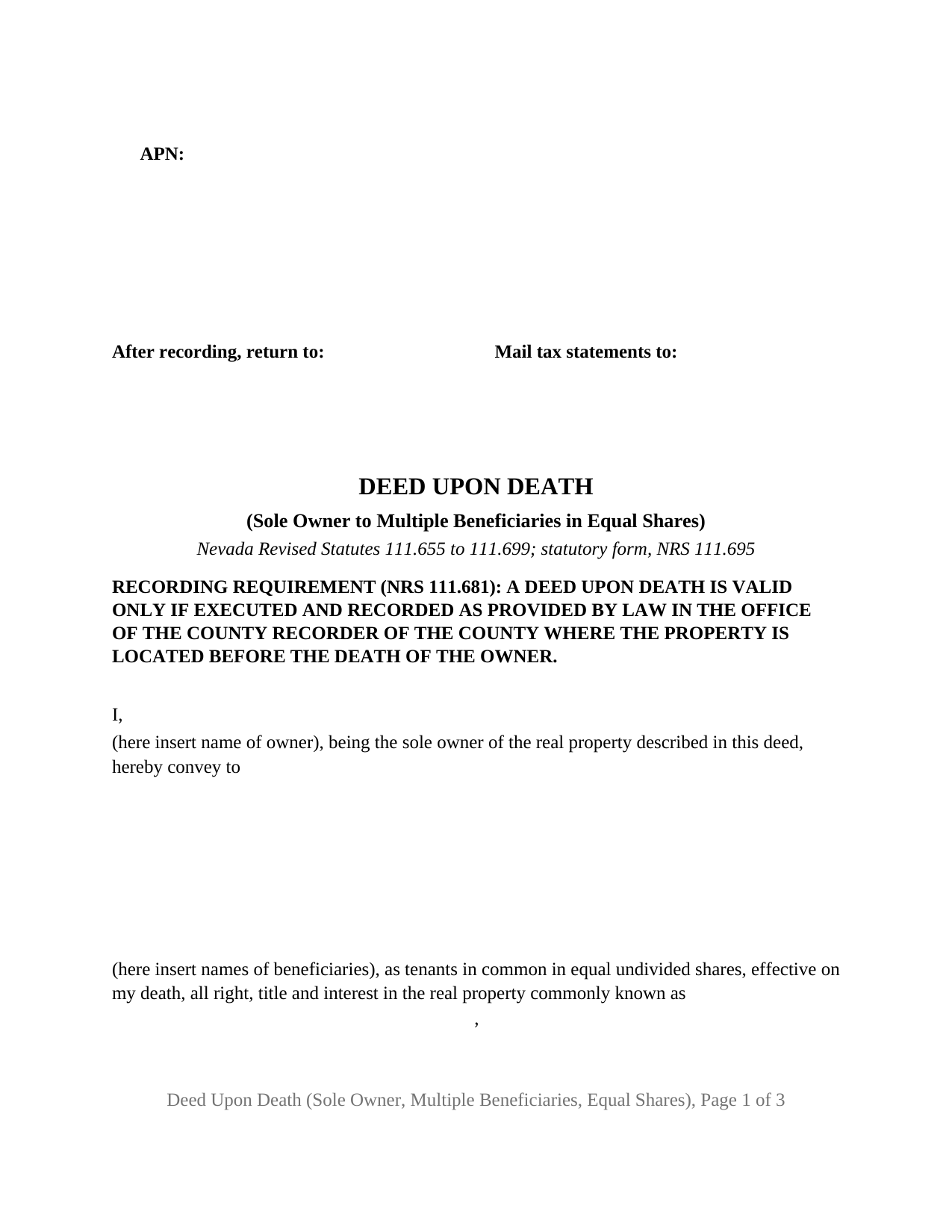
About the Nevada Deed Upon Death (Sole Owner, Multiple Beneficiaries (Equal Shares))
How to Use This Form
- Select your county or independent city from the list
- Download the county or independent city-specific form
- Fill in the required information
- Have the document notarized if required
- Record with your county or independent city recorder's office
What Others Like You Are Saying
"I just completed my first deed filing and I’m very happy with the experience. The deeds staff was ex…"
"The deed I needed was available to me easily. I was able to fill it out with the help of the example…"
"Works great thank you for saving us driving time!!"
"This company and it's customer service ARE wonderful. GREAT tool to assist you with any situation yo…"
"Speedy process, they provided me with the exact documents that I needed."
4.8/5 from 4,856 reviews. Read all
One Nevada owner, several beneficiaries, and an equal share for each: that is the configuration this deed upon death fixes as deed text. The form prepares the statutory deed of NRS 111.695 for a person who holds Nevada real property alone and names two or more beneficiaries to take it at death, outside probate, as tenants in common in equal undivided shares. The instrument other states call a transfer on death deed, TOD deed, or beneficiary deed is, under NRS 111.671, known in Nevada as a deed upon death.
Equal shares, written into the deed
NRS 111.673(1) lets an owner who creates a deed upon death choose the tenancy in which multiple beneficiaries will take title at death: a joint tenancy with right of survivorship, a tenancy in common, community property or community property with right of survivorship for a married couple, or any other tenancy Nevada recognizes. This form settles that designation in advance. The sentence that follows the beneficiary field is fixed: the beneficiaries take as tenants in common in equal undivided shares, effective on the owner's death. A deed to three children therefore carries three equal thirds, a deed to two carries two equal halves, and no beneficiary's share enlarges because another beneficiary dies first, since a tenancy in common carries no survivorship. Tenancy in common is also the estate NRS 111.060 supplies when a grant to two or more persons declares no joint tenancy; the form states it expressly rather than resting on the default. The beneficiary field itself takes names and mailing addresses only, the address being the item NRS 111.312(1)(a) places in every recorded conveyance, and NRS 111.667 defines a person broadly enough that a beneficiary may be an individual, a trust, or an entity.
One owner, signing as the sole owner
The statutory form is written for one or more owners, in the words I (We) and my (our). This form carries the singular throughout. The owner's name goes in the blank after the word I, and the words that follow are fixed deed text: being the sole owner of the real property described in this deed, hereby convey to. One signature block and one notary certificate follow. The recital is the signer's own statement of the configuration; the ownership rests on the vesting deed of record, and the guide describes what that deed shows for an unmarried owner, for a married owner or registered domestic partner holding separate property under NRS 123.130, and for title that is community property under NRS 123.220, where NRS 123.230(3) requires both spouses to join in a conveyance of community real property. Title held with another person under a right of survivorship is the pattern NRS 111.675 addresses, and it is outside what this deed recites.
What the deed does during life, and what it waits for
During the owner's life the deed does nothing to the title. NRS 111.685 provides that it does not affect the owner's right to transfer or encumber the property, creates no legal or equitable interest in a beneficiary, and does not expose the property to a beneficiary's creditors, and NRS 111.683 makes it effective without delivery to or acceptance by anyone named in it. What the deed waits for is the recorder's stamp and then the owner's death, in that order: NRS 111.681 makes a deed upon death valid only if it is executed and recorded in the county where the property is located before the owner dies, and the form restates that condition at the top of its first page. The deed is presented with the State of Nevada Declaration of Value, on which the transfer is claimed exempt from the real property transfer tax under NRS 375.090(10). It remains revocable until death, but only by a revocation executed and recorded under NRS 111.697, a separate statutory instrument prepared and recorded separately and not included in this package; a lifetime sale of the property voids the deed under NRS 111.677, and a later recorded deed upon death of the same property displaces it. At the owner's death the beneficiaries take subject to liens then existing (NRS 111.691), record the Death of Grantor Affidavit of NRS 111.699 with the death certificate and a declaration of value, likewise a separate instrument not included in this package, and publish and mail the notice to creditors NRS 111.689 describes, which opens a 90-day claims period.
The statute's sentences and the recorder's items
NRS 111.695 provides that a deed upon death must be in substantially the form it prints, and this form carries that form's sentences: the conveyance effective on the owner's death, the appurtenances clause, the uppercase legend stating that the deed is revocable, transfers no ownership until the grantor's death, and revokes all prior deeds upon death of the same property, the affirmation that the document contains no Social Security number, and the notary certificate the form prints, with its State of Nevada venue, its sworn sentence, its acknowledgment sentence, and its signature and seal line, a certificate NRS 240.1655(3)(b) makes sufficient as a form otherwise prescribed by Nevada law. Around the statutory text sit the items NRS 111.312 names for a recorded conveyance: the assessor's parcel number at the top left corner of the first page, the mailing address for tax statements, and a line for the preparer or prior recording reference of a metes-and-bounds description. The page itself follows NRS 247.110: letter size, one-inch margins, twelve-point Times body text over the ten-point minimum, and a blank three-inch square at the upper right of the first page for the recorder.
The configuration this form carries
The form recites one owner, signing alone as the sole owner of the described property, and two or more beneficiaries taking as tenants in common in equal undivided shares, with one signature block and one certificate. A widowed parent holding the family home alone and naming each adult child for an equal part, and an unmarried owner dividing a rental house between two siblings, present the pattern this deed recites. The form is not set up as a deed by two owners, by co-owners whose title carries a right of survivorship, by a trustee, an entity, or an attorney-in-fact, or as a deed to a single beneficiary, to beneficiaries in unequal shares, to beneficiaries as joint tenants with right of survivorship or in another tenancy NRS 111.673(1) names, or with the sole-and-separate designation NRS 111.673(2) describes; the chapter states no survival period and no lapse rule, and the form adds none.
The package includes the fillable Nevada deed upon death form in this sole-owner, equal-shares configuration, a completed example filled in for a Clark County owner conveying to three children, and the guide that explains each entry, the statutes behind it, and the recording steps. This description and the guide describe the form and the Nevada statutes that govern it in general terms, and they are not legal advice.
Important: County or Independent City-Specific Forms
Our deed upon death (sole owner, multiple beneficiaries (equal shares)) forms are specifically formatted for each of the 17 county or independent cities in Nevada.
After selecting your county or independent city, you'll receive forms that meet all local recording requirements, ensuring your documents will be accepted without delays or rejection fees.