Nevada Deed Upon Death (Sole Owner, Trust Beneficiary)
County or Independent City Specific Legal Forms Validated as recently as November 15, 2026 by our Forms Development Team
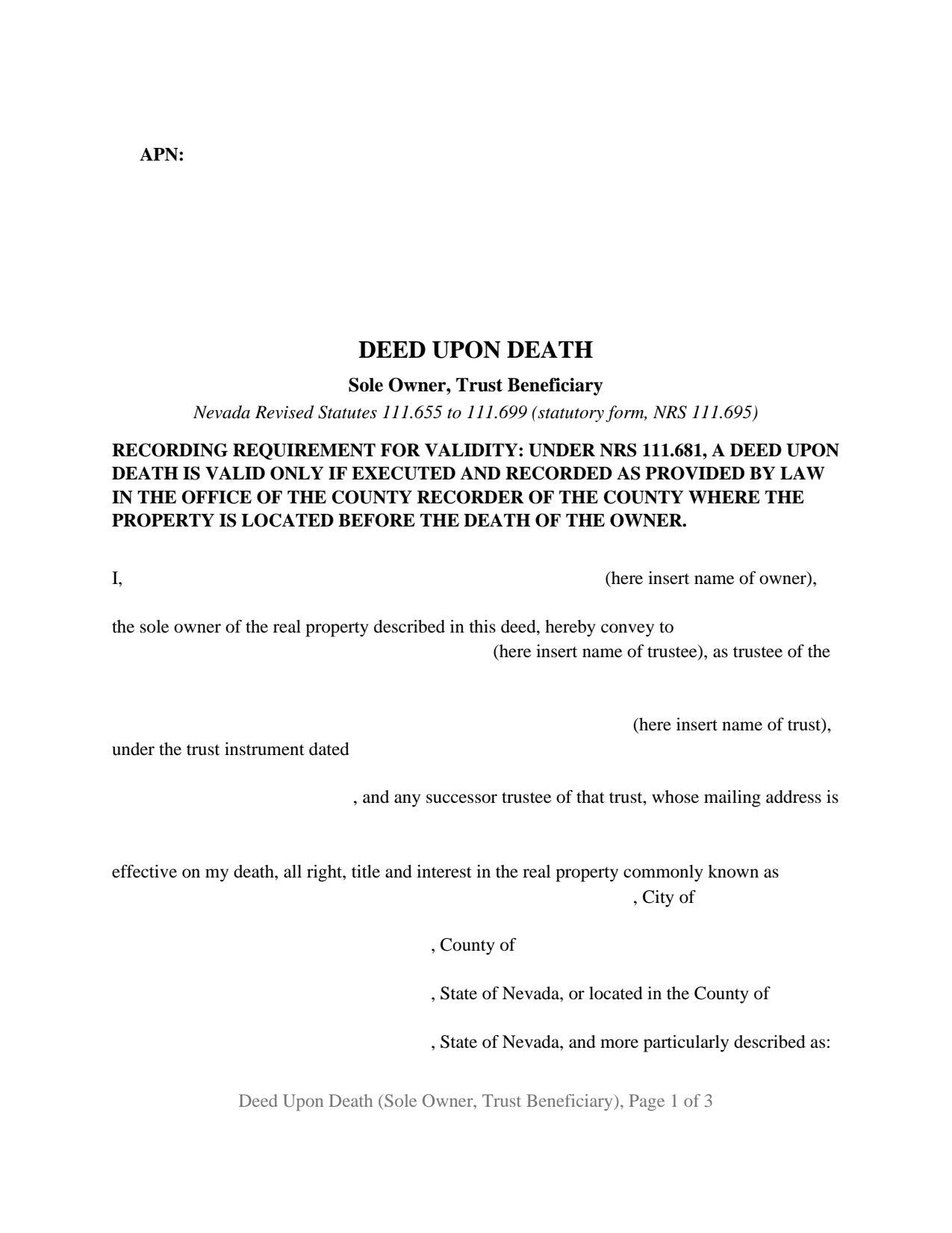
About the Nevada Deed Upon Death (Sole Owner, Trust Beneficiary)
How to Use This Form
- Select your county or independent city from the list
- Download the county or independent city-specific form
- Fill in the required information
- Have the document notarized if required
- Record with your county or independent city recorder's office
What Others Like You Are Saying
"So thankful that I could just find the form and complete the estate I am working on for my parents. …"
"Very happy with forms downloaded. Well worth the price. Could not find them anywhere else on the web…"
"I was able to find EXACTLY what I was looking for in just a couple minutes, plus a helpful guide, al…"
"Great site! Got what I needed and I'm not the brightest bulb in the box when it comes to this interw…"
"Would be better if you could save the forms to word for easier use on your computer."
4.8/5 from 4,856 reviews. Read all
A Nevada deed upon death can send real estate into a trust at the owner's death without retitling the property to the trustee now. This form prepares that deed for one owner who holds Nevada real property alone and names the trustee of a trust as the beneficiary, in the statutory form NRS 111.695 prints. Through the sole owner's lifetime the deed sits inert and revocable; at death, the trustee of the named trust takes all right, title and interest in the property, and the trust instrument takes over from there.
A beneficiary that is an office, not a person
The deed names its beneficiary in three parts: the trustee by name, the trust by its name, and the trust instrument by its date. The fixed text between those entries recites that the conveyance runs to the named trustee, as trustee of the named trust, under the trust instrument dated as stated, and any successor trustee of that trust. NRS 111.667 defines a person, for the deed upon death chapter, to include a trust, and NRS 111.663 defines a designated beneficiary as a person designated to receive property in a deed upon death, so the designation is one the chapter permits in its own words. The successor trustee language reaches whoever holds the office at the owner's death: NRS 163.100 provides that, unless the trust instrument or a court order says otherwise, the powers of a trustee are attached to the office and are not personal, so a change of trustee between signing and death does not strand the designation on a name. The trustee's mailing address rides inside the conveyance sentence, which is the grantee address NRS 111.312(1)(a) requires in every recorded conveyance.
Two patterns present this designation in Nevada records. One is an owner whose own revocable living trust is the beneficiary, so that the house passes at death into the plan the trust already describes, with no deed to the trustee during life and no change to the owner's rights in the property in the meantime (NRS 111.685). The other is an owner who names a trust created for someone else, such as a trust for a grandchild that holds and manages the property under its own terms. The completed example shows the first: an owner in Henderson naming herself as trustee of her own revocable living trust, with the Clark County eleven digit parcel number at the top left of the first page.
Nothing moves now, and the trust is not funded now
NRS 111.685 provides that during the owner's lifetime the deed does not affect any interest or right of the owner, including the right to transfer or encumber the property, does not create a legal or equitable interest in favor of the designated beneficiary, and does not subject the property to the beneficiary's creditors. Applied to a trust beneficiary, that means the property is not trust property while the owner lives: the trustee holds nothing, the trust instrument reaches nothing, and the owner can sell, refinance, or revoke without the trustee's involvement. NRS 111.683 makes the deed effective without notice or delivery to or acceptance by the beneficiary and without consideration, so the trustee neither signs nor appears. If the owner conveys the property to someone else during life, NRS 111.677 makes the deed void.
What the chapter does not say matters as well. It states no survival period and no lapse rule for a beneficiary, and it does not address a trust that has been revoked or has terminated before the owner's death; the guide describes that silence rather than filling it. At the owner's death the trustee takes subject to every lien then on the property under NRS 111.691, and NRS 111.689 keeps the property within reach of the owner's estate for allowed claims and statutory allowances where the probate estate falls short, with a notice to creditors the beneficiary publishes and mails after the death.
One owner, one signature, the statute's own certificate
The form recites exactly one owner, a natural person signing in his or her own right, and recites that the owner is the sole owner of the real property the deed describes. It carries one signature block, with the printed name NRS 247.190 asks for beneath every signature, and one notary certificate, the certificate NRS 111.695 prints rather than the general short form of NRS 240.166. That certificate opens with the venue State of Nevada, County of, continues with a sworn sentence and an acknowledgment sentence in which the owner, personally known to the notary or proved by satisfactory evidence, acknowledges executing the instrument, and closes with the notary's signature and seal; NRS 240.1655(3)(b) makes a certificate in a form otherwise prescribed by Nevada law sufficient. The form is not set up for two owners conveying in one deed, the configuration NRS 111.675 addresses for survivorship property, for an owner signing through an attorney in fact, for a trustee or entity as the owner, or for an individual, an entity, or several beneficiaries taking under the tenancies NRS 111.673 lists. A married owner's community property is held by both spouses under NRS 123.225, and NRS 123.230(3) requires both to join in a conveyance of community real property; the sole owner this deed recites holds the property alone, as the vesting deed shows.
Valid only when recorded, and exempt from transfer tax
NRS 111.681 makes the deed valid only if executed and recorded with the county recorder of the county where the property is located before the owner's death, and the form restates that condition in capitals under its title. The deed goes to the recorder with the State of Nevada Declaration of Value under NRS 375.060, on which the exemption for a deed upon death, NRS 375.090(10), is claimed by number, so no real property transfer tax is computed. The uppercase legend and the Social Security number affirmation the statutory form prints are carried word for word, and the tax statement block at the end of the deed carries the name and address NRS 111.312(3) requires in any deed. A revocation is itself a recorded instrument under NRS 111.697, prepared and recorded separately and not included in this package, and after the owner's death the trustee records the Death of Grantor Affidavit NRS 111.699 prescribes, with the death certificate and a declaration of value attached, likewise prepared and recorded separately and not included in this package.
The package includes the fillable Nevada deed upon death form for a sole owner naming a trust beneficiary, a completed example filled in for a realistic Clark County fact pattern, and the guide that walks through every entry, the trust and recording statutes that shape it, and the path from signing to the recorder's counter. Both this description and the guide are general descriptions of the form and of Nevada law, not legal advice, and neither applies the law to any particular owner, trust, or property.
Important: County or Independent City-Specific Forms
Our deed upon death (sole owner, trust beneficiary) forms are specifically formatted for each of the 17 county or independent cities in Nevada.
After selecting your county or independent city, you'll receive forms that meet all local recording requirements, ensuring your documents will be accepted without delays or rejection fees.