Nevada Deed Upon Death (Sole Owner, One Individual Beneficiary)
County or Independent City Specific Legal Forms Validated as recently as November 15, 2026 by our Forms Development Team
About the Nevada Deed Upon Death (Sole Owner, One Individual Beneficiary)
How to Use This Form
- Select your county or independent city from the list
- Download the county or independent city-specific form
- Fill in the required information
- Have the document notarized if required
- Record with your county or independent city recorder's office
What Others Like You Are Saying
"I have not completed the submission of documents yet but the initial sign up and documents were easi…"
"Excellent source for obtaining documents and instructions."
"My sister in law is in a hospital ICU with Covid, so we were trying to get her affairs in order. Dee…"
"Fast and easy. Sample completed form & guidelines very useful."
"The affidavit guidance was a great help and helped reduce the stress that usually comes with dealing…"
4.8/5 from 4,856 reviews. Read all
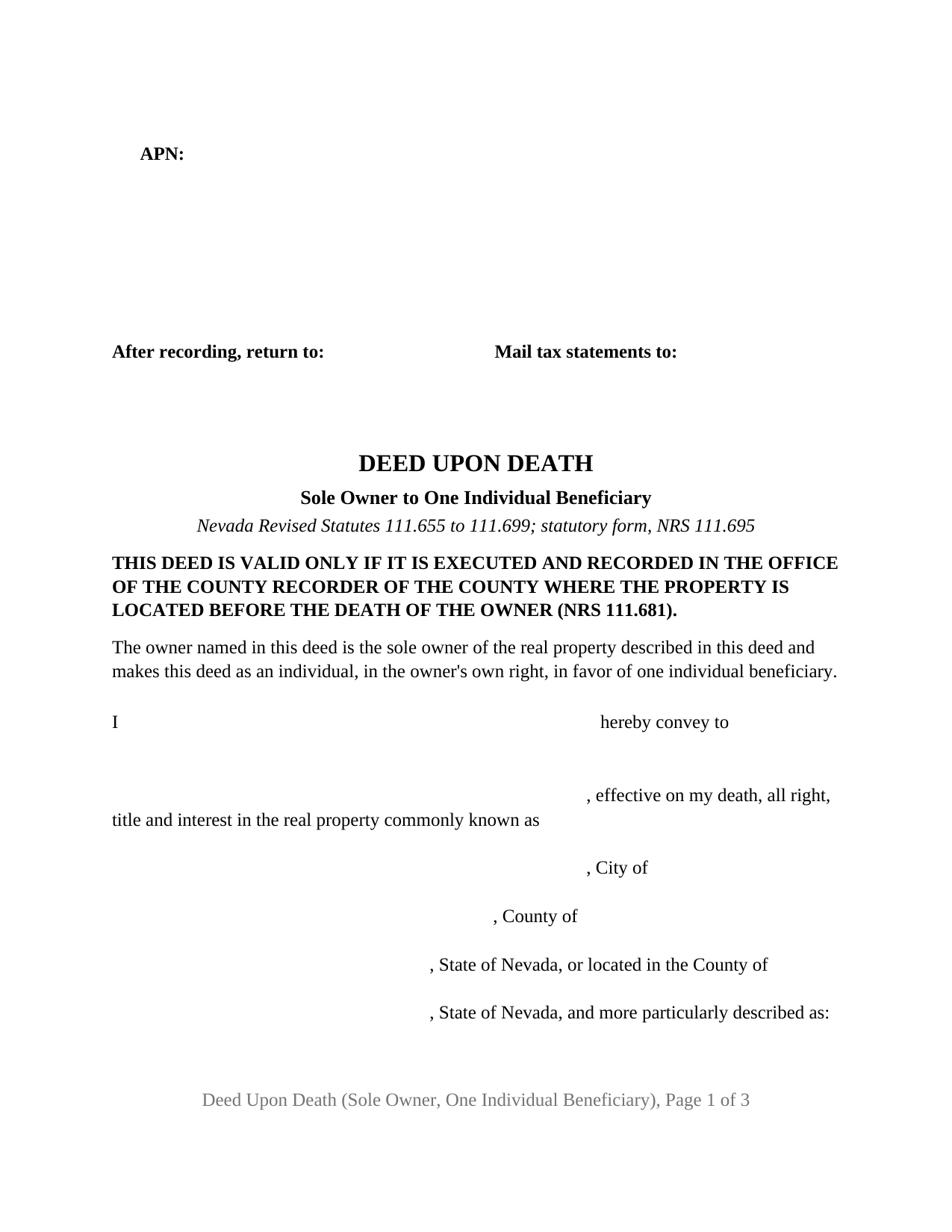
One owner, one name in the beneficiary blank, one signature, one notary certificate. This form prepares a Nevada deed upon death for a person who holds real property as its sole owner and who names a single individual to receive it at death, in the statutory form NRS 111.695 prints and with that form's sentence fixed to the singular: I hereby convey, effective on my death. The result is the simplest shape the Nevada transfer on death deed takes, and the shape most owners of a house in one name are looking for when they search for a beneficiary deed or TOD deed in Nevada.
One name on each side of the statutory sentence
The deed's operative sentence is the statute's own. The owner's name goes in the first blank, the beneficiary's name in the second, and between them the words hereby convey to, followed by effective on my death, all right, title and interest in the real property commonly known as, the street address, city, and county, and the legal description. The form carries the appurtenances clause, the capital-letter legend, and the Social Security number affirmation exactly as NRS 111.695 prints them. What the form fixes is the count: the statute's I (We) and my (our) alternatives are resolved to the singular, so the sentence reads as one person's conveyance and nothing on the page invites a second owner's name.
The beneficiary side is fixed the same way. NRS 111.673 lets an owner name several beneficiaries and state the tenancy in which they take, and NRS 111.667 lets a trust or an entity be a beneficiary; this form names one natural person and carries no tenancy entry, because one beneficiary takes alone. The beneficiary's mailing address, which NRS 111.312(1)(a) requires in a recorded conveyance, has its own block beneath the legal description so the statutory sentence stays as the statute wrote it. The beneficiary does not sign, and under NRS 111.683 the deed is effective without notice to, delivery to, or acceptance by the beneficiary.
The sole-owner recital and what the title record shows
Above the statutory sentence the deed states, as fixed text, that the owner named in it is the sole owner of the described property and makes the deed as an individual, in the owner's own right, in favor of one individual beneficiary. That sentence states the configuration the form is built around. In Nevada's title records the pattern appears in two ways: an unmarried owner who took title alone, and a married owner or registered domestic partner whose vesting deed recites the property as sole and separate property, the separate property NRS 123.130 describes. Property acquired during a marriage that is not separate property is community property under NRS 123.220, each spouse holds a present and equal interest in it under NRS 123.225, and NRS 123.230(3) requires both spouses to join in conveying it; that is a two-owner pattern, and this form recites exactly one owner. The guide walks through how a vesting deed shows which pattern a title presents.
The form is likewise not set up for an owner who signs through an attorney-in-fact, for a trustee or an entity as owner, or for two owners who hold with a right of survivorship, whose deed NRS 111.675 postpones to the death of the last survivor only when both of them join in it.
Recorded before death, or not at all
A Nevada deed upon death has one condition that overrides every other detail of its preparation. NRS 111.681 makes the deed valid only when it has been executed and recorded, before the owner's death, in the office of the recorder of the county where the property lies. The form restates that condition in capital letters beneath its title, and the recorder's intake items under NRS 111.312 are each given a place: the assessor's parcel number at the top left corner of the first page, the beneficiary's mailing address, and the name and address for tax statements. The deed travels to the recorder with a State of Nevada Declaration of Value, and because NRS 375.090(10) exempts a deed upon death from the real property transfer tax, the declaration claims the exemption and no tax is computed.
Until the owner dies, the recorded deed changes nothing. NRS 111.685 preserves the owner's right to sell, mortgage, or encumber the property and creates no interest in the beneficiary; NRS 111.677 voids the deed if the owner transfers the property during life and, where more than one deed upon death is recorded for the same property, makes the last one recorded before death the effective deed. The deed can be undone at any time by an executed and recorded revocation under NRS 111.697, which is a separate statutory instrument prepared and recorded separately and not included in this package; a revocatory act on the deed itself, such as striking or destroying it, revokes nothing.
The certificate the statute prints, completed once
NRS 111.695 prints its own notary certificate rather than the NRS 240.166 short form, and this form reproduces it under one caption for the one signer: the venue State of Nevada, County of, a sworn sentence naming the notary and the owner, a second sentence recording that the owner appeared, was known to the notary or identified by satisfactory evidence, and acknowledged executing the deed, and the notary's signature and seal at the close. NRS 240.1655(3)(b) makes a certificate in a form otherwise prescribed by Nevada law sufficient, and NRS 111.240 requires a conveyance of Nevada real property to be acknowledged before it is recorded. The guide describes what the notary completes in each of the certificate's blanks, the stamp statement NRS 240.1655(1)(d) requires, and the treatment of an owner who signs while in another state, whose certificate is that state's.
After the owner's death
At the owner's death the named beneficiary takes the property subject to any liens then existing on it (NRS 111.691) and records, in the same county, the Death of Grantor Affidavit NRS 111.699 prescribes, with a declaration of value and a copy of the death certificate attached; the affidavit is a separate instrument prepared and recorded separately and not included in this package. The beneficiary also publishes and mails the notice to creditors NRS 111.689 describes, and claims against the owner's estate that the probate estate cannot satisfy may be enforced against the property to that extent. The chapter names no alternate beneficiary and this form carries none: if the one named beneficiary does not survive the owner, the property passes under the owner's will or by intestacy unless a later recorded deed upon death names someone else, a limit the guide states plainly.
The package includes the fillable Nevada deed upon death form in this sole-owner, single-beneficiary configuration, a completed example filled in for a Clark County owner naming an adult daughter, and the guide, which walks through every blank on the form, the statutes it rests on, and the trip to the county recorder. This description and the guide are general descriptions of the form and of Nevada law; they are not legal advice.
Important: County or Independent City-Specific Forms
Our deed upon death (sole owner, one individual beneficiary) forms are specifically formatted for each of the 17 county or independent cities in Nevada.
After selecting your county or independent city, you'll receive forms that meet all local recording requirements, ensuring your documents will be accepted without delays or rejection fees.