New Hampshire Quitclaim Deed (Divorce)
County Specific Legal Forms Validated as recently as October 8, 2026 by our Forms Development Team
About the New Hampshire Quitclaim Deed (Divorce)
How to Use This Form
- Select your county from the list
- Download the county-specific form
- Fill in the required information
- Have the document notarized if required
- Record with your county recorder's office
What Others Like You Are Saying
"Ordered the Ohio Land Contract forms for Jefferson County. It was an awesome purchase for $28 bucks.…"
"The experience has been excellent. The site gave me exactly what I was looking for. The documentatio…"
"Very quick and efficient. Received recorded document within hours after beginning the process. Very …"
"The website and information is fine. The proof in the pudding, of course, is whether the forms I use…"
"Site was easy to navigate and helped me to quickly locate the documents I was searching for. Thank y…"
4.8/5 from 4,821 reviews. Read all
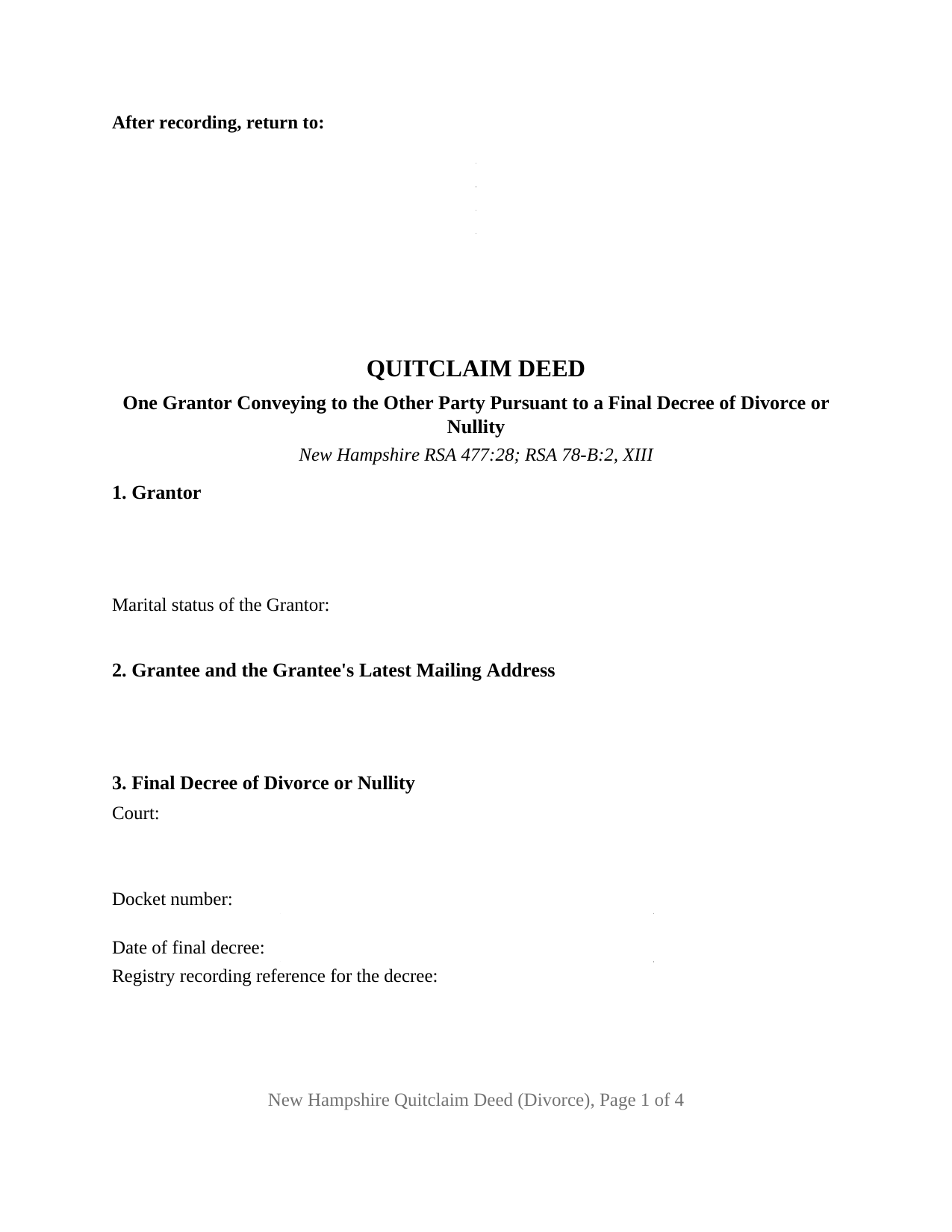
A New Hampshire final decree can order one party to give up the marital home, and RSA 477:3-a treats a court order affecting title as an instrument the registry records at length. What the grantor and grantee indexes carry under the parties' names, though, is a deed. Under RSA 477:28, this fillable form prepares the deed that follows the order: one party to a divorce or nullity proceeding conveys to the other, and Section 3 names the decree behind it.
The Order Behind the Conveyance
RSA 458:16-a draws the property question broadly: paragraph I reaches all property belonging to either or both parties, whatever name title stands in, and paragraph II lets the court order an equitable division when a dissolution of a marriage is decreed. Paragraph V keeps the court from ordering a sale where one party can fully and fairly compensate the other, so the record often shows a conveyance between the parties. Section 3 collects the court, the docket number, the decree date, and a registry reference where a certified copy of the decree was itself recorded. No New Hampshire statute located makes the decree itself a conveyance of record title.
A Single Party Conveying, With the Decree on the Page
The form recites exactly one grantor: an individual named as a party to that proceeding, signing personally, with a marital status entry. The grantee is the other party, named with the latest mailing address RSA 478:4-a, I(a) makes an intake item, and signs nothing. One signature line follows, its printed name entry answering RSA 478:4-a, I(c), then one acknowledgment certificate built on the RSA 456-B:8 short form. Patterns that present this configuration in the record include a survivorship residence the decree awards wholly to one party, a parcel in one party's name that the decree awards to the other, and a deed recorded well after the decree so the index matches the order. An entity grantor, a trustee, and an agent under a power of attorney each recite a capacity this form does not print.
An Exemption That Depends on the Decree
RSA 78-B:1 presumes every transfer taxable, and the divorce exception is narrow: RSA 78-B:2, XIII covers a transfer of title between spouses pursuant to a final decree of divorce or nullity. Section 10 carries what RSA 78-B:6 wants before a register completes any recording, either evidence of payment or a statement that the transaction is not subject to the tax. A filing consequence follows: under RSA 78-B:10 no declaration of consideration goes to the Department of Revenue Administration for a transfer exempt under RSA 78-B:2 other than a noncontractual transfer under paragraph IX. A buyout changes the arithmetic: cash paid or mortgage debt assumed is consideration, taxed at 75 cents per $100 against each side.
Homestead, Before the Decree and After
RSA 480:5-a holds the homestead right outside any deed of a family residence unless the owner and the owner's spouse both execute it with the formalities land conveyances require. Once the decree enters the parties are no longer spouses, and the deed carries the grantor's own release: the operative section releases to the grantee all rights of homestead and other interests, naming the RSA 480:3-a occupancy right. RSA 480:1 measures the stakes at $400,000 for a single person as of January 1, 2026, and Brady v. Sumski, 176 N.H. 165 (2023), reads an ownership requirement into it. Appellate law has not reached that rule as applied to a conveyance made pursuant to a decree, a point the guide records with its statutes.
Where the Covenants Stop
A New Hampshire quitclaim promises something rather than nothing. The words with quitclaim covenants reach encumbrances this grantor made, apart from those the deed excepts, and claims traced through this grantor, and no further back; Section 6 names the instrument by which the grantor took title, and Section 7 gathers the exceptions. A recorded mortgage keeps running against the land, and no deed takes a grantor off the note it secures.
The download delivers the deed as a fillable PDF, a completed example filled in for a Hillsborough County decree transfer of a Goffstown home, and a plain language guide to the eleven sections, the decree entries, the signing formalities, and the recording and tax steps. Searchers reach this instrument as a divorce deed or a quitclaim deed after divorce, and the spelling quit claim is common, though RSA 477:28 prints quitclaim. These materials describe New Hampshire law generally and are not legal advice.
Important: County-Specific Forms
Our quitclaim deed (divorce) forms are specifically formatted for each of the 10 counties in New Hampshire.
After selecting your county, you'll receive forms that meet all local recording requirements, ensuring your documents will be accepted without delays or rejection fees.