New Hampshire Quitclaim Deed (Interspousal)
County Specific Legal Forms Validated as recently as October 21, 2026 by our Forms Development Team
About the New Hampshire Quitclaim Deed (Interspousal)
How to Use This Form
- Select your county from the list
- Download the county-specific form
- Fill in the required information
- Have the document notarized if required
- Record with your county recorder's office
What Others Like You Are Saying
"The forms were as I expected them to be. The guide was very helpful. Overall very good."
"This has been a lifesaver for me. Exactly what I needed. Forma are easy to fill in. Thank you for of…"
"Hi When and how will I get the copy of my deed ? Thanks"
"Thank you. After searching for the correct forms and instructions on my county website, and finding …"
"Happy with the forms and the service, would recommend to others."
4.8/5 from 4,831 reviews. Read all
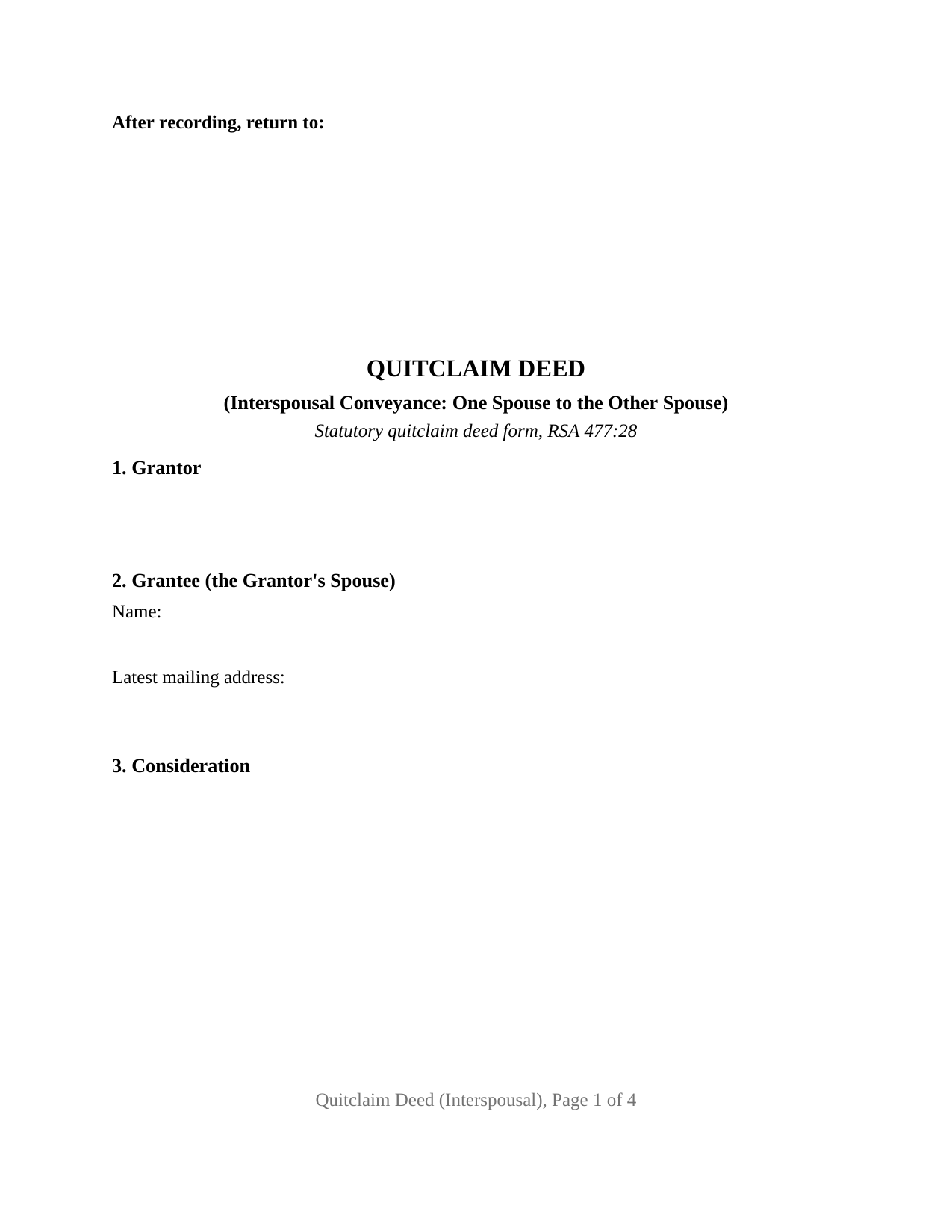
An interspousal quitclaim deed is the New Hampshire conveyance where the person who would ordinarily sign to let go of the homestead right stands on the receiving side of the deed. This fillable form prepares that instrument under RSA 477:28: one married record owner grants to that owner's spouse, a single signature completes it, and the homestead release runs from the grantor to the grantee.
The Homestead Right Changes Direction
RSA 480:5-a holds the homestead right outside any deed of a family residence unless the owner and the owner's wife or husband both execute the instrument, which on a sale produces two signatures. Here the spouse whose joinder the statute contemplates is the grantee, so the form answers the point in print: a numbered section states the marriage, and the operative section releases to the grantee all rights of homestead and other interests, including the occupancy right of RSA 480:3-a, with nothing reserved. RSA 480:1 measures the stakes at $400,000 for each person, capped at $550,000 in the aggregate as of January 1, 2026, and Brady v. Sumski, 176 N.H. 165 (2023), reads an ownership requirement into that section. New Hampshire appellate law has not reached the execution rule as applied to an owner conveying to that owner's own spouse, as the guide included here records.
One Grantor, One Certificate, and a Grantee Who Signs Nothing
The deed recites exactly one grantor: an individual holding record title, married to the sole grantee, signing personally. Under the signature sits the printed name entry that RSA 478:4-a, I(c) makes an intake item, followed by one acknowledgment certificate in the RSA 456-B:8 short form, and Section 11 states in print that the grantee takes under the deed and signs nothing. Patterns that present this configuration in the record include an owner who held title before the marriage moving the property into the other spouse's name, a spouse conveying back a fractional interest taken under an earlier deed, and a couple completing a marital property settlement in which the residence goes to one of them. A deed naming both spouses as grantees, a conveyance out of two record owners, and a trustee conveyance each carry a different signature architecture.
Three Transfer Tax Paths for One Deed Between Spouses
RSA 78-B presumes every transfer of New Hampshire real estate taxable, and a deed between spouses can land in any of three places. A transfer for value, including money paid by the grantee spouse or an assumption of mortgage debt, is taxed at $0.75 per $100 on each side, purchaser and seller both liable, which registries state as $1.50 per $100 in total. A transfer made pursuant to a final decree of divorce or nullity falls under RSA 78-B:2, XIII, and the parties remain spouses until that decree enters. A true gift is a noncontractual transfer under RSA 78-B:2, IX, which RSA 78-B:1-a, III defines as a transfer meeting the three elements of a gift, so an obligation taken on by the receiving spouse pushes the deed back toward the taxable column. Section 10 holds the statement RSA 78-B:6 looks for, since no recording completes without tax indicia or a statement that the transaction is not subject to the tax. The declaration of consideration that follows a gift goes to the Department of Revenue Administration separately, prepared apart from this package.
Covenants That Stop at the Grantor's Own Years in Title
A New Hampshire quitclaim promises something rather than nothing. The RSA 477:28 phrase with quitclaim covenants binds the grantor as to encumbrances the grantor made and as to claims traced through the grantor, and no further back. Between spouses the limit is usually the entire point, because the property keeps the history it had when the grantor took it: a recorded mortgage keeps running against the land, Section 7 collects the exceptions to the covenants, and Section 6 names the instrument by which the grantor acquired the property.
The download delivers the interspousal quitclaim deed as a fillable PDF, a completed example filled in for a Rockingham County gift in which an Exeter owner conveys the marital home to his wife, and a plain language guide covering all eleven numbered sections, the homestead release, the signing formalities, and the registry and tax steps. Buyers search this instrument as an interspousal deed or a spousal transfer deed, and often type quit claim as two words, while RSA 477:28 writes quitclaim. These materials describe New Hampshire law in general terms and are not legal advice.
Important: County-Specific Forms
Our quitclaim deed (interspousal) forms are specifically formatted for each of the 10 counties in New Hampshire.
After selecting your county, you'll receive forms that meet all local recording requirements, ensuring your documents will be accepted without delays or rejection fees.