New Hampshire Quitclaim Deed (Trustee Grantor)
County Specific Legal Forms Validated as recently as September 29, 2026 by our Forms Development Team
About the New Hampshire Quitclaim Deed (Trustee Grantor)
How to Use This Form
- Select your county from the list
- Download the county-specific form
- Fill in the required information
- Have the document notarized if required
- Record with your county recorder's office
What Others Like You Are Saying
"Great service and instructions are excellent."
"Had the forms i needed for illinois. More than i expected. Most companies would charge per form."
"Reasonably priced and Extremely easy to use."
"This information was extremely helpful and needed. The price is so worth it also."
"Worked very quickly and smoothly. Helps if you know what documents you need. Thanks."
4.8/5 from 4,829 reviews. Read all
On this New Hampshire quitclaim deed the grantor is a trustee, and title leaves a trust rather than entering one. A single trustee signs, as trustee of the named trust and not individually, and RSA 477:28 supplies the covenants that signature carries. The form prepares that conveyance for one trustee holding record title.
One Trustee, a Capacity in Print, and a Single Certificate
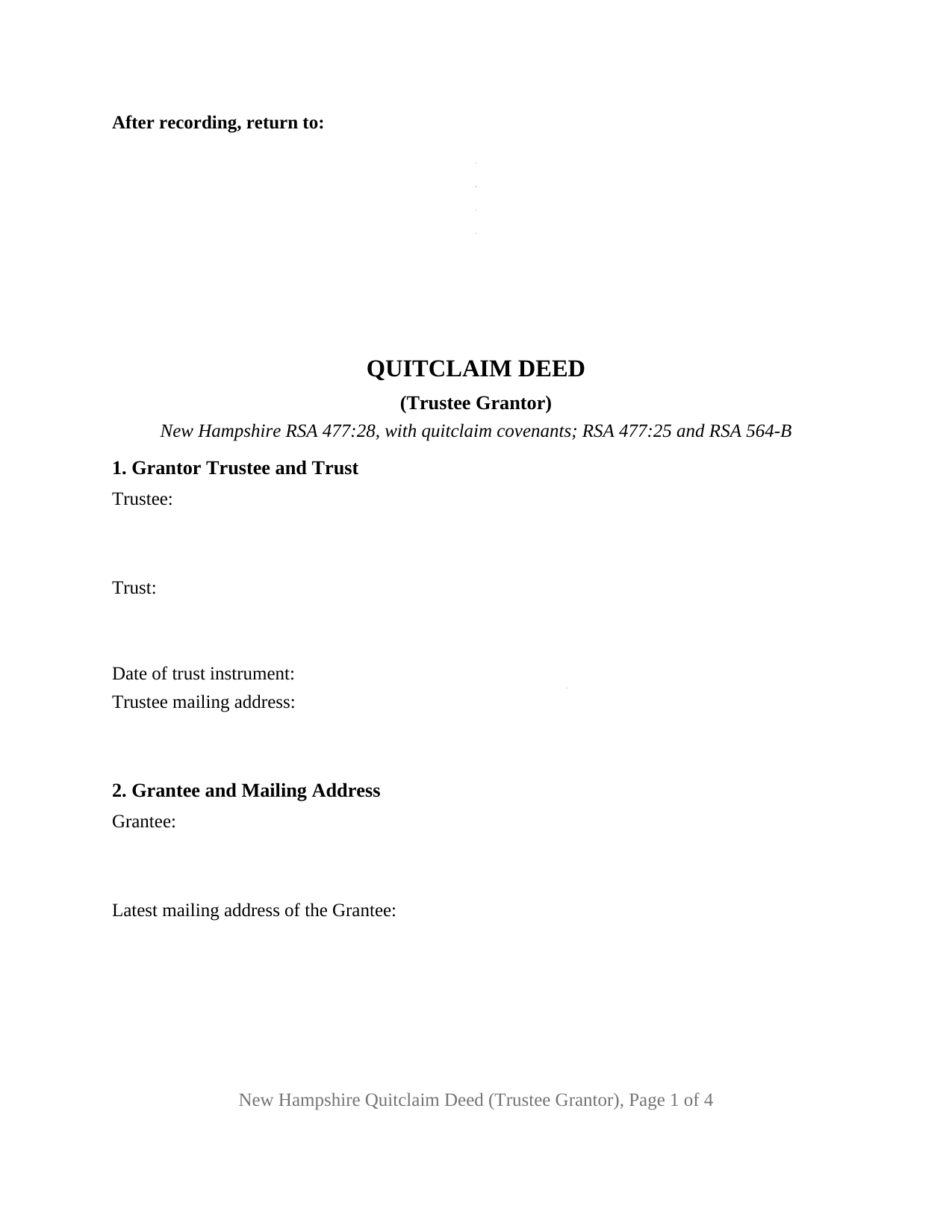
Section 1 asks for three entries a title examiner reads together: the trustee's name followed by the word Trustee, the trust name, and the date of the trust instrument, which ties this deed to the one that placed the property in the trust. One signature line carries the printed name entry RSA 478:4-a, I(c) makes an intake item, and one acknowledgment certificate follows in the representative capacity short form of RSA 456-B:8, II, whose blank takes the signer's name, the word Trustee, and the trust. The operative section states in print that the trustee makes the quitclaim covenants in that capacity rather than personally. Patterns that present this configuration in the record include a trustee selling trust real estate at a closing, a trustee distributing a house to a beneficiary, and a trustee deeding a parcel back to the trust's creator. Two cotrustees, an owner signing personally, and an executor under the RSA 477:30 fiduciary form each carry a different signature architecture.
Where the Power to Convey Comes From, and What Records It
New Hampshire answers a purchaser's first question about a trustees deed with a recorded document, not a promise. RSA 477:25 vests legal title in a grantee who takes as trustee, with full power to convey in accordance with the trust, and RSA 564-B:8-816, I(2) lets a trustee sell property at public or private sale. Section 8 collects the authority relied on: the trust article that authorizes sales, and the recording reference of a certificate under RSA 564-B:10-1013. Recorded in the same registry with deed formalities, that certificate is the device the statute says conclusively establishes the trustee's power to convey; it is prepared separately, not included in this package.
Covenants Measured by the Trust's Own Years in Title
A New Hampshire quitclaim is not a promise-free deed. The covenant phrase binds the grantor as to encumbrances the grantor made, except as the deed states, and to claims traced through the grantor, and no further back. For a trustee that boundary is usually the point: the parcel keeps whatever it carried when the trust took it, and Section 7 collects the exceptions while Section 6 names the trustee's own vesting instrument.
Three Transfer Tax Paths Out of a Trust
RSA 78-B treats every transfer as taxable unless an exception applies, and a deed out of a trust can land in three places. A sale is taxed on the price, half against each side. Department of Revenue Administration guidance measures several trust transfers at the minimum tax instead, where the beneficial interest carries no transferable shares and the trust was funded for estate planning as a testamentary substitute: transfers between the trust and its grantor, transfers to the beneficiaries at the grantor's death, transfers to a beneficiary who is a natural object of the grantor's bounty, and transfers to a successor trustee. Minimum tax is still tax, so the deed records with payment. A transfer from an irrevocable trust meeting the elements of a gift is untaxed under RSA 78-B:2, IX. Section 9 carries the statement RSA 78-B:6 looks for.
The Homestead Right That Stayed Behind
One New Hampshire rule surprises readers of a deed out of a trust. Under RSA 480:9 the person who deeds a residence to the trustees of a revocable trust keeps the homestead right unless the deed expressly releases it, so that right can sit with that person while record title sits with the trustee. RSA 480:5-a governs execution of any deed conveying or encumbering it. This form carries no signature line for a retained homestead right; the guide records the point with its statutes.
The download delivers the fillable deed, a completed example filled in for a Carroll County sale by the trustee of a family revocable trust in Wolfeboro, and a plain language guide to the eleven sections, the registry, and the tax steps. Searchers reach this transaction as a trustees deed or a deed from a trust, and the two word spelling quit claim turns up as well, though the statute prints quitclaim. Nothing here is legal advice; the package describes New Hampshire law in general terms.
Important: County-Specific Forms
Our quitclaim deed (trustee grantor) forms are specifically formatted for each of the 10 counties in New Hampshire.
After selecting your county, you'll receive forms that meet all local recording requirements, ensuring your documents will be accepted without delays or rejection fees.