New Hampshire Quitclaim Deed (Individual Grantor by Attorney-in-Fact)
County Specific Legal Forms Validated as recently as October 22, 2026 by our Forms Development Team
About the New Hampshire Quitclaim Deed (Individual Grantor by Attorney-in-Fact)
How to Use This Form
- Select your county from the list
- Download the county-specific form
- Fill in the required information
- Have the document notarized if required
- Record with your county recorder's office
What Others Like You Are Saying
"Explanation of all forms is simple and easy to understand. The forms are made in accordance to my st…"
"The website was very easy to work. The documents were just what I needed and everything that my stat…"
"I received my product in great condition and it works ok. Thankyou!!!"
"This was SO much easier than having to go down to the county recorder's office. I would definitely u…"
"I say I really do love Deed.com! Super easy to navigate and easy to get what you need for paperwork …"
4.8/5 from 4,829 reviews. Read all
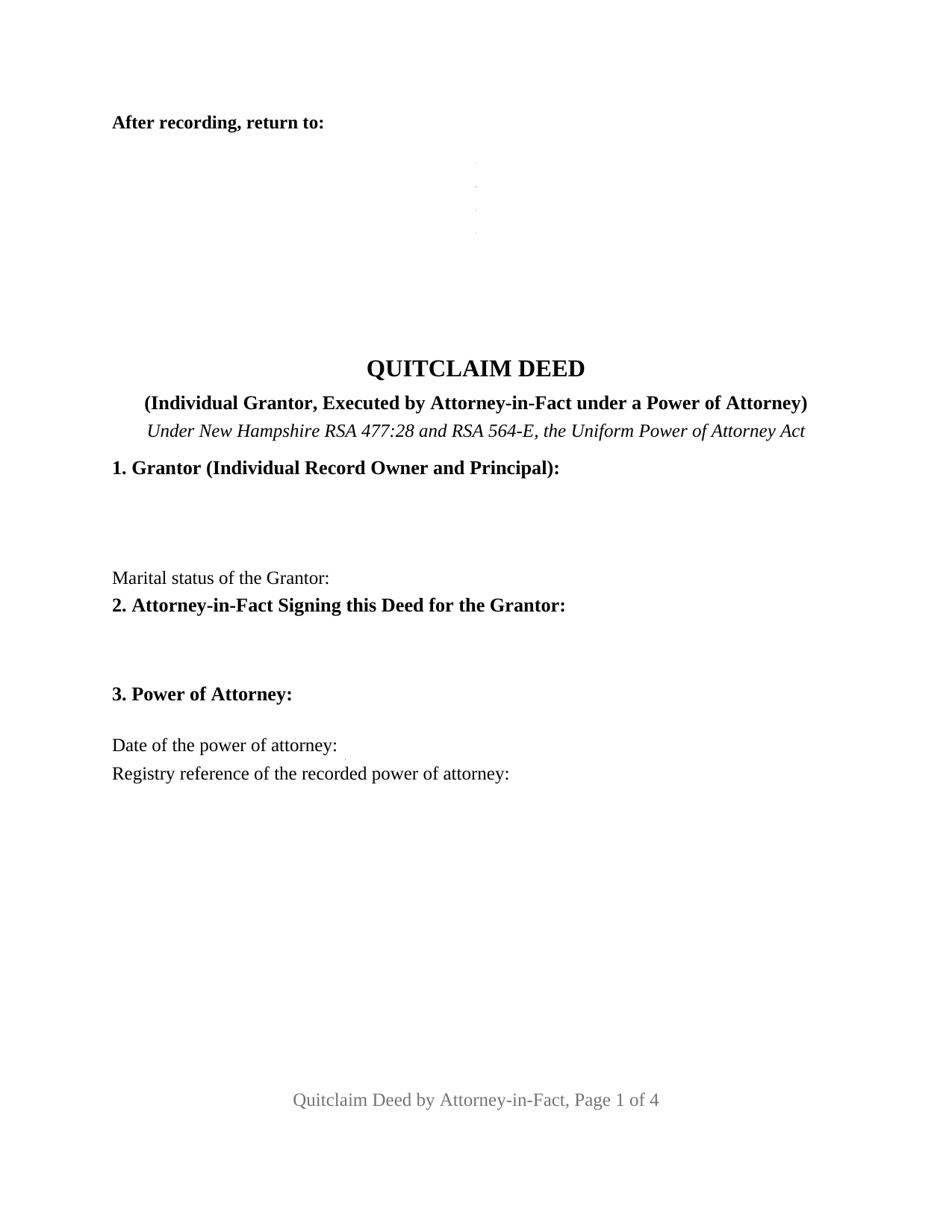
A power of attorney puts one person's signature where another person's name belongs. This fillable New Hampshire quitclaim deed prepares that conveyance under RSA 477:28 for one individual record owner whose attorney-in-fact signs it: the owner is named as Grantor, the agent is named as the person who signs, and a numbered section identifies the power of attorney behind the signature.
A Deed Signed by Someone Else's Hand
New Hampshire has allowed this since its earliest conveyancing statutes: RSA 477:1 provides that real estate may be conveyed by deed executed by any person or by that person's attorney, acknowledged and recorded as the chapter directs. What the agent may do comes from RSA 564-E, the Uniform Power of Attorney Act, and the answer is direct. RSA 564-E:204 lists quitclaim among the acts that general authority over real property carries. RSA 564-E:201(a) keeps a shorter list apart, authority to make a gift and to create or change rights of survivorship among them, which exist only on an express grant, and RSA 564-E:201(g) binds the principal as though the principal had acted.
The Signature the Agent Gives Before This One
Two signing steps precede the deed, and one is distinctly a New Hampshire rule. RSA 477:9 requires every power of attorney to convey real estate to be signed and acknowledged, and RSA 564-E:105 adds the principal's non-electronic signature, the acknowledgment, and the disclosure statement that section prints. Then RSA 564-E:113(a) withholds an agent's authority under a general power of attorney until that agent signs an acknowledgment in the statutory form and affixes it, at any time before exercising the power. Both are prepared apart from this package.
One Signature, One Representative Certificate
The form recites exactly one Grantor, an individual holding record title, with a marital status entry, and one person who signs: the attorney-in-fact named in Section 2, signing in the Grantor's name and not individually. Below the signature sits the printed name entry RSA 478:4-a, I(c) makes an intake item, then one certificate in the representative capacity short form of RSA 456-B:8, II, which RSA 456-B:1, IV reaches by defining representative capacity to include an agent or attorney in fact for a principal. Section 3 takes the date of the power of attorney and its registry reference. Patterns that present this configuration in the record include an owner living in another state while a New Hampshire parcel is sold, an owner whose durable power of attorney is in use after a loss of capacity, and an owner who appointed an agent to close a transaction the owner does not attend. Two record owners, an entity, a trustee, and a court appointed fiduciary under RSA 477:30 each recite a different capacity.
The Document the Deed Refers To
RSA 477:9 is permissive on the question searchers ask most: a power of attorney to convey real estate may be recorded as required for a deed, and a copy of the record may be used in evidence. Recording it is not a condition of the agent's authority. What draws it into the registry anyway is RSA 477:3-a, reaching every instrument affecting title, and the reading a later examiner gives a deed whose authority document is absent from the chain. RSA 564-E:302 prints the companion certification, made under penalty of perjury that the principal is alive and the authority unrevoked, prepared separately and not included here.
Covenants, Homestead, and the Statement That Lets It Record
The covenants are the owner's, not the agent's. The RSA 477:28 phrase with quitclaim covenants reaches encumbrances the Grantor made, apart from those the deed excepts, and claims traced through the Grantor, and no further back; the operative section adds that the attorney-in-fact makes no covenant of title individually. That section also releases the Grantor's homestead and other interests, while RSA 480:5-a leaves a non-owner spouse's position to that spouse's own signature. Section 10 carries what RSA 78-B:6 wants before a register completes any recording, and an agent's conveyance is taxed as the owner's own would be.
The download delivers the fillable deed, a completed example filled in for a Grafton County sale where a Plymouth agent signs for an owner living in Florida, and a plain language guide to the eleven sections, the power of attorney entries, and the recording steps. Searchers reach it as a POA deed, and the two word spelling quit claim is common, though RSA 477:28 writes quitclaim as one word. This package describes New Hampshire law generally and does not give legal advice.
Important: County-Specific Forms
Our quitclaim deed (individual grantor by attorney-in-fact) forms are specifically formatted for each of the 10 counties in New Hampshire.
After selecting your county, you'll receive forms that meet all local recording requirements, ensuring your documents will be accepted without delays or rejection fees.