New Hampshire Quitclaim Deed (Trustee Grantee)
County Specific Legal Forms Validated as recently as October 19, 2026 by our Forms Development Team
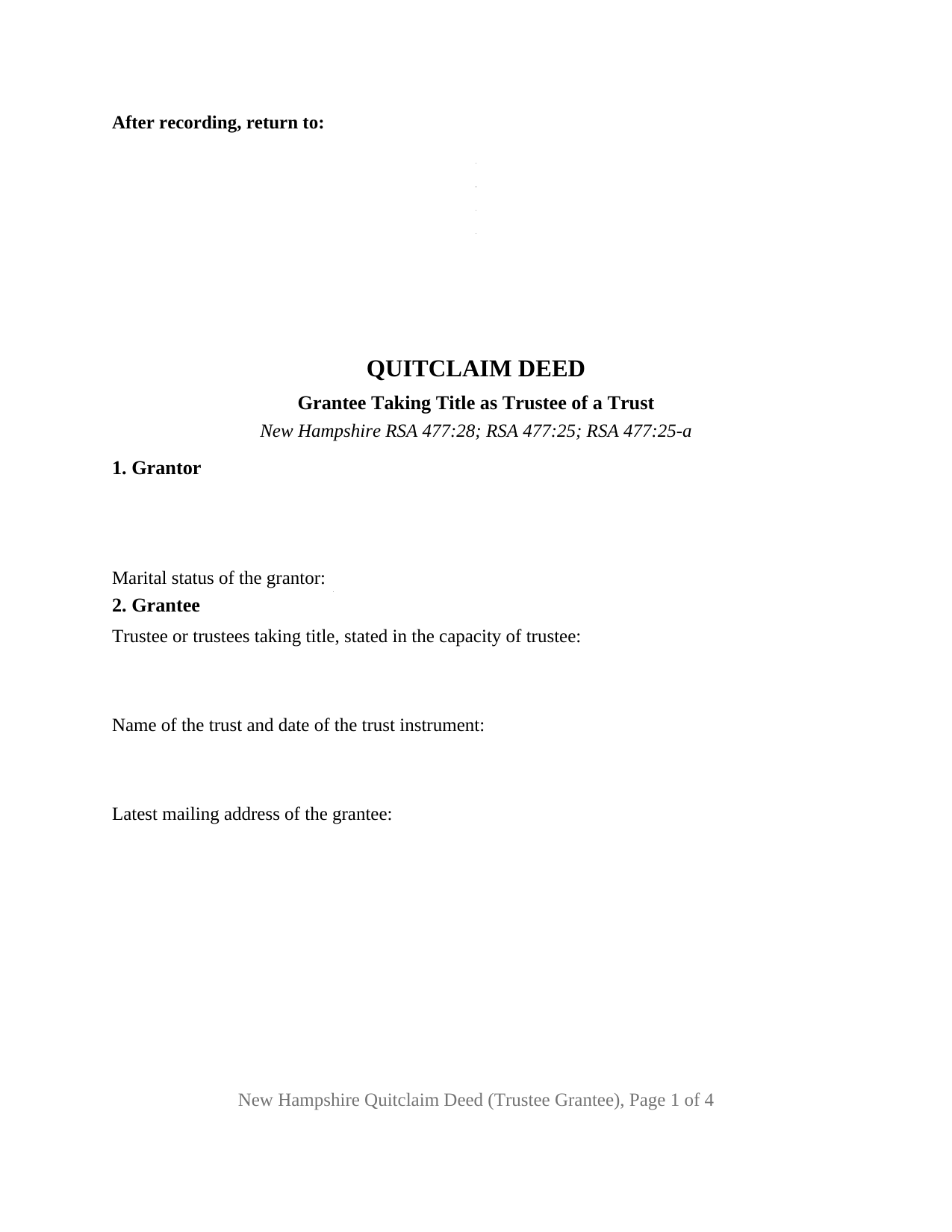
About the New Hampshire Quitclaim Deed (Trustee Grantee)
How to Use This Form
- Select your county from the list
- Download the county-specific form
- Fill in the required information
- Have the document notarized if required
- Record with your county recorder's office
What Others Like You Are Saying
"Record retrieval by staff is very prompt!!! Great customer service for sure!"
"The requested forms were easy to access. Thank you."
"The site was easy to navigate."
"Easy access to forms saving lots of time researching reqmts from a State/Municipal Govt website. I s…"
"Quick and easy. Would recommend this site to everyone. Deed was sent to the site and recorded at my …"
4.8/5 from 4,832 reviews. Read all
Most deed variants take their shape from the person who signs. This one takes its shape from the party who receives. On this New Hampshire quitclaim deed the grantee is a trustee, named in that capacity and holding for a trust, while one individual grantor signs and the trustee signs nothing. The form prepares that conveyance under RSA 477:28.
What a Trustee Grantee Actually Receives
RSA 477:25 answers the question this configuration raises. A conveyance made to a grantee in trust, or as trustee under a declaration of trust, vests in that grantee, as trustee, legal title with full power to convey the real estate in accordance with the trust. The deed therefore names the people who will hold the title, states that they take as trustees and not individually, and identifies the trust by name and by the date of the trust instrument. New Hampshire keeps a backstop for deeds drafted the other way: RSA 477:25-a treats a conveyance naming a trust as grantee, with no trustee named in that capacity, as made to all trustees who have accepted the office. This form does not rely on it.
The Homestead Right Does Not Ride Along Automatically
A deed into a trust raises a question an arm's length sale never does: what becomes of the signer's homestead right. Under RSA 480:9, a conveyance by deed to the trustees of a revocable trust does not cost the person executing the deed the homestead right, unless the deed expressly releases it. A recording condition rides with that rule: the retained right cannot be enforced against a person who takes an interest or a lien after the property goes into the trust without notice of the trust's revocability. The statute names two ways to give that notice, the word revocable inside the trust name as the deed states it, or a statement in the deed that the trust was revocable when the conveyance was made. Section 8 carries both.
One Signature, One Certificate, a Grantee Who Takes Without Signing
The form recites one grantor, an individual conveying personally, with a marital status entry, one signature line carrying the printed name RSA 478:4-a, I(c) makes an intake item, and one acknowledgment certificate in the RSA 456-B:8 short form. The grantee section carries three entries an examiner reads together: the trustee or cotrustees stated in that capacity, the trust name with the date of the trust instrument, and the grantee's latest mailing address. Ownership patterns that present this configuration in the record include a sole owner moving a parcel into an existing family trust, a trust buying real estate at a closing so the deed runs to the trustees, and a co-owner conveying a fractional interest to trustees who already hold the rest of the title. The form is not set up for two grantors, an entity grantor, or a trustee conveying trust property back out.
The Tax Path a Deed Into a Trust Takes
RSA 78-B:1 presumes every transfer of New Hampshire real estate taxable unless RSA 78-B:2 exempts it, and RSA 78-B:6 blocks recording without tax indicia or a statement that the transaction is not taxed. Department of Revenue Administration guidance treats a transfer to a revocable trust as taxable unless an exception applies, with the tax measured at the minimum where the beneficial interest carries no transferable shares, the trust was funded for estate planning as a testamentary substitute, and the transfer runs between the trust and its grantor. A transfer to an irrevocable trust goes untaxed under that guidance where the elements of a gift are met, the noncontractual category of RSA 78-B:2, IX. Section 9 holds the resulting statement.
Covenants That Begin Where the Grantor's Ownership Began
New Hampshire's quitclaim is not a promise-free deed. The RSA 477:28 phrase with quitclaim covenants binds the grantor as to encumbrances the grantor made and claims traced through the grantor, and no further back, so a trust taking family property inherits the older history of the title as it stood. Section 7 collects the exceptions.
The download delivers the fillable deed, a completed example for a Hillsborough County transfer moving an Amherst home into the owner's revocable trust, and a plain language guide to the eleven sections, the signing formalities, and the recording and tax steps. People search this transaction as a deed into a trust; the spelling quit claim turns up as well, though RSA 477:28 prints quitclaim. These materials describe New Hampshire law in general terms and are not legal advice.
Important: County-Specific Forms
Our quitclaim deed (trustee grantee) forms are specifically formatted for each of the 10 counties in New Hampshire.
After selecting your county, you'll receive forms that meet all local recording requirements, ensuring your documents will be accepted without delays or rejection fees.