New Hampshire Quitclaim Deed (Married Couple as Grantors)
County Specific Legal Forms Validated as recently as September 28, 2026 by our Forms Development Team
About the New Hampshire Quitclaim Deed (Married Couple as Grantors)
How to Use This Form
- Select your county from the list
- Download the county-specific form
- Fill in the required information
- Have the document notarized if required
- Record with your county recorder's office
What Others Like You Are Saying
"First time using DEEDS.COM and very helpful with documents to fill out. I highly recommend this comp…"
"I like what I see so far!"
"Excellent service. Easy to use"
"Awesome forms, filled them out on my computer, printed them out complete, notarized, recorded, wonde…"
"This site couldn't be any easier to use. Very pleased."
4.8/5 from 4,829 reviews. Read all
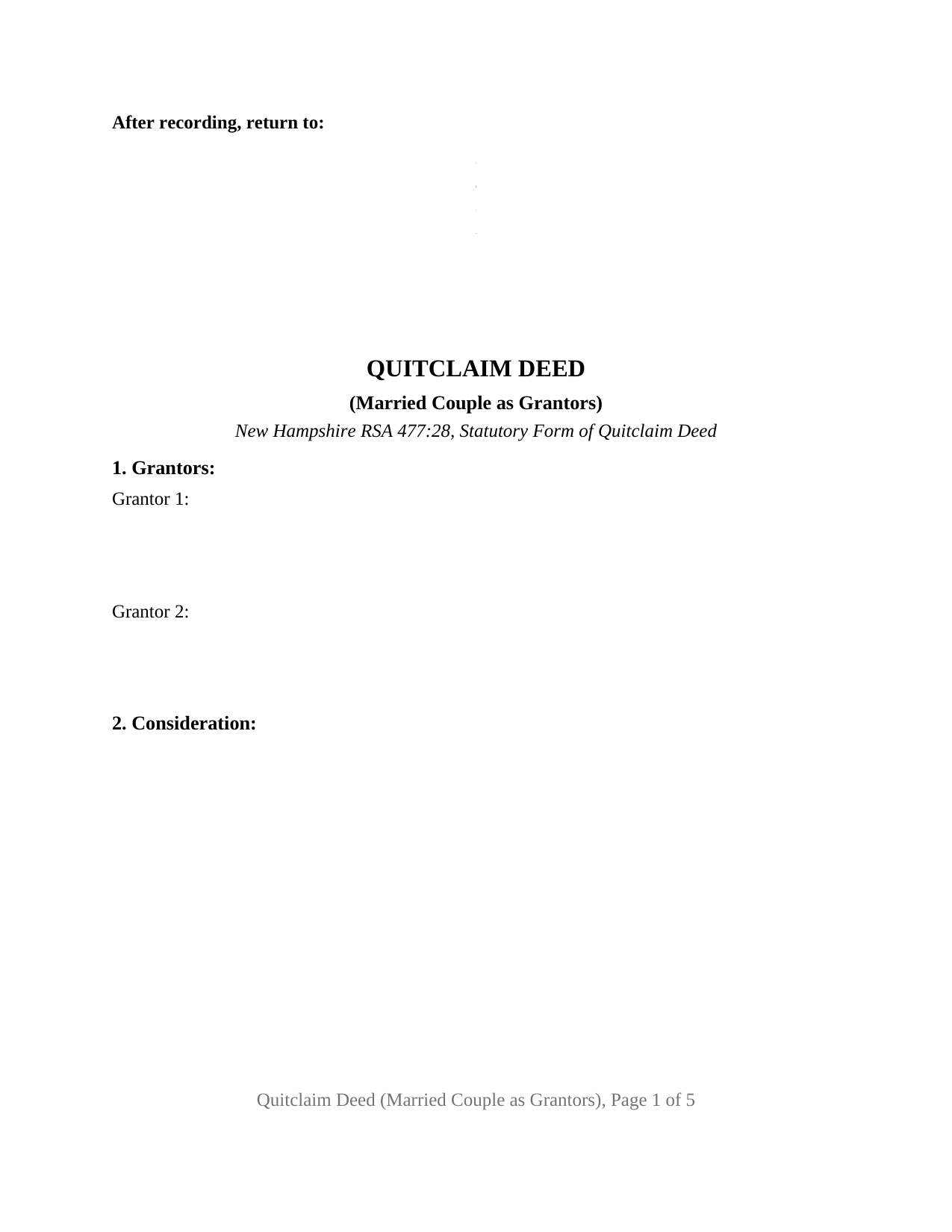
When spouses convey New Hampshire real estate together, the deed can state the marriage on its face. This fillable form prepares a quitclaim deed under RSA 477:28 for exactly that configuration: two grantors who are married to each other, both signing, with a printed statement of the marriage and a printed release of homestead and other interests by each spouse built into the operative text.
A Marriage Written Into the Operative Section
Where a generic co-owner deed asks each grantor's marital status as a blank, this deed answers it in print. The operative section states that the grantors are married to each other and that each grantor, as the spouse of the other, releases to the grantee all rights of homestead and other interests in the property, the release the RSA 477:28 statutory form prints after the property description. That printed architecture is what RSA 480:5-a looks for: a conveyance of the homestead right takes execution by the owner and the owner's spouse, and a deed carrying both spouses as grantors, both releases, and both signatures leaves nothing about the household's homestead position to inference. With New Hampshire's exemption running to $400,000 per person and a $550,000 aggregate cap across multiple claimants after the 2026 amendments, the release language is the part of a family conveyance a title examiner reads first.
What the Record Shows for This Configuration
The form recites two grantors, married to each other, each signing personally; two signature lines with a printed name under each, and an acknowledgment certificate for each grantor in the RSA 456-B:8 short form, so the spouses may acknowledge together or separately. Patterns that present this configuration in the record include spouses deeding the family home into their revocable trust, where RSA 480:9 preserves the homestead right unless the deed expressly releases it to the trust; a couple giving a lake camp or house lot to an adult child; and spouses conveying a parcel that stands in one spouse's name of record while the other joins and releases. A sole owner, two co-owners not married to each other, an entity, and a trustee each convey through a different signature architecture than this deed recites.
Covenants That Run Only Through the Couple's Years in Title
New Hampshire's quitclaim is not covenant-free. The words with quitclaim covenants carry defined statutory promises, and on this deed they run from both spouses at once: whatever encumbrances the grantors themselves created and did not except are covered, and claims traced through the grantors are defended, while everything older than the couple's ownership stays outside the promises. A family taking title from parents or from a couple's trust reads that scope directly off the deed's covenant phrase.
The Gift Case and the Statement That Lets It Record
Family conveyances by married couples are often gifts, and New Hampshire treats them distinctly. RSA 78-B:6 stops a deed from recording unless transfer tax evidence accompanies it or the deed itself states that the transaction is not subject to the tax, and this form carries a numbered transfer tax statement section for exactly that entry. A noncontractual transfer, the gift category, is exempt under RSA 78-B:2, IX, and the statement on the deed cites it; a taxable transfer instead pays at the combined rate of $1.50 per $100 of consideration through the registry. One wrinkle travels with the gift case: the RSA 78-B:10 declaration of consideration still goes to the Department of Revenue Administration for a noncontractual transfer even though no tax is due, a filing prepared separately and not included in this package. The description section opens by naming the town or city, and the grantee entry carries the latest mailing address, the two items New Hampshire registers verify before accepting any deed.
The download delivers the fillable quitclaim deed, a completed example showing a Grafton County couple deeding a subdivision lot to their son with the exemption statement filled in, and a plain language guide to all eleven sections, the homestead release, and the registry and tax steps. Quit claim deed is a frequent search spelling; the New Hampshire statute writes quitclaim. These materials describe state law generally and are not legal advice.
Important: County-Specific Forms
Our quitclaim deed (married couple as grantors) forms are specifically formatted for each of the 10 counties in New Hampshire.
After selecting your county, you'll receive forms that meet all local recording requirements, ensuring your documents will be accepted without delays or rejection fees.