New Hampshire Transfer on Death Deed (Sole Owner, Multiple Beneficiaries (Equal Shares))
County Specific Legal Forms Validated as recently as November 16, 2026 by our Forms Development Team
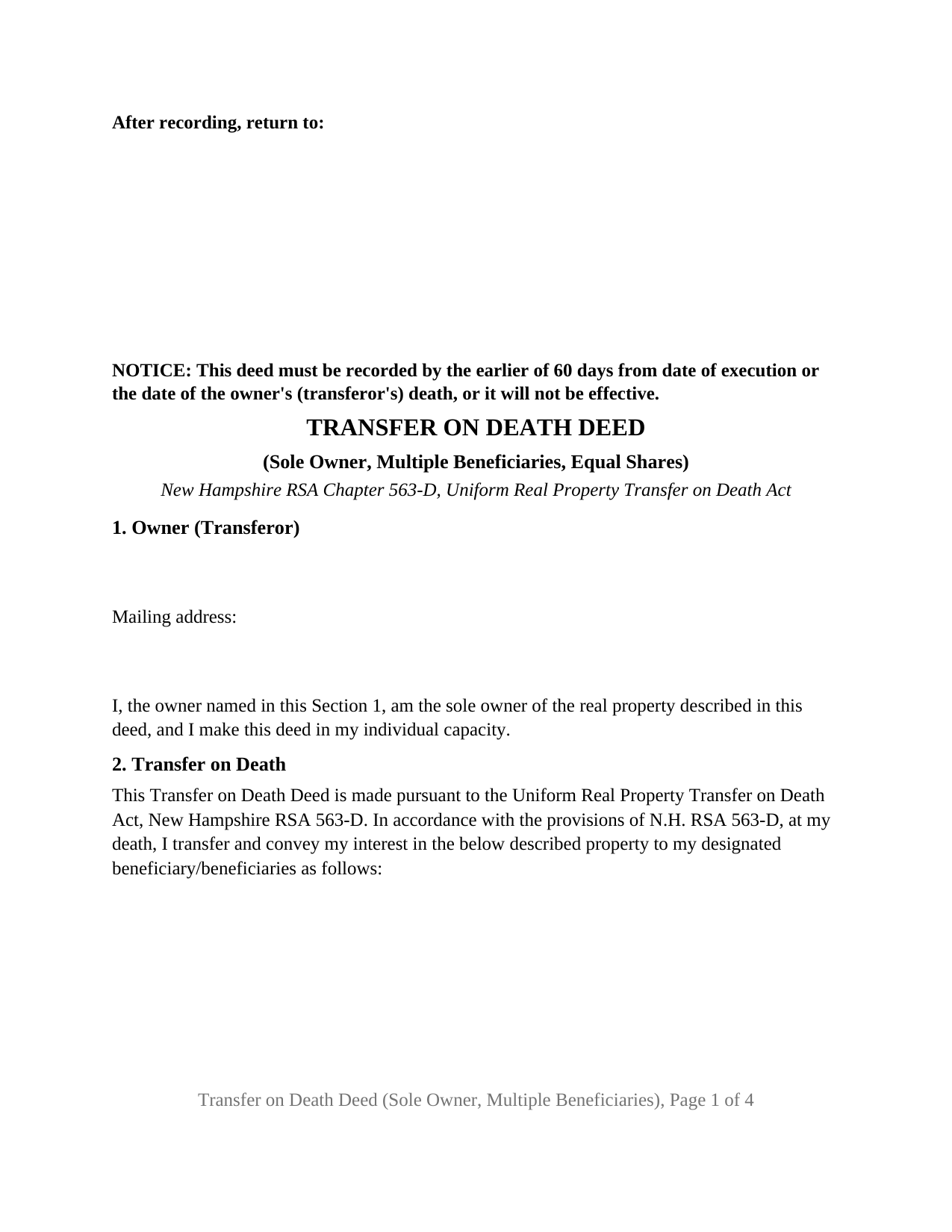
About the New Hampshire Transfer on Death Deed (Sole Owner, Multiple Beneficiaries (Equal Shares))
How to Use This Form
- Select your county from the list
- Download the county-specific form
- Fill in the required information
- Have the document notarized if required
- Record with your county recorder's office
What Others Like You Are Saying
"Very quick and gave me exactly what I needed! I would have had to go down to the courts and take off…"
"Quick and friendly answers. So Easy!"
"My experience could not have been better. Easy to communicate with, even though I'm largely ignorant…"
"Amazing forms and great value. That may sound like hyperbole talking about legal forms but it's not,…"
"recorded deed space to small for corrective deed requirement"
4.8/5 from 4,858 reviews. Read all
A New Hampshire owner who holds real estate alone and wants it divided among several people at death, in equal shares and without probate, can do that with one recorded instrument. This form prepares a transfer on death deed under RSA Chapter 563-D for exactly that configuration: one owner, signing alone as the sole owner of the property, naming two or more beneficiaries who take equal and undivided shares at the owner's death. The equal shares are fixed as deed text; the beneficiaries, their mailing addresses, and the property are the blanks.
Equal shares, and nothing passing between the beneficiaries
The share words on the form are the words of RSA 563-D:13, I(c): concurrent interests pass to the beneficiaries in equal and undivided shares with no rights of survivorship. Three children named on this deed each take an undivided one third at the owner's death and hold it as tenants in common. When one of them later dies, that third passes under that child's own estate plan, not to the other two. A deed meant to give the whole property to whichever beneficiaries outlive the others would have to create a joint tenancy among them specifically, which this form does not do.
When one beneficiary dies before the owner
Every beneficiary's interest is contingent on surviving the owner under RSA 563-D:13, I(b), and a beneficiary who does not survive takes nothing; the anti lapse rule for wills, RSA 551:12, does not apply to a transfer on death deed. For a deed with several beneficiaries, RSA 563-D:13, I(d) supplies the next step: the lapsed share goes to the other beneficiaries in proportion to their interests, unless the deed provides otherwise. On this form, where every share is equal, the surviving beneficiaries divide the property equally among themselves. The form adds an optional secondary beneficiary section, the designation the RSA 563-D:19 optional form prints, which operates only if no primary beneficiary survives the owner; while any primary beneficiary is alive to take, a secondary beneficiary takes nothing.
One owner, one signature, one certificate
The form recites one owner who holds the entire interest in the property in that owner's own name and makes the deed in an individual capacity, and it carries one signature block and one acknowledgment certificate in the RSA 456-B:8 short form, taken before a notary public or justice of the peace as RSA 477:3 allows. A parent whose house stands in the parent's name alone, a widow or widower who holds the whole title after the other spouse's death, and a long time owner who bought alone present the pattern this deed recites. The form is not set up as a deed by two owners, by co-owners who hold with a right of survivorship, by a trustee, by an entity, or by an agent or guardian, and it is not set up for unequal shares or for a joint tenancy among the beneficiaries. A married sole owner signs alone: RSA 563-D:12 provides that the deed affects no interest of the owner or anyone else during the owner's life, RSA 563-D carries no spousal signature requirement, and the surviving spouse's homestead occupancy right under RSA 480:3-a exists independently of the deed.
Beneficiaries by name and mailing address
RSA 478:4-a, I(a) makes the latest mailing address of every grantee a condition of the register's acceptance, so each beneficiary appears in the list with a full name and a complete mailing address, with an optional relationship label such as my daughter. Because RSA 563-D:2 defines person to include a trust, a corporation, a limited liability company, and a government as well as an individual, the list may mix a child, a charity, and a trust named through its trustee, each taking an equal share; the guide shows how each is written.
Sixty days to record, and before death
RSA 563-D:9 makes the deed void unless it is recorded in the registry of deeds for the county where the property lies both before the owner's death and within 60 days after the date of execution, and the form carries at its top the recording notice the statute's optional form prints. The deed also carries the transfer tax sentence the optional form supplies, citing the RSA 78-B:2, XXV exemption for a transfer on death deed made for no consideration; RSA 78-B:6 lets the register record an instrument without tax indicia only when it states that the transaction is not subject to the tax. The first sentence of the property section names the town or city and the county, which RSA 478:4-a places in the first description paragraph. The deed remains revocable for the owner's life under RSA 563-D:6, by a later instrument executed with the formalities of a deed and recorded as RSA 563-D:11 requires; that revocation instrument is prepared and recorded separately and is not included in this package. After the owner's death, the beneficiaries record the notice of death affidavit RSA 563-D:22 describes within 60 days, an affidavit that is likewise prepared and recorded separately and not included in this package, and one whose filing RSA 563-D:22 says is not a condition of the transfer of title.
A beneficiary deed for several beneficiaries, by any name
Buyers search for this instrument as a beneficiary deed, a TOD deed, or a transfer on death deed with multiple beneficiaries; the New Hampshire statute calls it a transfer on death deed, and RSA 563-D:9 requires that title on the instrument, which the form carries. The package includes the fillable transfer on death deed, a completed example filled in for a Rockingham County owner naming three children in equal shares with a secondary beneficiary, and the guide, which covers each section, the signing and notarization rules, the homestead and marital questions, and the recording steps. Neither this description nor the guide is legal advice; each describes the form and the New Hampshire statutes that govern it in general terms.
Important: County-Specific Forms
Our transfer on death deed (sole owner, multiple beneficiaries (equal shares)) forms are specifically formatted for each of the 10 counties in New Hampshire.
After selecting your county, you'll receive forms that meet all local recording requirements, ensuring your documents will be accepted without delays or rejection fees.