New Hampshire Transfer on Death Deed (Sole Owner, Trust Beneficiary)
County Specific Legal Forms Validated as recently as November 16, 2026 by our Forms Development Team
About the New Hampshire Transfer on Death Deed (Sole Owner, Trust Beneficiary)
How to Use This Form
- Select your county from the list
- Download the county-specific form
- Fill in the required information
- Have the document notarized if required
- Record with your county recorder's office
What Others Like You Are Saying
"Quick easy and reliable. Thank you"
"Very helpful"
"Great service, quick and affordable. Thank you!"
"Great job! Fast and easy. Terrific communications."
"Amazing from start to finish!"
4.8/5 from 4,858 reviews. Read all
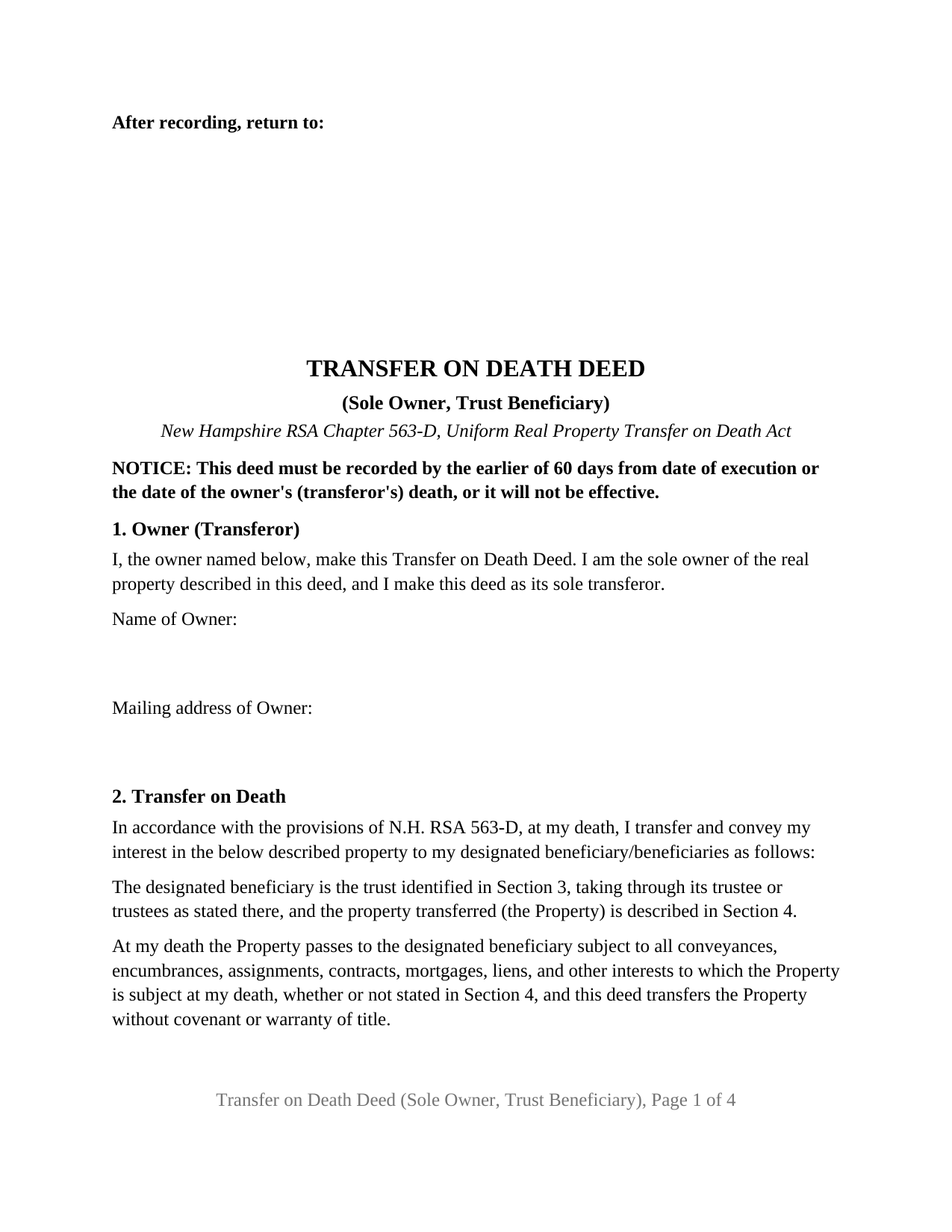
A New Hampshire transfer on death deed can name a trust, rather than a person, to receive the owner's real estate at death. This form prepares that deed for one owner who holds the property alone and who designates the trustee of a trust, commonly the owner's own revocable living trust, as the beneficiary under RSA Chapter 563-D. The property stays in the owner's name for life and passes at death to the trustee, to be held and distributed under the terms of the trust, without probate and without a lifetime deed into the trust.
Why the deed names the trustee, not the trust alone
RSA 563-D:2 defines a beneficiary as a person and defines person to include a trust, so the chapter permits the designation. New Hampshire conveyancing law then says how title to real estate reaches a trust. RSA 477:25 vests legal title in a grantee who takes in trust or as trustee, with full power to convey in accordance with the trust, and RSA 477:25-a treats a conveyance that names a trust without naming a trustee as made to all of the trustees who have accepted the office, while stating that a trust created under New Hampshire law is not an entity capable of holding title in its own name. The deed's beneficiary section is built on those two sections. A fixed sentence designates the trustee or trustees of the trust, in their capacity as trustees and not individually, to hold the property under the terms of that trust, and four entries identify the trust by its name, by the date of its instrument, by the trustee or trustees now serving, and by the trustee's mailing address, the address RSA 478:4-a requires for every grantee named in a recorded deed.
A funding step that waits for death
An owner who creates a revocable living trust faces a choice about real estate: deed it into the trust during life, or leave it in the owner's own name. A lifetime deed into the trust changes the record title now and raises the homestead-release question RSA 480:9 addresses. This deed takes the other path. RSA 563-D:12 provides that during the owner's life the deed does not affect the owner's rights or the rights of creditors and creates no interest in the beneficiary, so the owner keeps title, keeps every right to sell, mortgage, or lease, and keeps the right to revoke the deed under RSA 563-D:11 by a later recorded instrument. At death, RSA 563-D:13 passes the interest the owner then holds to the trustee, subject to the mortgages, liens, and other matters then affecting the property and without covenant or warranty of title, and the trust instrument governs from there.
Sole owner, one signature, one certificate
The deed recites exactly one owner, the sole owner of the described property, signing as its sole transferor. It fixes nothing about marital status: the name entry carries the owner's name as the vesting deed shows it, followed by the status recital New Hampshire practice commonly adds. One signature block, OWNER, and one acknowledgment certificate in the RSA 456-B:8 short form follow, with the officer line labeled for the justice, notary public, or commissioner RSA 477:3 names. An owner who settled a revocable trust, serves as its trustee, and named a successor trustee to take office at death presents the pattern the deed recites; so does an owner designating a trust that another person settled. The form is not set up for two owners, for joint owners holding with a right of survivorship, for an owner acting through an agent, a trustee, or a guardian, or for an individual, a charity, or a company as beneficiary, and it names no secondary beneficiary; each of those configurations follows a different pattern.
Recorded within 60 days, and before death
RSA 563-D:9 makes recording a condition of validity, measured two ways: the deed is void unless it reaches the registry of deeds for the county where the land lies before the owner dies and within 60 days after the date it is signed. The deed carries the bold notice the RSA 563-D:19 optional form prints for that condition, the title Transfer on Death Deed that RSA 563-D:9 requires, and the form's own operative sentence word for word. It also states that the deed is exempt from the real estate transfer tax under RSA 78-B:2, XXV as a revocable transfer on death deed for no consideration, the statement RSA 78-B:6 accepts in place of tax stamps, and it names the town or city in the first sentence of the property description, the placement RSA 478:4-a requires. The guide covers the statewide Uniform Standards for the page, the RSA 478:17-g recording fees and LCHIP surcharge, and the notice of death affidavit under RSA 563-D:22 that the trustee records within 60 days after the owner's death, an affidavit that is prepared and recorded separately and is not included in this package.
A beneficiary deed to a living trust, by any name
Buyers search for this instrument as a TOD deed, a beneficiary deed, or a transfer on death deed to a living trust; the New Hampshire statute calls it a transfer on death deed, and that title appears on the instrument. The package includes the fillable transfer on death deed, a completed example filled in for a Rockingham County owner designating the trustee of her revocable trust, and the guide that walks through each section, the trust-naming convention, the acknowledgment formalities, the spousal and homestead statutes, and the recording sequence. This description and the guide describe the form and the governing statutes of New Hampshire in general terms; they are not legal advice.
Important: County-Specific Forms
Our transfer on death deed (sole owner, trust beneficiary) forms are specifically formatted for each of the 10 counties in New Hampshire.
After selecting your county, you'll receive forms that meet all local recording requirements, ensuring your documents will be accepted without delays or rejection fees.