New Hampshire Transfer on Death Deed (Two Joint Owners with Right of Survivorship, Last Survivor)
County Specific Legal Forms Validated as recently as November 16, 2026 by our Forms Development Team
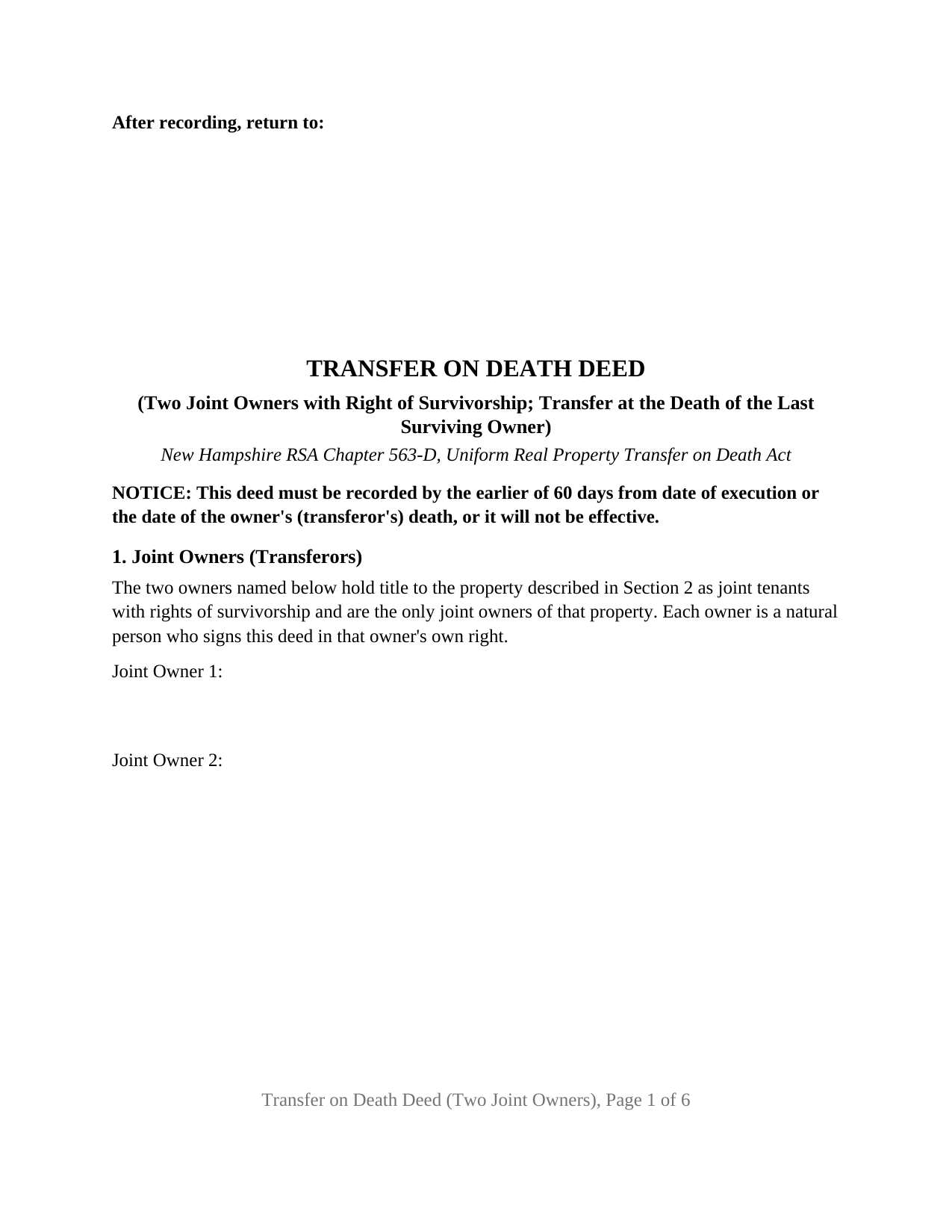
About the New Hampshire Transfer on Death Deed (Two Joint Owners with Right of Survivorship, Last Survivor)
How to Use This Form
- Select your county from the list
- Download the county-specific form
- Fill in the required information
- Have the document notarized if required
- Record with your county recorder's office
What Others Like You Are Saying
"I was looking for the proper quit claim deed for my state. I found it on deeds.com along with instru…"
"Phenomenal service! If only every request and transaction with other companies could be this seamles…"
"Very easy user friendly thank you for that"
"Hard to find, obscure, forms were available. I did not think I was going to be able to find them, le…"
"I bought a Quitclaim Deed package for Fayette County, Kentucky, to transfer my house into a Living T…"
4.8/5 from 4,858 reviews. Read all
Two New Hampshire co-owners who hold their property as joint tenants with rights of survivorship can sign one transfer on death deed that does nothing at the first death and everything at the second. Built under RSA Chapter 563-D for exactly two joint owners, this deed fixes the transfer to the named beneficiaries at the death of the last surviving owner.
A deed that waits for the second death
RSA 563-D:13, III writes the timing into the statute. If a transferor is a joint owner and is survived by another joint owner, the property that is the subject of the deed belongs to the surviving joint owner with right of survivorship; if the transferor is the last surviving joint owner, the transfer on death deed is effective. The survivorship already in the title does its ordinary work at the first death, and the recorded deed sits in the registry until the surviving owner dies. The deed's operative section says so in its own words: the owners hold as joint tenants with rights of survivorship, the transfer to the designated beneficiary is to occur at the transferor's death, the transferor being the last surviving owner, and while an owner is survived by the other joint owner the property belongs to the survivor and the deed transfers nothing at that death.
Why the recital names the joint tenancy
RSA 563-D:2, III defines a joint owner as an individual who owns property concurrently with one or more other individuals with a right of survivorship; the definition includes a joint tenant and excludes a tenant in common. Under RSA 477:18 a New Hampshire deed to two people creates a tenancy in common unless it expresses a joint tenancy, and the words as joint tenants with rights of survivorship, or as tenants by the entirety, after the grantee names are the statute's own clear expression of that intention. Section 1 of this form therefore opens with a fixed recital: the two owners hold the described property as joint tenants with rights of survivorship, they are the only joint owners of it, and each signs in that owner's own right. The guide walks through reading the vesting deed against RSA 477:18, and the completed example quotes the survivorship words from the source of title entry.
Revoking takes every living joint owner
A recorded transfer on death deed can only be undone by a later recorded instrument, and for a deed made by joint owners RSA 563-D:11, I(b) adds a joinder rule: a deed of joint owners is revoked only if it is revoked by all of the living joint owners, and revocation by one transferor does not affect the deed as to the interest of the other. While both owners live, neither can quietly remove a beneficiary; after the first death, the last surviving owner alone holds the power to revoke, to sell, or to mortgage, because the survivor is then the sole owner. The guide describes the revocation instrument RSA 563-D:11 recognizes, which is prepared and recorded separately and is not included in this package.
Two signatures, two certificates, one recording trip
Both owners sign, each on a numbered signature block with the printed name RSA 478:4-a requires under every party signature, and the form carries a separate acknowledgment certificate for each owner in the RSA 456-B:8 short form, with an officer line that reads Notary Public or Justice of the Peace because RSA 477:3 takes a grantor's acknowledgment before a justice, notary public, or commissioner. The two certificates are a layout choice that lets the owners acknowledge on different days or before different officers; in the completed example one owner appears before a notary public in Rockingham County and the other before a justice of the peace in Hillsborough County two days later. What the two signatures share is the recording deadline: RSA 563-D:9 voids the deed unless it reaches the registry within 60 days after execution and before the transferor's death, and since each owner is a transferor, the deed goes to the registry promptly after the second signature while both owners are living.
What this configuration is and is not set up as
The form recites exactly two record owners, two signature blocks, and two acknowledgment certificates, and it fixes the transfer at the death of the last surviving owner. A married couple whose deed runs to them as joint tenants with rights of survivorship, or as tenants by the entirety, which RSA 477:18 treats as a joint tenancy, presents the pattern this deed recites, and so do two siblings who bought a lake house together with survivorship words in their deed, or a parent and an adult child added to the title as joint tenants. The form is not set up as a deed by one owner, by co-owners who hold as tenants in common, by three or more joint owners, by a trustee, by an entity, or by an agent under a power of attorney, and the recital in Section 1 does not describe a pair whose joint tenancy was severed by a later deed or a divorce decree provision. New Hampshire has no separate tenancy by the entirety estate, has abolished dower and curtesy under RSA 560:3, and is not a community property state, so the joint tenancy itself is the only marital estate the deed needs to name.
Beneficiaries, shares, and the transfer tax line
The primary beneficiary section names one or more beneficiaries by name and mailing address, and an optional secondary section names who takes if no primary beneficiary survives the last surviving owner. Where two or more beneficiaries are named and the deed says nothing more, RSA 563-D:13, I(c) gives them equal and undivided shares with no survivorship between them, and the guide describes the lapse and share rules the chapter supplies. The deed carries the RSA 563-D:19 statement that it is exempt from real estate transfer tax as a revocable transfer on death deed for no consideration under RSA 78-B:2, XXV, which is the statement RSA 78-B:6 requires on a deed recorded without tax stamps, and the property section opens with the town or city and the county because the register cannot accept a deed without the municipality in the first sentence of its description.
A TOD deed for joint tenants, by any name
Buyers search for this instrument as a joint beneficiary deed, a survivorship TOD deed, or a transfer on death deed for a married couple; New Hampshire's statute calls it a transfer on death deed and requires that title on the face of the instrument. The package includes the fillable transfer on death deed for two joint owners, a completed example filled in for a Rockingham County fact pattern with two married owners naming their two children, and the guide, which covers each section of the deed, the acknowledgment and homestead rules, and the registry's fees and format standards. This description and the guide explain the form and the New Hampshire statutes behind it in general terms, and neither is legal advice.
Important: County-Specific Forms
Our transfer on death deed (two joint owners with right of survivorship, last survivor) forms are specifically formatted for each of the 10 counties in New Hampshire.
After selecting your county, you'll receive forms that meet all local recording requirements, ensuring your documents will be accepted without delays or rejection fees.