New Hampshire Transfer on Death Deed (Sole Owner - Primary and Alternate Beneficiary)
County Specific Legal Forms Validated as recently as November 16, 2026 by our Forms Development Team
About the New Hampshire Transfer on Death Deed (Sole Owner - Primary and Alternate Beneficiary)
How to Use This Form
- Select your county from the list
- Download the county-specific form
- Fill in the required information
- Have the document notarized if required
- Record with your county recorder's office
What Others Like You Are Saying
"Great company to work with, quick responses."
"Great service!"
"Simply to use. Excellent communication."
"My first experience with deeds.com was excellent. My task was handled promptly and efficiently. Coun…"
"DEEDS.COM IS THE BEST WAY TO E-RECORD DEEDS. THEY ARE FAST, POLITE AND A FANTASTIC DEAL FOR THE SERV…"
4.8/5 from 4,858 reviews. Read all
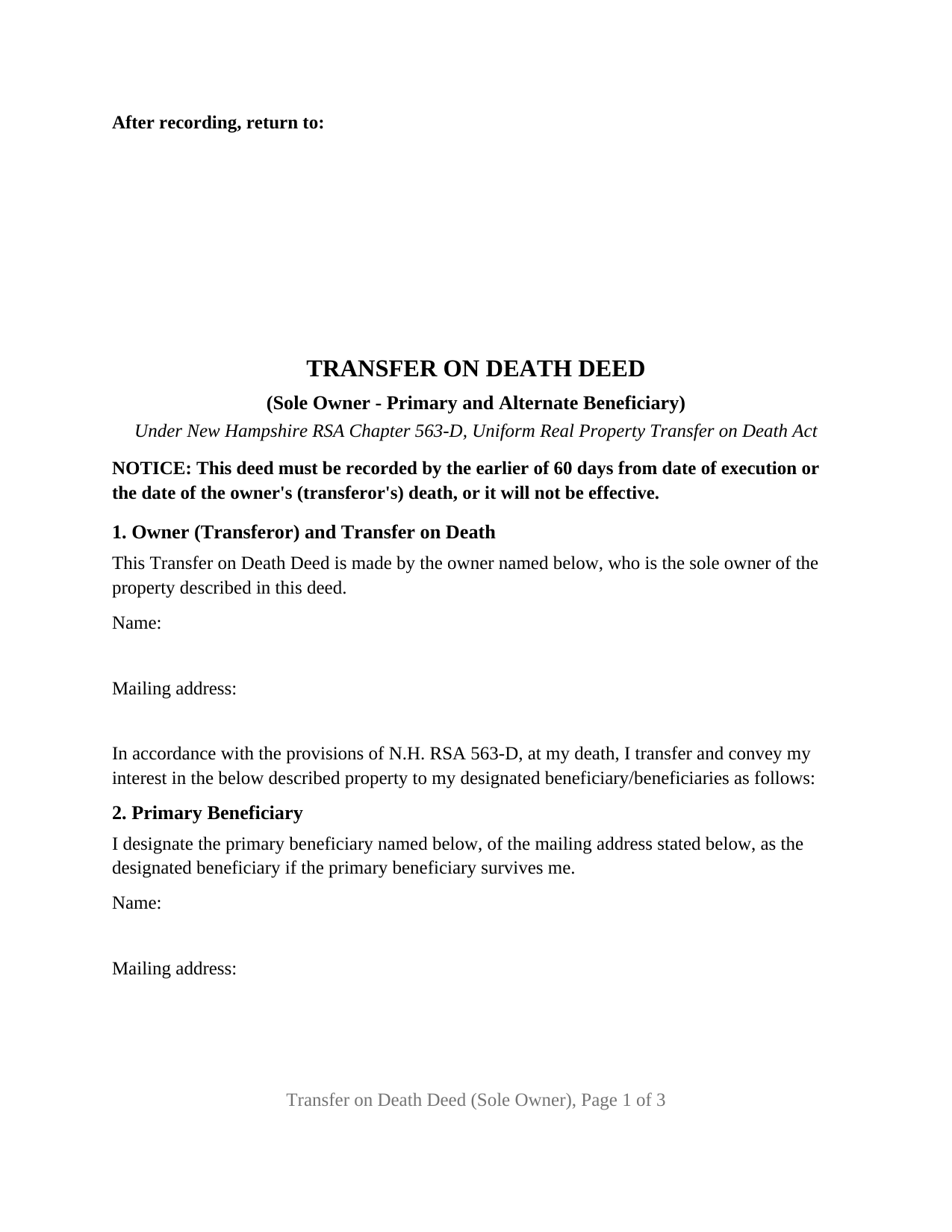
A New Hampshire transfer on death deed made by one owner can name a second person to step in if the first does not survive. This form is that deed, drawn under RSA Chapter 563-D for a sole owner of New Hampshire real property: one owner, one primary beneficiary, and one alternate beneficiary who takes only if the primary beneficiary does not survive the owner, all stated on the face of a deed that transfers nothing until the owner dies.
A designation with a built-in second answer
The uniform act makes a beneficiary's interest contingent on surviving the owner. RSA 563-D:13, I(b) provides that the interest of a designated beneficiary who fails to survive the transferor lapses unless the deed provides otherwise, and it switches off the anti-lapse rule of RSA 551:12, so the children of a beneficiary who died first do not take in that beneficiary's place under the deed. A deed naming one beneficiary and nothing more therefore transfers nothing at all if that beneficiary dies first, and the property passes through the owner's estate instead. The alternate beneficiary sentence is how this deed provides otherwise. It designates the alternate beneficiary as the designated beneficiary if the primary beneficiary does not survive the owner, the same designation the optional statutory form in RSA 563-D:19 prints under the heading Secondary Beneficiary. If the primary beneficiary survives, the alternate takes nothing; if neither survives, the designation lapses and the deed is silent. The guide walks through each of those outcomes under the statute.
The alternate designation also answers a marriage question. RSA 563-D:14, I deems a designated beneficiary to have predeceased the transferor where the marriage between them ends in divorce or annulment after the deed is executed, unless the deed provides otherwise. A sole owner who names a spouse as primary beneficiary and a child as alternate has already written down what happens in that event.
One owner, one signature, one certificate
The deed identifies the owner as the sole owner of the described property, and that sentence is fixed deed text rather than a blank or a checkbox. The owner block takes the owner's full name, with the marital status that customarily follows a name in a New Hampshire deed, and the owner's mailing address. The form carries one signature block and one acknowledgment certificate in the RSA 456-B:8 short form, captioned for a notary public or justice of the peace, since RSA 477:3 takes a grantor's acknowledgment before a justice, notary public, or commissioner and RSA 477:7 makes an acknowledged and recorded deed valid without attesting witnesses. A widow naming an adult child as primary beneficiary and a grandchild as alternate, as the completed example shows, a single owner naming a sibling with a charity as alternate, and a married owner who holds title alone naming the spouse first and a child second present the sole owner pattern this deed recites. The form is not set up as a deed by two owners, by a trustee, by a conservator or guardian, or by an agent under a power of attorney, and it is not set up to name two or more primary beneficiaries or two or more alternates; each of those follows a different pattern.
Who can be named
RSA 563-D:2 defines a beneficiary as a person and defines person to include an individual, a trust, a corporation, a limited liability company, a partnership, an estate, and a governmental subdivision, so the primary and alternate blocks accept a relative, a trust named through its trustee, a charity, or a company. Each block also takes a mailing address, because RSA 478:4-a, I(a) bars the register from accepting a deed that omits the latest mailing address of every grantee; the guide describes the naming convention for each class.
Sixty days, and then before death
RSA 563-D:9 makes the deed void unless it is recorded at length in the registry of deeds for the county where the land lies, both before the owner's death and within 60 days following the date of execution. The form prints the notice the RSA 563-D:19 form carries for that rule directly under the title, and the guide treats the two deadlines, the registry fee schedule under RSA 478:17-g, and the county surcharge and payment practices that vary from registry to registry. The deed also prints the statutory form's statement that it is exempt from the real estate transfer tax under RSA 78-B:2, XXV as a revocable transfer on death deed for no consideration, the statement RSA 78-B:6 requires before a register records an instrument without tax stamps.
Revocable, and nothing changes during life
Before my death, I have the right to revoke this deed: the form carries that sentence from the statutory form, and RSA 563-D:6 makes the deed revocable even if it said otherwise. Revocation takes a later instrument executed with deed formalities, acknowledged after the deed it revokes, and recorded by the earlier of 60 days from its execution or the owner's death under RSA 563-D:11; that instrument is prepared and recorded separately and is not included in this package. During the owner's life, RSA 563-D:12 provides that the deed does not affect the owner's right to sell, mortgage, or lease, does not affect creditors, does not affect eligibility for public assistance, and creates no interest in either beneficiary. At death, the beneficiary who takes receives the property subject to every mortgage and lien then of record and without warranty of title, and the beneficiary then records the notice of death affidavit RSA 563-D:22 describes within 60 days after the death, a separate instrument prepared and recorded separately and not included in this package, whose filing the statute says is not a condition of the transfer of title.
What the package carries
Whether a buyer arrives looking for a beneficiary deed, a TOD deed, or a revocable transfer on death deed, the instrument in New Hampshire bears the title Transfer on Death Deed, the title RSA 563-D:9 requires, and this form prints it. Three items make up the package: the fillable transfer on death deed, a completed example drawn on a Rockingham County fact pattern with one owner, one primary beneficiary, and one alternate beneficiary, and the guide, which covers each section of the form, the acknowledgment, the homestead and spousal rules, and the two recording deadlines. The guide and this description explain the form and the New Hampshire statutes behind it in general terms only and are not legal advice.
Important: County-Specific Forms
Our transfer on death deed (sole owner - primary and alternate beneficiary) forms are specifically formatted for each of the 10 counties in New Hampshire.
After selecting your county, you'll receive forms that meet all local recording requirements, ensuring your documents will be accepted without delays or rejection fees.