North Dakota Warranty Deed
County Specific Legal Forms Validated as recently as October 7, 2026 by our Forms Development Team
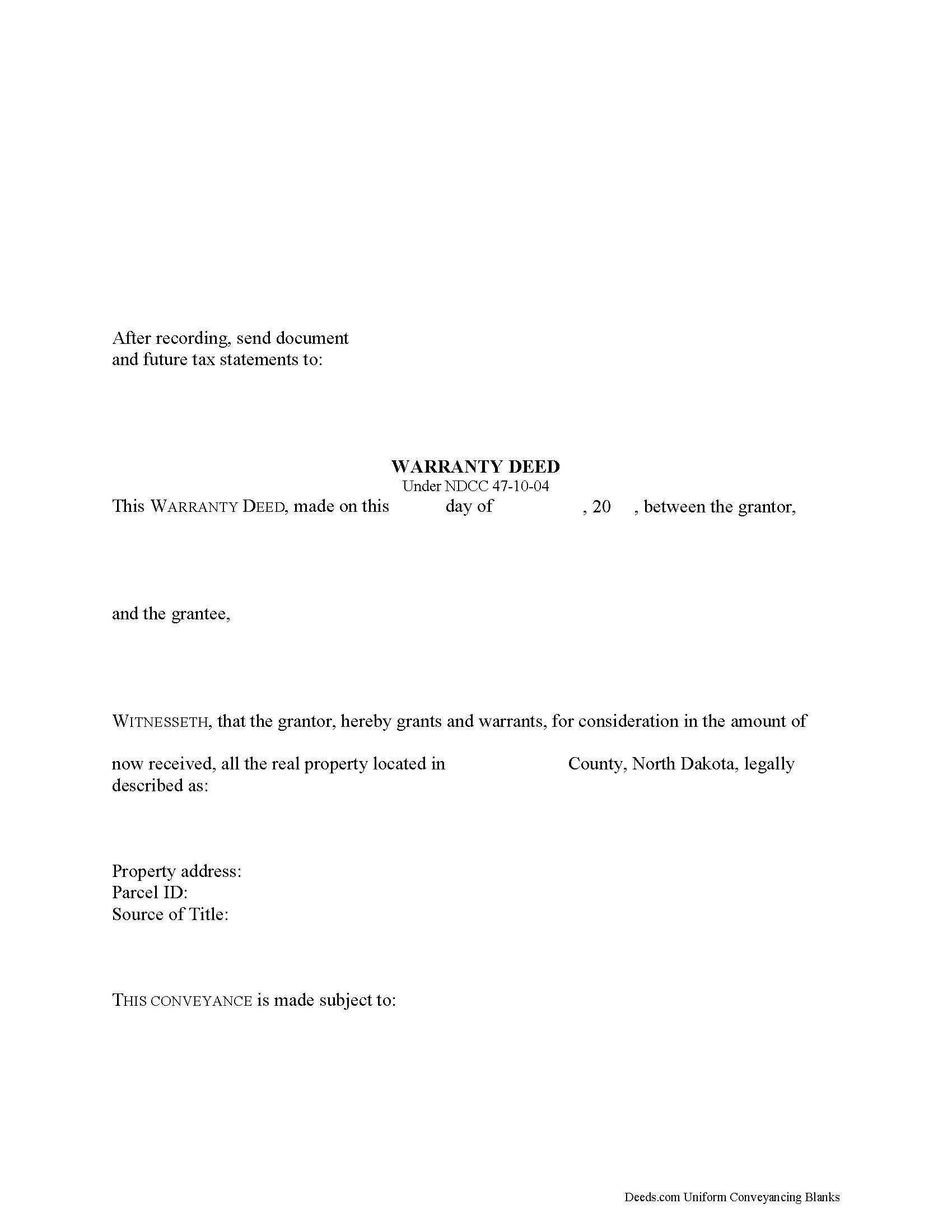
About the North Dakota Warranty Deed
How to Use This Form
- Select your county from the list
- Download the county-specific form
- Fill in the required information
- Have the document notarized if required
- Record with your county recorder's office
What Others Like You Are Saying
"Contents were well done. Could not remove and replace the "Deeds/" footer, rendering the f…"
"very helpful in a trouble free manner."
"Easy to use"
"Dry convenient and had just the form I needed and included directions, filled out sample form and ot…"
"Easy and efficient way to get a deed copy."
4.8/5 from 4,824 reviews. Read all
North Dakota caps what a deed promises by implication. Under Century Code Section 47-10-19, the operative word in a conveyance implies two covenants and no others: that the grantor has not already conveyed the same estate to someone else, and that the estate is free of encumbrances the grantor made or allowed. Both look backward only at the grantor. A warranty that reaches every earlier owner in the chain has to be written into the instrument, and this North Dakota warranty deed writes it out in the words the Century Code itself supplies.
Covenants the code spells out, in a deed it never prescribes
Chapter 47-10 takes an unusual split approach. It gives no mandatory warranty deed form, yet Section 47-10-04 states, sentence by sentence, what each covenant means: that the grantor now is seized in fee simple, that the grantee shall enjoy the property without lawful disturbance, that the property is free from all encumbrances, that further assurances will be executed on demand, and that the grantor will warrant the property against all persons lawfully claiming it. Section 7 of this deed carries those five covenants in that statutory substance, which is what separates a general warranty deed from a limited or special warranty instrument in this state. Section 6 is where the warranty stops: the taxes, recorded easements, mineral reservations, and restrictive covenants listed there are excepted, and Section 47-10-18 leaves the encumbrance covenant enforceable on a recorded encumbrance that nobody knew about.
One or two names on either side
The party blocks are open. Section 1 and Section 2 are four-line entries that take one or two natural persons apiece, with no printed status line, no vesting checkbox, and no capacity wording fixed in advance, so the filler supplies the names and whatever descriptive words go with them. Section 10 carries two grantor signature blocks and a matching acknowledgment certificate for each, and a conveyance by a single grantor simply leaves the second block and its certificate blank. Four count patterns run through the same instrument that way: one grantor to one grantee, one to two, two to one, and two to two. The form is not set up for an entity grantor, a trustee, or a signer acting under a power of attorney, each of which recites authority this instrument does not preprint, and its two blocks stop at two owners on a side.
What the grantee entry decides
Co-ownership in North Dakota is chosen by wording, not by assumption. Section 47-02-08 makes an interest in favor of several persons an interest in common unless the transfer declares otherwise, and Section 47-02-06 recognizes a joint tenancy only where the transfer expressly declares it, which is why survivorship language belongs with the grantee names or nowhere. Two forms familiar elsewhere are simply unavailable: the state has no community property regime, and Renz v. Renz confirms that estates by the entirety have never been recognized here. Married grantees accordingly take in common or as declared joint tenants, the same as anyone else.
Through the auditor, then the recorder
Section 11-18-02 sends the instrument to the county auditor first, because the recorder refuses a deed until the auditor certifies transfer and tax status. Two statements then have to be on the deed's face: the full consideration or exemption certification of Section 11-18-02.2, signed by the grantee or the grantee's agent rather than by the seller, and the legal description drafter statement of Section 47-19-03.1 for a metes and bounds description. Formatting is statutory too, and the penalties are specific: a first page without three inches of clear space at the top costs an added page and its fee, a page that misses the one inch label margin costs ten dollars, and a non-government form below 10 point Calibri is refused outright. This deed is built to clear all three. Section 11-18-23 keeps Social Security numbers off the record, and once the instrument is filed, Section 47-19-41 gives it constructive notice and priority over anything unrecorded.
Included in the download are the fillable deed, a completed example filled in for a Grand Forks County sale from the grantor block through both certificates, and a guide that walks the sections, the covenants, the homestead rule of Section 47-18-05, and the recording steps. These materials describe North Dakota law generally and are not legal advice.
Important: County-Specific Forms
Our warranty deed forms are specifically formatted for each of the 53 counties in North Dakota.
After selecting your county, you'll receive forms that meet all local recording requirements, ensuring your documents will be accepted without delays or rejection fees.