Ohio Gift Deed (Individual Grantor by Attorney-in-Fact or POA)
County Specific Legal Forms Validated as recently as October 20, 2026 by our Forms Development Team
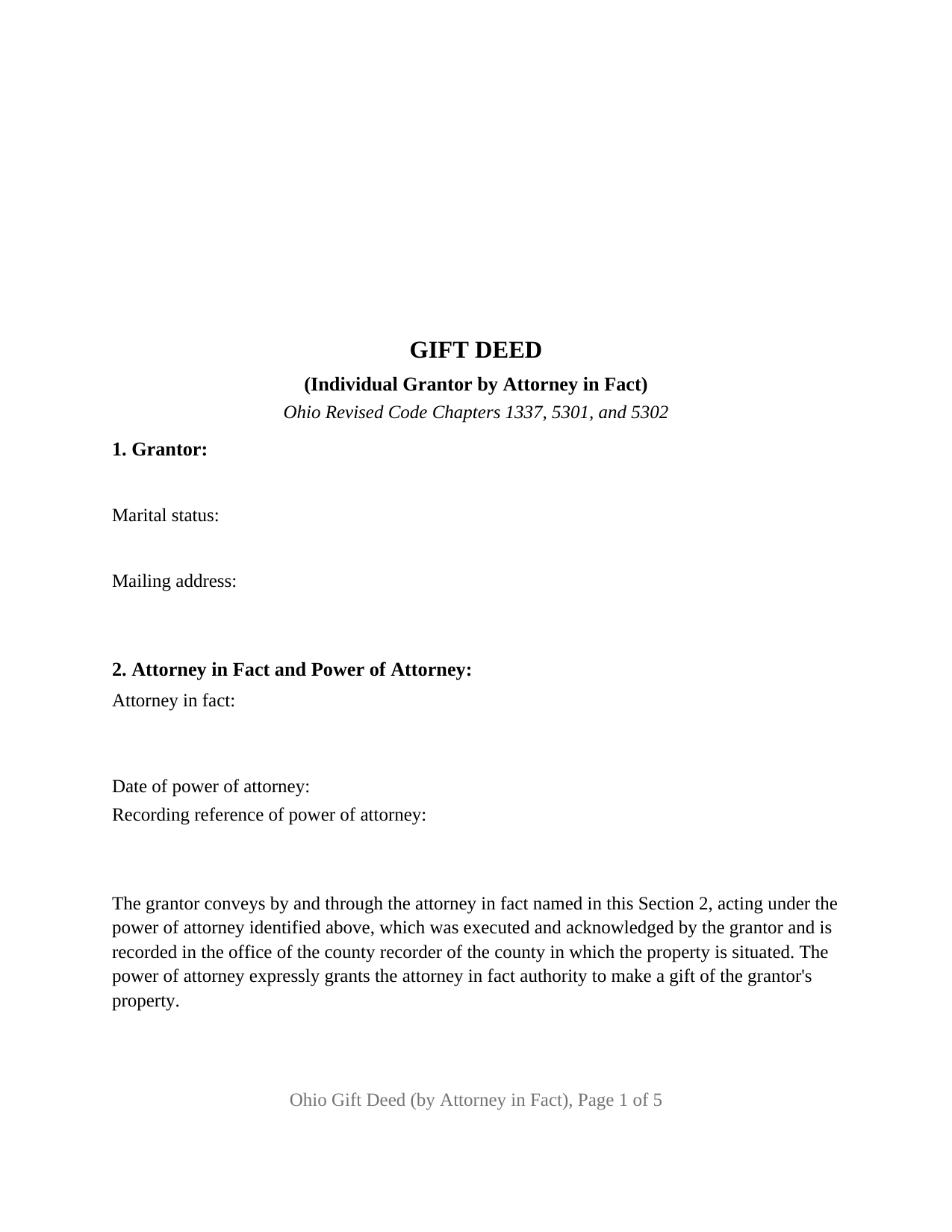
About the Ohio Gift Deed (Individual Grantor by Attorney-in-Fact or POA)
How to Use This Form
- Select your county from the list
- Download the county-specific form
- Fill in the required information
- Have the document notarized if required
- Record with your county recorder's office
What Others Like You Are Saying
"good source"
"I am an invalid and needed just one quitclaim form. I was able to quickly enter and complete the for…"
"i like this service! so convenient! 10 out of the 10"
"Everything great thank you"
"Great service. Easy to use and affordable."
4.8/5 from 4,829 reviews. Read all
When the owner of Ohio real estate cannot sign a deed giving it away, Ohio law lets an attorney in fact sign in the owner's place, on two conditions in Chapter 1337 of the Revised Code: the power of attorney must expressly grant the authority to make a gift, and it must be on record in the county where the land lies before the deed is. This Ohio Gift Deed (Individual Grantor by Attorney-in-Fact or POA) form prepares that conveyance, a deed of gift by one individual grantor, signed by the grantor's agent under a recorded power of attorney, for no consideration and without covenants.
A gift the power of attorney has to name
Ohio's Uniform Power of Attorney Act separates dealing with real estate from giving it away. Section 1337.42(A)(2) allows an agent to make a gift only if the power of attorney expressly grants that authority, Section 1337.58 caps a general gift authority at the annual federal gift tax exclusion per donee unless the instrument says otherwise, and Section 1337.42(B) keeps an agent outside the principal's family line from giving the property to the agent. The deed identifies the power of attorney by date and recording reference and recites that it expressly grants the authority to make a gift.
The power of attorney records first
Section 1337.04, rewritten by Senate Bill 94 effective October 24, 2024, sets the order: the principal executes and acknowledges the power of attorney before the agent executes the deed, and the power of attorney is recorded with the county recorder where the property is situated before the deed is. The section forgives a same-day recording in the wrong order and supplies an affidavit cure for one never recorded in time.
Signing for someone else, and the certificate that says so
The attorney in fact signs the grantor's name by the agent's own signature as attorney in fact, the convention the Section 1337.60 statutory form describes, in the GRANTOR, BY ATTORNEY IN FACT block. The acknowledgment that follows is the Section 147.55(E) short form, naming the agent as attorney in fact on behalf of the named principal, and Section 1337.02 provides that the deed conveys the grantor's interest as fully as one the grantor signed in person.
The spouse still signs in person
A power of attorney speaks for the principal alone. A married grantor's spouse holds a dower interest of the spouse's own under Section 2103.02, and only the spouse can release it. The deed therefore carries a release of dower section with a blank for the spouse's name, a SPOUSE OF GRANTOR signature block, and a second acknowledgment certificate in the Section 147.55(A) individual form, so the spouse signs the same deed the agent signs. Where the grantor is unmarried, those three elements stay blank.
What this configuration recites
The form recites one individual grantor, identified by name, marital status, and mailing address, conveying through one attorney in fact under one recorded power of attorney, to one or two grantees. An aging parent whose adult child, as agent, conveys the family home to a sibling, and a principal in long-term care whose agent carries out a gift the power of attorney was written to permit, present the pattern this deed recites. The form is not set up as a conveyance by a grantor signing in person, by two or more grantors, by a trustee, an executor, or a company, by a spouse who also acts through an attorney in fact, or as a gift from the principal to the agent.
Like every Ohio deed of absolute conveyance, this one passes through the county auditor under Section 317.22 with form DTE 100 or DTE 100EX before the recorder accepts it; a gift outside the Section 319.54(G)(3)(d) family lines pays the conveyance fee on open-market value. The deed carries the tax-mailing address, prior instrument reference, survey line, and preparer statement Ohio recording calls for, laid out to the Section 317.114 margins and type size.
The package includes the fillable deed, a completed example of a Hamilton County gift from a father, through his daughter as attorney in fact, to his son, and the guide, which covers each section of the deed, the power of attorney rules of Chapter 1337, the spouse's dower release, the auditor's fee forms, and the recording sequence. This description and the guide describe Ohio law in general terms and are not legal advice.
Important: County-Specific Forms
Our gift deed (individual grantor by attorney-in-fact or poa) forms are specifically formatted for each of the 88 counties in Ohio.
After selecting your county, you'll receive forms that meet all local recording requirements, ensuring your documents will be accepted without delays or rejection fees.