Ohio Gift Deed (Partnership or Limited Partnership Grantor)
County Specific Legal Forms Validated as recently as October 20, 2026 by our Forms Development Team
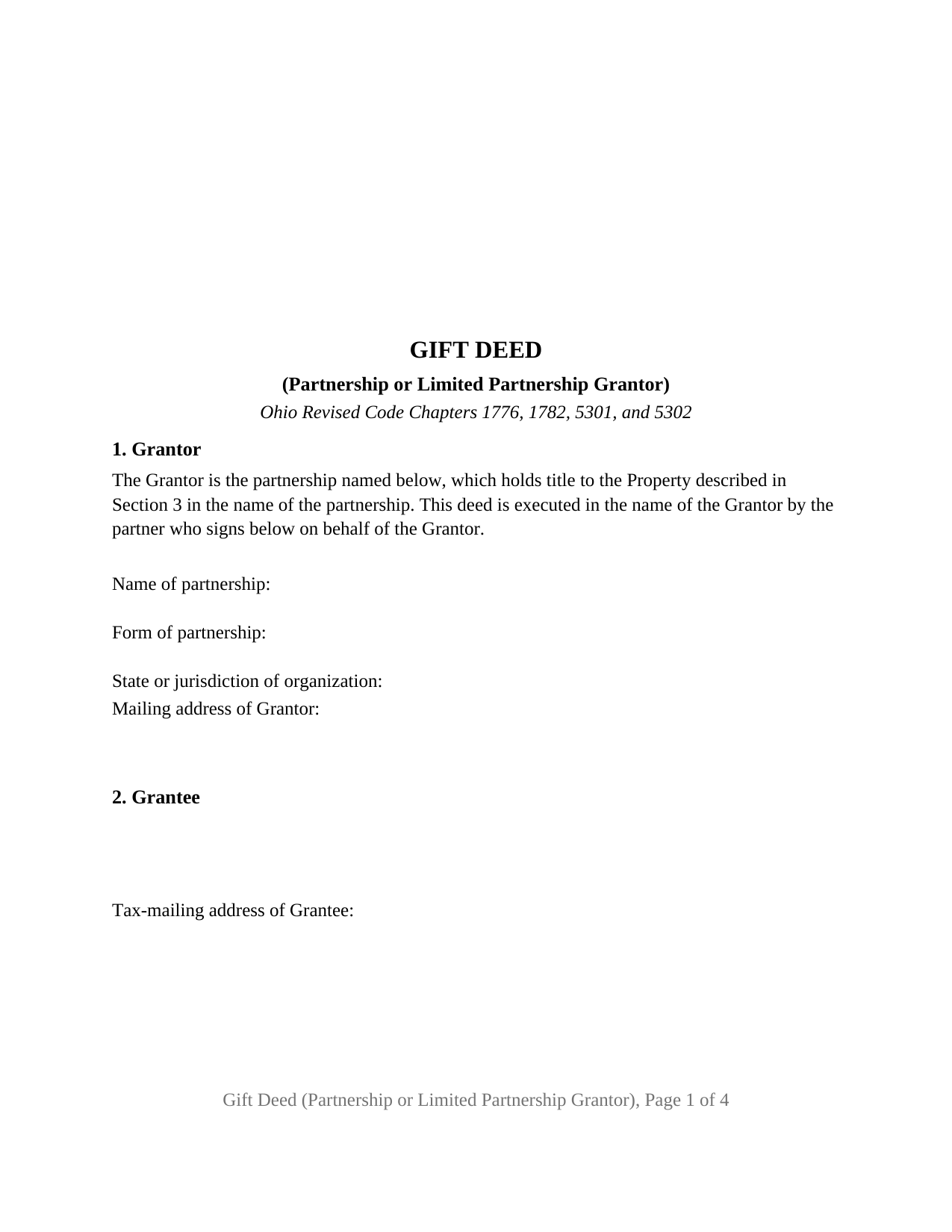
About the Ohio Gift Deed (Partnership or Limited Partnership Grantor)
How to Use This Form
- Select your county from the list
- Download the county-specific form
- Fill in the required information
- Have the document notarized if required
- Record with your county recorder's office
What Others Like You Are Saying
"Fast accurate service"
"Very well organized and easy to understand. Will probably use your service again in the future for o…"
"I was actually quite pleased with the ease of use of this site. I really, really liked the step by s…"
"Phenomenal service! If only every request and transaction with other companies could be this seamles…"
"I like using Deeds.com for all of our out-of-state deeds because they make the process almost comple…"
4.8/5 from 4,829 reviews. Read all
When an Ohio partnership gives away real property, the deed is signed in the partnership's name by one partner, and no spouse signs it. This Ohio Gift Deed (Partnership or Limited Partnership Grantor) prepares that conveyance for a general partnership or a limited partnership that holds title in the partnership name: a gift recital in place of a price, a grant without covenants of any kind, a signature block in the form the partnership, by its partner, and the partnership acknowledgment certificate printed in Ohio Revised Code Section 147.55(D).
A grantor that is an entity, and a signer who is not the owner
Under Section 1776.23 of the Ohio Uniform Partnership Act, property acquired in a partnership's name belongs to the partnership and not to the partners individually, and Section 1776.32(A)(1) lets a partner transfer it by an instrument executed in the partnership name. A general partner of a limited partnership holds the same powers under Section 1782.24. Section 1 of the deed names the partnership, its form, its state of organization, and its address, and recites that the partnership holds title in its own name and executes the deed through the partner who signs. The acknowledgment names the partner and the partnership in the statutory words: partner (or agent) on behalf of the partnership, a partnership.
Why dower stays off this deed
Deeds by natural persons in Ohio end with a release of dower, the life estate Section 2103.02 gives a spouse in one third of the other spouse's real property. A partnership has no spouse, and Section 1776.47 provides that a partner is not a co-owner of partnership property and has no interest in it that can be transferred; the partner's interest in the partnership is personal property under Sections 1776.48 and 1782.39. The form therefore carries no dower release and no signature line for the spouse of any partner.
Authority the deed describes but does not supply
A gift is ordinarily outside the ordinary course of a partnership's business. Section 1776.31(B) binds the partnership to such an act only when the other partners authorized it, and Section 1776.41(J) calls for the consent of all partners unless the partnership agreement provides otherwise. The deed states the capacity in which the partner signs; the partnership agreement, a consent of the partners, and for a limited partnership the certificate naming its general partners are where a title examiner reads the authority. The guide also describes the recorded statement of partnership authority of Section 1776.33.
The gift exemption that does not reach a partnership
Under Section 317.22 the county recorder does not accept a deed of absolute conveyance until the county auditor has stamped it, and the auditor's review is where the conveyance fee of Section 319.54(G)(3), or the exemption claimed on form DTE 100EX, is applied. Division (d) exempts a gift between spouses or between parent and child, a description a partnership does not meet, and division (m), the no-consideration exemption, excludes gifts. A partnership's gift to a partner's child therefore pays the fee on the property's open-market value as Section 319.202(D) defines it, while a partnership's gift to a 501(c)(3) organization in furtherance of its charitable purposes falls within division (r) and pays none.
One partnership, one partner, one certificate
The form recites exactly one grantor, a partnership holding title in its own name, signed by exactly one partner, with one acknowledgment certificate. Its grantee section is an open block for one or two grantees and any designation of how two grantees hold, from the tenancy in common Section 5302.19 supplies by default to the survivorship tenancy of Section 5302.17. A family limited partnership passing a building lot to a partner's adult child, and a general partnership donating a parcel to a land trust, present the pattern this deed recites. The form is not set up as a conveyance of land the record shows in individual partners' names, as a distribution of property to a partner, or as a deed by a liquidating trustee, a corporation, a limited liability company, a trustee, or an attorney in fact, and it carries no second signature block for a second general partner.
The package includes the fillable deed, a completed example for a Hamilton County gift by a family limited partnership to a partner's son, and the guide that walks through every section, the partner's authority, the conveyance-fee forms, and recording. This description and the form state Ohio law in general terms and are not legal advice.
Important: County-Specific Forms
Our gift deed (partnership or limited partnership grantor) forms are specifically formatted for each of the 88 counties in Ohio.
After selecting your county, you'll receive forms that meet all local recording requirements, ensuring your documents will be accepted without delays or rejection fees.