Ohio Gift Deed (Individual)
County Specific Legal Forms Validated as recently as October 20, 2026 by our Forms Development Team
About the Ohio Gift Deed (Individual)
How to Use This Form
- Select your county from the list
- Download the county-specific form
- Fill in the required information
- Have the document notarized if required
- Record with your county recorder's office
What Others Like You Are Saying
"I was looking for a certain form I needed. Deeds.com had the necessary form and I was able to purcha…"
"Quick download, hassle-free, no forced membership-just a straight-forward transaction. Thank you!"
"Love to use DEEDS>COM"
"Wow! So easy and such a cost savings. Thanks"
"Was a bit skeptical because I'd never heard of it, but just got something submitted and confirmed re…"
4.8/5 from 4,828 reviews. Read all
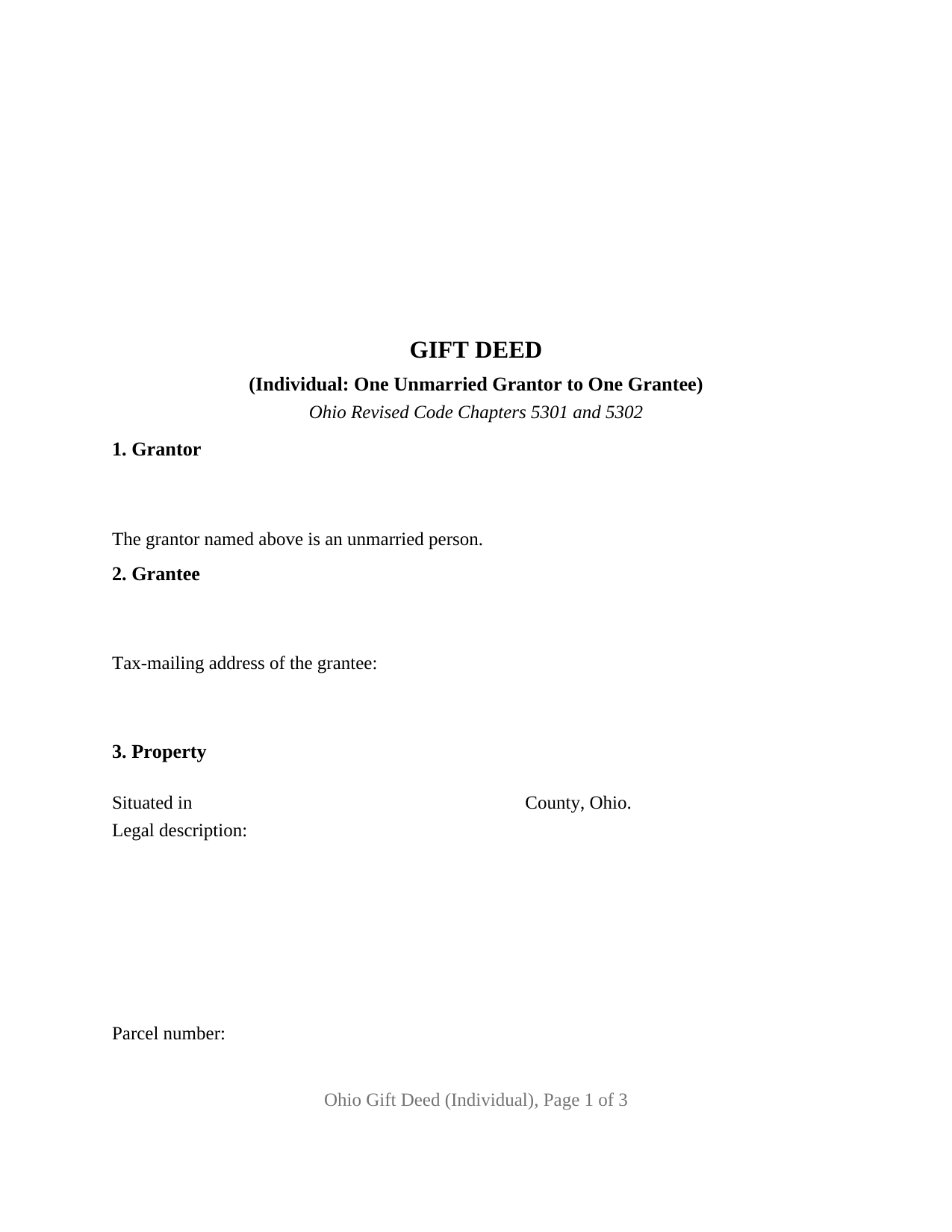
One signature, one acknowledgment certificate, and no dower release: that is the shape of the Ohio Gift Deed (Individual), the deed by which one unmarried person gives Ohio real property to one grantee for no consideration. The form prints the grantor's unmarried status as fixed deed text, names a single grantee with the tax-mailing address the county auditor reads, and conveys with the word grant and without covenants of any kind on the part of the grantor.
Why an unmarried grantor signs alone
Ohio is a dower state. Revised Code Section 2103.02 endows a spouse with a life estate in one third of the real property the other spouse owned during the marriage, and an Ohio deed by a married owner carries the spouse's signature releasing that interest. The same section terminates dower on an absolute divorce and ends it at the owner's death, and dower never arises for a person who has never married. A grantor with no spouse has no dower holder, so this deed carries no release sentence and no second signature line. The grantor's status is recited in Section 1 as a fixed sentence rather than a blank.
Gift wording on a quit-claim frame
Section 5302.01 allows the statutory deed forms to be altered as circumstances require, and this gift deed, also searched for as a deed of gift, is the quit-claim form with the words for valuable consideration paid replaced by a statement that the deed is a gift and that nothing has been paid or is to be paid. Section 5302.03 makes grant a sufficient word of conveyance and implies no covenant from it, so the deed says in its own text that it is made without covenants of any kind on the part of the grantor, the posture Section 5302.11 gives the quit-claim form. The grantee takes the grantor's whole interest, subject to the encumbrances of record, and receives no title warranty.
The fee question the grantee's relationship decides
A deed of absolute conveyance reaches the Ohio recorder only after the county auditor stamps it, and the stamp follows the conveyance-fee statement. Section 319.54(G)(3)(d) exempts a gift between husband and wife, or parent and child or the spouse of either; a gift to anyone else is still a gift and therefore outside the no-consideration exemption of division (m), so the state fee of ten cents per hundred dollars, plus any county transfer tax, is computed on the open-market value Section 319.202(D) assigns to a gift. The completed example, an aunt giving a Hamilton County lot to her nephew, falls on the fee-paying side.
One grantor, one grantee, one certificate
The form recites exactly one grantor, a natural person signing in the grantor's own right and recited as an unmarried person, and exactly one grantee. The grantor block takes a name and mailing address; the grantee block takes a name, a mailing address, and the tax-mailing address Section 319.20 requires for transfer; the property section takes the county, legal description, parcel number, and street address; a prior instrument reference and an encumbrances section follow. One signature block and one acknowledgment certificate in the Section 147.55(A) short form close the deed. A brother giving a vacant lot to his sister, a divorced owner conveying a condominium to a grandchild, and a never-married owner giving a cottage to a longtime companion present the pattern this deed recites. The form is not set up as a conveyance by a married grantor, by two grantors, to two grantees, or by a trustee, an entity, or an attorney in fact.
Laid out for the auditor's stamp and the recorder's scanner
The deed follows the Section 317.114 standard: twelve-point type over the ten-point statutory floor, one-inch side and bottom margins, a three-inch blank top margin on the first page where the auditor and recorder stamp, and a one-and-one-half-inch top margin on each later page. It carries the Section 5301.25(B) survey statement and the preparer's name Section 317.111 requires. Under Section 5301.01 the grantor signs and acknowledges before a notary public or another officer that section names, and no witnesses sign.
The package includes the fillable deed, a completed example for a Hamilton County gift from an unmarried aunt to her nephew, and the guide that walks through every section, the dower analysis for an unmarried grantor, the conveyance-fee forms, and the recording steps. The form and this description describe what Ohio law provides in general terms and are not legal advice.
Important: County-Specific Forms
Our gift deed (individual) forms are specifically formatted for each of the 88 counties in Ohio.
After selecting your county, you'll receive forms that meet all local recording requirements, ensuring your documents will be accepted without delays or rejection fees.