Ohio Gift Deed (Married Grantor with Non-Owner Spouse Joinder)
County Specific Legal Forms Validated as recently as October 20, 2026 by our Forms Development Team
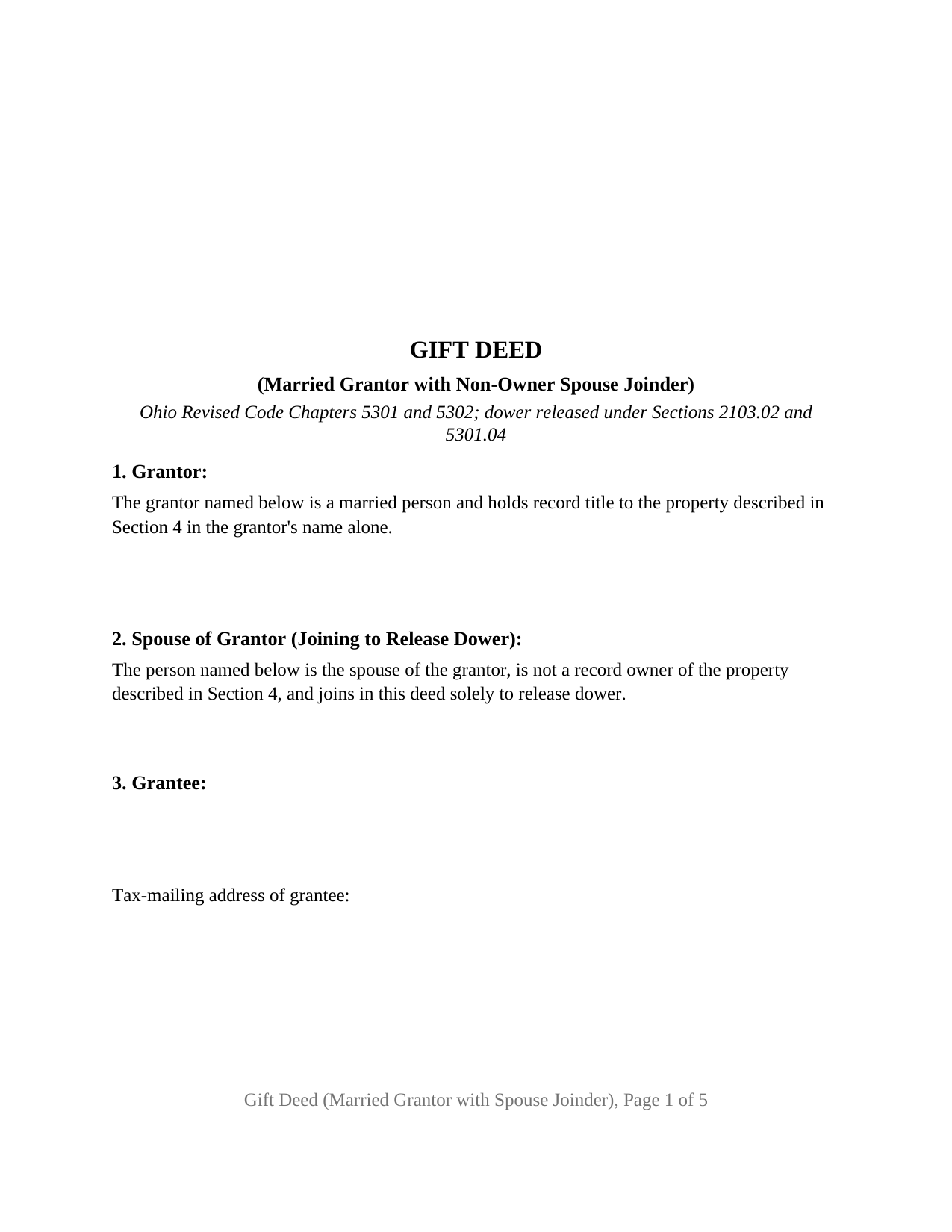
About the Ohio Gift Deed (Married Grantor with Non-Owner Spouse Joinder)
How to Use This Form
- Select your county from the list
- Download the county-specific form
- Fill in the required information
- Have the document notarized if required
- Record with your county recorder's office
What Others Like You Are Saying
"Very easy to work with. A lot less money than a lawyer."
"I asked for a letter of testamentary form and this is what I got. Not at all what I was hoping for. …"
"It was very easy to get the documents which I needed."
"good service"
"Very helpful. I live in Arkansas and needed information and documents for a Missouri transaction. I …"
4.8/5 from 4,828 reviews. Read all
One name on the title, two signatures on the deed. This Ohio Gift Deed (Married Grantor with Non-Owner Spouse Joinder) prepares a conveyance for no consideration by a married person who holds Ohio real property in that person's name alone, with the owner's husband or wife signing the same instrument to release dower. The deed prints the gift recital, the Ohio dower release sentence, and a signature block and acknowledgment certificate for each of the two signers.
Why a spouse who owns nothing still signs
Ohio kept dower. Under Revised Code Section 2103.02, a husband or wife holds a life estate in one third of any real property the other spouse owned as an estate of inheritance during the marriage, unless released or barred. The interest follows the marriage, not the name on the deed, so a gift of a house titled in one spouse's name alone passes subject to the other spouse's inchoate dower unless that spouse releases it. Ohio's statutory deed forms close with the sentence by which the grantor's wife or husband releases all rights of dower therein. This deed prints that sentence in its operative section and gives the spouse a labeled signature line, so the release is signed, acknowledged, and recorded with the gift it accompanies.
A deed that recites its own configuration
The grantor section states as fixed text that the grantor is a married person and holds record title in the grantor's name alone. The spouse section states that the person named is the grantor's spouse, is not a record owner, and joins solely to release dower. The configuration is printed on the deed; the names and mailing addresses are the only entries. A married owner who received the property by inheritance, bought it before the wedding, or took title in one name during the marriage presents the pattern this deed recites. The spouse conveys no title; the release of dower is the whole of the spouse's part.
A gift in fee simple, without covenants
In place of the words for valuable consideration paid, the deed states that the conveyance is a gift and that no money or other consideration has been paid or is to be paid. The conveyance uses grant, the word Section 5302.03 makes sufficient, and states that it is made in fee simple but without covenants of any kind on the part of the grantor, the effect Section 5302.11 gives the statutory quitclaim form. The grantee takes whatever interest the grantor holds, subject to everything of record, and the deed makes no promise about the title. The grantee section is open to one or two grantees and any Ohio ownership designation they supply.
One grantor, one joining spouse, two certificates
The form recites exactly one record owner and exactly one joining spouse, and both sign on every deed; neither block is optional in this configuration. Each signer has an acknowledgment certificate in the Section 147.55(A) short form, so the grantor and the spouse may appear before a notary public or another officer Section 5301.01 names on different days, in different counties, or in different states. Ohio requires no witnesses on a deed. The form is not set up as a conveyance by an unmarried owner, by two record owners, by spouses who hold title together, by a trustee, an entity, or an attorney in fact, or by three or more persons on either side.
What the auditor sees before the recorder does
Under Section 317.22 a deed of absolute conveyance goes to the county auditor before the county recorder accepts it. The auditor reads the grantee's tax-mailing address and the prior instrument reference that Section 319.20 requires, both printed on this form, and takes the conveyance-fee statement, form DTE 100 declaring value or form DTE 100EX claiming an exemption. A gift between spouses, or between a parent and a child or the child's spouse, is exempt under Section 319.54(G)(3)(d); a gift to anyone else pays the fee on the open-market value Section 319.202(D) assigns to a gift. The deed is laid out to the Section 317.114 standard and carries the Section 317.111 preparer statement.
Three items ship together: the fillable deed, a completed example showing a Hamilton County mother conveying a house to her adult daughter while the mother's husband releases dower, and a guide covering each section, the dower analysis, the auditor's fee forms, and the recording sequence. This description and the guide describe the form and Ohio law in general terms and are not legal advice.
Important: County-Specific Forms
Our gift deed (married grantor with non-owner spouse joinder) forms are specifically formatted for each of the 88 counties in Ohio.
After selecting your county, you'll receive forms that meet all local recording requirements, ensuring your documents will be accepted without delays or rejection fees.