Ohio Gift Deed (Individual Grantor to Charitable Organization)
County Specific Legal Forms Validated as recently as October 20, 2026 by our Forms Development Team
About the Ohio Gift Deed (Individual Grantor to Charitable Organization)
How to Use This Form
- Select your county from the list
- Download the county-specific form
- Fill in the required information
- Have the document notarized if required
- Record with your county recorder's office
What Others Like You Are Saying
"Deeds.com was user-friendly, clear, specific and complete. I used the site to create and submit a No…"
"Awesome and very fast service!!!"
"Easy to use and super convenient."
"just what I needed...thanks"
"Fast Service, Easy to use. Highly Recommend!"
4.8/5 from 4,828 reviews. Read all
A gift of Ohio real property to a charity reads differently on the county auditor's fee table than a gift to a friend. Division (r) of Ohio Revised Code Section 319.54(G)(3) charges no conveyance fee on a transfer to an organization exempt from federal income taxation under section 501(c)(3) of the Internal Revenue Code, provided the transfer is without consideration and in furtherance of the organization's charitable or public purposes. This Ohio Gift Deed (Individual Grantor to Charitable Organization) prepares the conveyance that exemption describes: one individual grantor, one charitable organization as grantee, no consideration, and the spouse's release of dower.
A grantee that is an organization, not a person
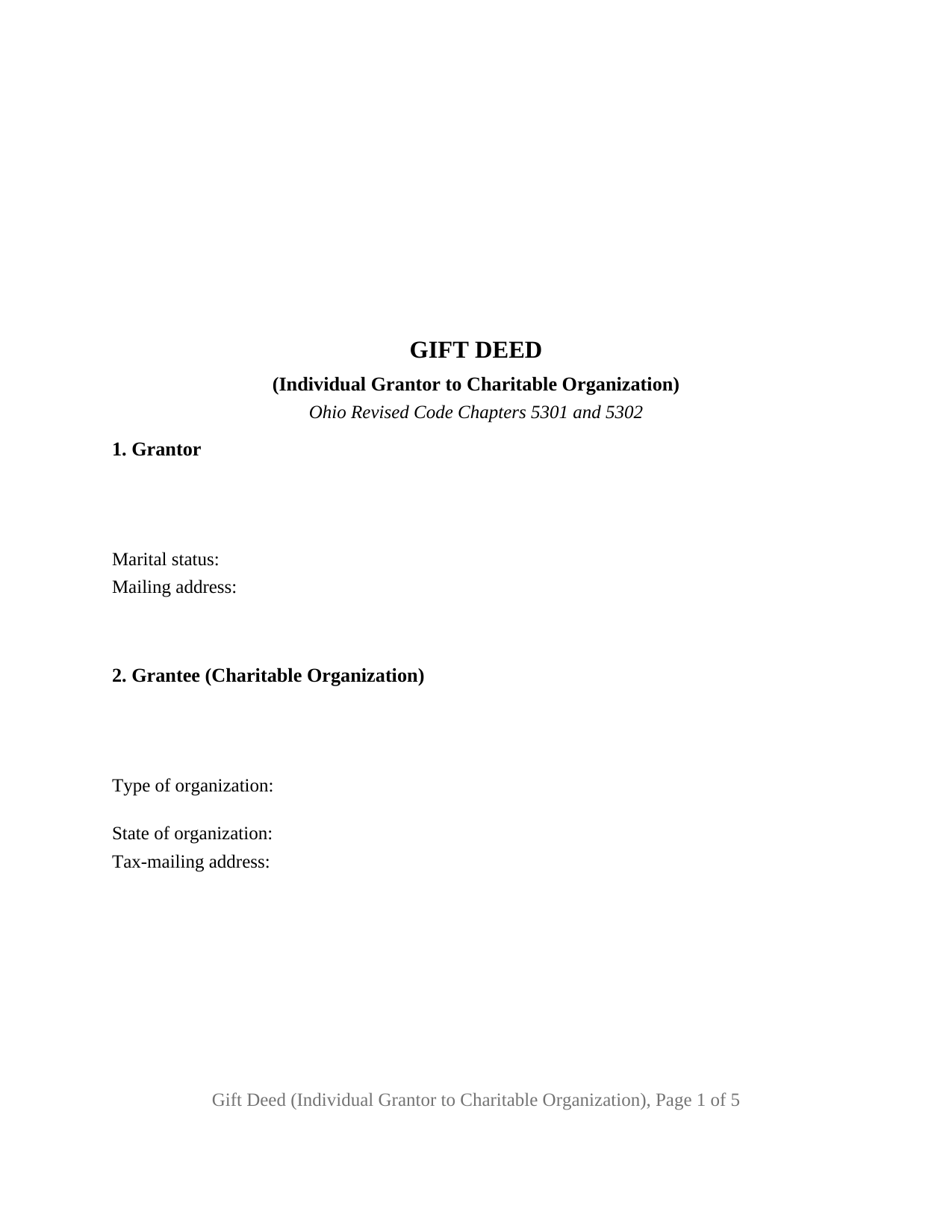
The grantee section is written for an entity: the organization's exact legal name, its type and state of organization, and the tax-mailing address Section 319.20 requires on an instrument the auditor transfers. The operative clause grants to the grantee, a charitable organization, without covenants of any kind on the part of the grantor, the force Section 5302.11 gives a deed in substance following the statutory quitclaim form.
The two conditions behind the fee exemption
Division (r) turns on two facts the deed recites and the auditor verifies: the organization is exempt under section 501(c)(3), and the transfer is without consideration and in furtherance of its charitable or public purposes. The deed recites a gift made without consideration and in furtherance of those purposes, with no money or other consideration paid or to be paid. The exemption is claimed on form DTE 100EX, the Department of Taxation's statement of reason for exemption, at line 5(r), whose instructions note that the auditor may ask for Internal Revenue Service exemption certificates or articles of incorporation to substantiate the claim. Section 322.01 keeps an exempt instrument outside the county permissive transfer tax as well. Where the organization is not a 501(c)(3) organization, the fee applies, and Section 319.202(D) measures a gift by the estimated price it would bring in the open market, not by the zero the deed recites.
One grantor, and the spouse who signs for dower
This is the individual-grantor configuration of the Ohio gift deed, sometimes searched as a charitable deed of gift or a donation deed: one natural person conveying in that person's own right, with marital status entered as a fact. Section 2103.02 gives a spouse a life estate in one third of the real property the other spouse owned during the marriage, so a married grantor who holds title alone conveys subject to that inchoate dower unless the spouse releases it. Section 5 of the deed carries the release sentence the statutory forms print for the wife or husband of the grantor, worded for the spouse, and the signature section places a SPOUSE OF GRANTOR block with its own acknowledgment certificate beside the GRANTOR block; an unmarried grantor leaves both blank. A homeowner giving a house to a nonprofit housing organization, a landowner giving woodland to a conservation organization, and a parishioner giving a lot to a religious society present the pattern this deed recites. The form is not set up as a conveyance by two or more grantors, by a trustee or an entity, or by an attorney in fact, and its grantee is an organization holding title in its own name rather than a natural person, a trustee, or a governmental body.
What the auditor and the recorder read
Section 317.22 keeps a deed of absolute conveyance off the record until the auditor has stamped it and indorsed the transfer, so the deed carries the Prior Instrument Reference line, the Section 5301.25(B) survey sentence, and the Section 317.111 preparer statement. The page is built to Section 317.114, with a blank three-inch band at the top of page one for the county stamps and twelve-point type over the ten-point minimum. Execution follows Section 5301.01, with no witnesses, and each certificate prints the Section 147.55(A) short form. Exemption of the parcel from real property taxation once the organization owns it is a separate application under Section 5715.27, not something the deed accomplishes.
The package includes the fillable deed, a completed example for a Hamilton County gift of a platted lot from a married homeowner to a nonprofit community land trust, and the guide that walks through every section, the dower release, the DTE 100EX exemption, and recording. The form and this description state what Ohio law provides in general terms; they are not legal advice.
Important: County-Specific Forms
Our gift deed (individual grantor to charitable organization) forms are specifically formatted for each of the 88 counties in Ohio.
After selecting your county, you'll receive forms that meet all local recording requirements, ensuring your documents will be accepted without delays or rejection fees.