Ohio Lis Pendens Discharge
County Specific Legal Forms Validated as recently as October 29, 2026 by our Forms Development Team
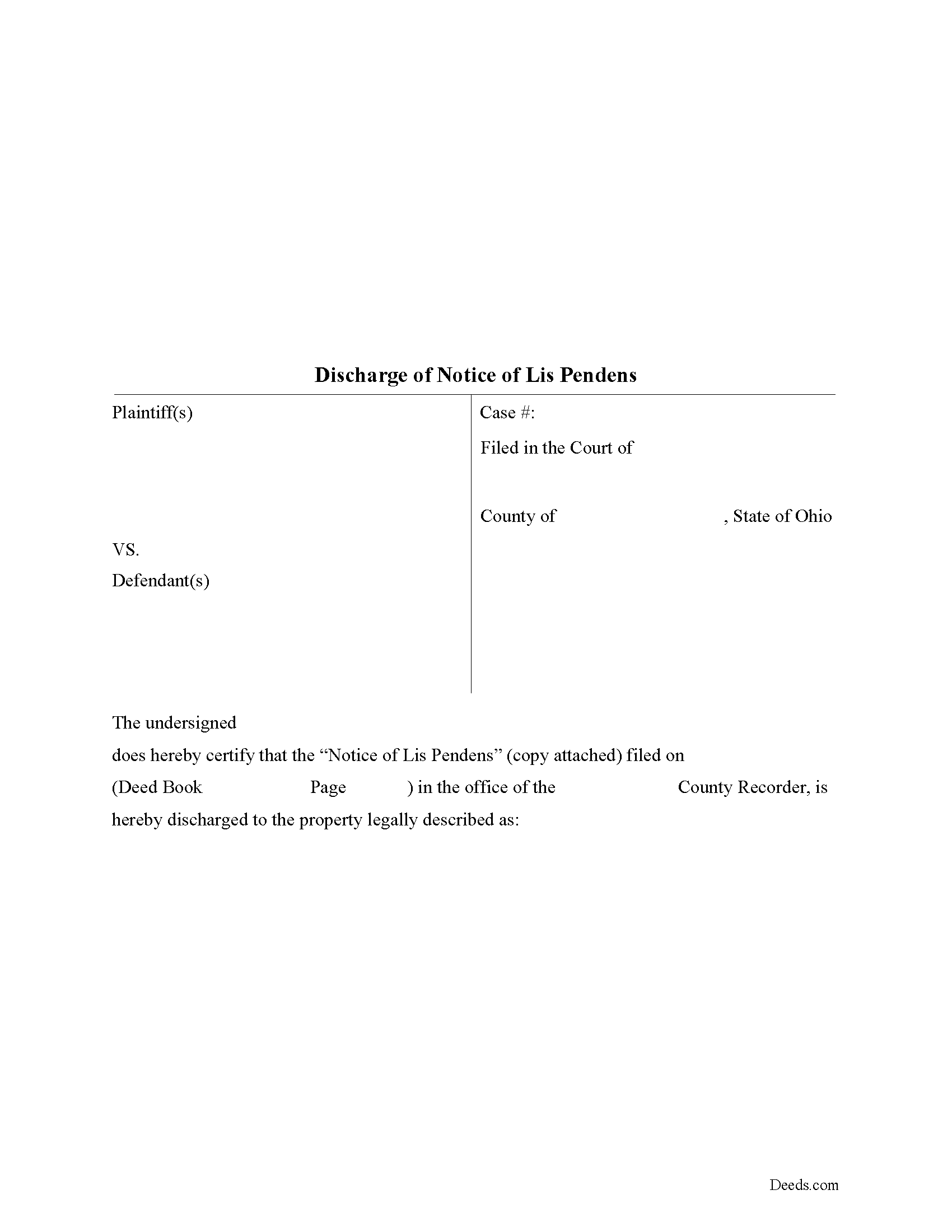
About the Ohio Lis Pendens Discharge
How to Use This Form
- Select your county from the list
- Download the county-specific form
- Fill in the required information
- Have the document notarized if required
- Record with your county recorder's office
What Others Like You Are Saying
"The e-recording service was invaluable. This was my first experience recording a document in any cap…"
"excellent...exactly what i need...."
"Very easy to use... awaiting info"
"Easy site to work with."
"Excellent service for recovering a couple of deeds that had been misplaced. They were fast and effic…"
4.8/5 from 4,856 reviews. Read all
An Ohio lis pendens notice does not leave the land records on its own. The statutory lis pendens under Ohio Revised Code Section 2703.26 ends with the lawsuit, but the affidavit recorded to publicize it stays in the chain of title until something of record withdraws it. This form is that instrument: an Ohio Lis Pendens Discharge, a second affidavit of facts relating to title under Section 5301.252 by which the person or persons who recorded the notice swear that the court has ended the action as to the property and discharge, release, and withdraw the recorded notice.
A notice that outlives the lawsuit
Ohio's lis pendens arises from the court file: under Section 2703.26 the filing of the complaint charges third persons with notice, and while the action is pending no interest can be acquired by third persons in the subject of the action as against the plaintiff's title. The section names no ending; Ohio courts have held that lis pendens operates only while the action is pending and terminates upon final judgment. A dismissal entry in the court file does not reach the recorded notice; the discharge, recorded in the same county and indexed under the same record owner, states the terminating entry under oath.
What the affidavit swears to
Section 5301.252 permits any person having knowledge of the facts, or competent to testify to them in open court, to record an affidavit stating facts that may affect title to Ohio real estate, and makes the recorded affidavit evidence of those facts. The form's sworn section recites that qualification, recites that the affiant caused the earlier notice to be recorded, identifies the court entry that terminated the action as to the property, and states that the action is no longer pending within the meaning of Section 2703.26. On those facts the affiant discharges, releases, and withdraws the recorded notice and gives notice of record that the action no longer affects title. A closing sentence keeps the instrument in its lane: it is not a judgment, decree, or order, it does not vacate or modify any court entry, and it creates, releases, or satisfies no lien.
The statute fixes three things every affidavit of facts carries, a description of the land, a reference to an instrument of record containing it, and the name of the record owner under which the recorder indexes it, and the form collects each along with the recording reference of the notice, the court, case number, and parties, and the title and date of the terminating entry.
One or two affiants, each under oath
The form carries two affiant signature blocks, AFFIANT and SECOND AFFIANT, and two jurat certificates, one for each, because an affidavit is sworn rather than acknowledged and Ohio's notarial statute keeps the two acts apart. Each certificate has its own venue lines, date, and officer block, so two affiants may swear on different days or before different officers. A single plaintiff leaves the second block and its certificate blank; two co-plaintiffs who recorded one notice, the pattern the completed example shows, sign both. The form is set up for natural persons signing in their own right; a representative signer follows a different pattern.
Recording in the county where the land lies
The affidavit is recorded with the county recorder of the county in which the real estate is situated, the office that recorded the notice, at the deed recording fee of 34 dollars for the first two pages and 8 dollars for each page after, plus a preservation surcharge of up to 5 dollars where the county levies one. The affidavit conveys nothing, so the auditor's conveyance fee and transfer process that a deed passes through does not apply to it. The form follows Ohio's standard format statute, with the three inch blank top margin on the first page and 12 point body text, so it records at the base fee. For registered land, and for an action filed in a county other than the one where the property lies, the clerk's certificates under Section 5309.58 and Civil Rule 3(G) remain the statutory filings; the guide explains where this affidavit sits beside them.
The package includes the fillable Ohio Lis Pendens Discharge form, a completed example filled in for a realistic Franklin County fact pattern, and the guide that walks through each section, the governing law, signing, and recording. The description and the guide describe the form and Ohio law in general terms; they are not legal advice.
Important: County-Specific Forms
Our lis pendens discharge forms are specifically formatted for each of the 88 counties in Ohio.
After selecting your county, you'll receive forms that meet all local recording requirements, ensuring your documents will be accepted without delays or rejection fees.