Oklahoma Quitclaim Deed (Corrective)
County Specific Legal Forms Validated as recently as October 22, 2026 by our Forms Development Team
About the Oklahoma Quitclaim Deed (Corrective)
How to Use This Form
- Select your county from the list
- Download the county-specific form
- Fill in the required information
- Have the document notarized if required
- Record with your county recorder's office
What Others Like You Are Saying
"Quick and easy to use and with the provided instructions and example it took a lot of the guess work…"
"I LOVE that very concise directions and a sample completed deed were included. They were incredibly …"
"Awesome same-day service!"
"Being new at this, the system was somewhat difficult to understand at first. It took a couple of tri…"
"So far excellent service - I made a boo boo on the deed - no problem they made the change before the…"
4.8/5 from 4,830 reviews. Read all
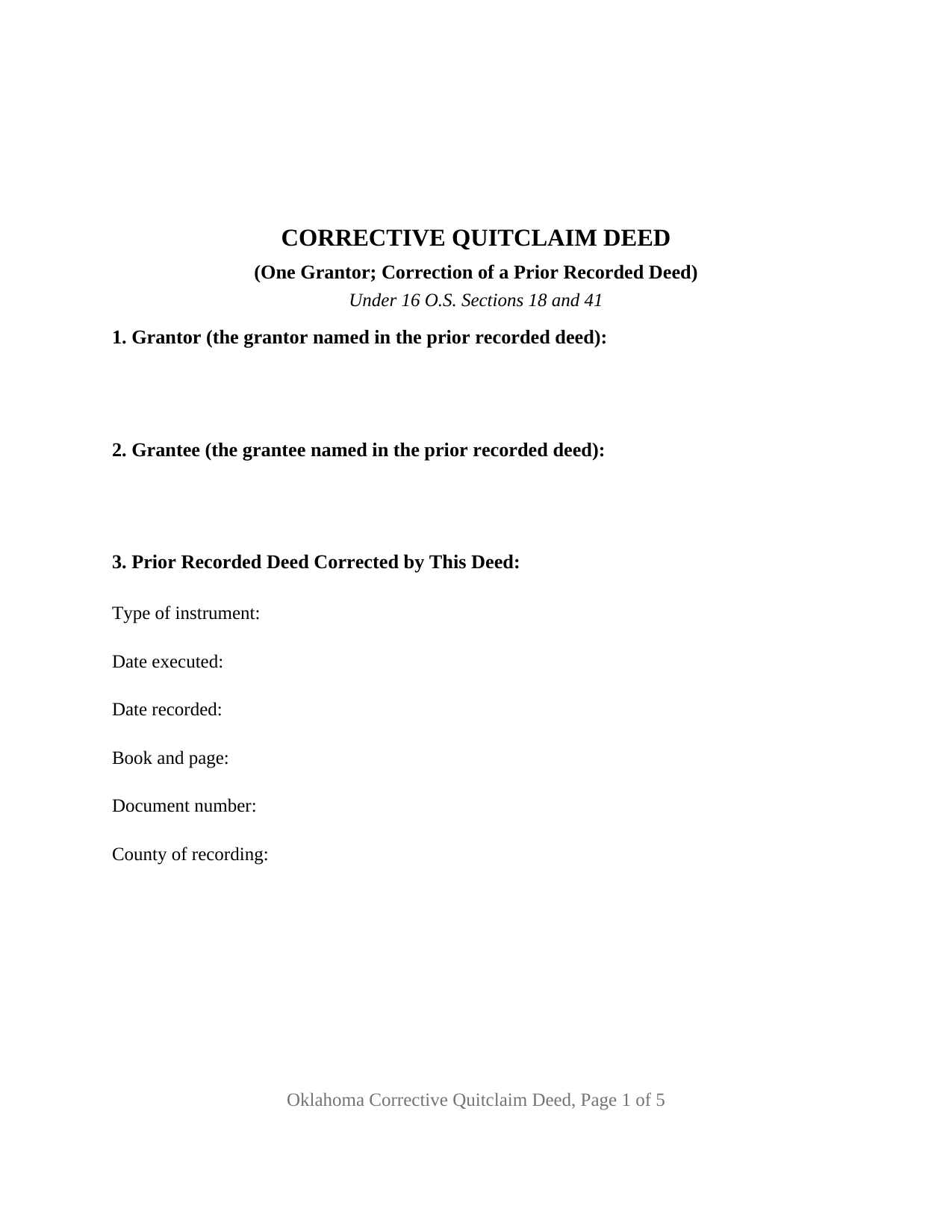
A corrective deed is the one Oklahoma conveyance that changes nothing about the bargain. This form names the grantor and the grantee of a deed already on record, sets out the single term that deed got wrong, sets out the same term as corrected, and then quitclaims a second time on the corrected words. No money moves, no new party appears, and the earlier instrument stays exactly where the county clerk indexed it.
Two blanks that do the correcting
Sections 4 and 5 sit at the center of the form and hold one term apiece: the term as the record actually carries it, then the same term put right. Section 3 above them pins the earlier instrument down by type, date executed, date recorded, book and page, document number, and county, so a title examiner can lay the two documents side by side. Section 6 carries the legal description in corrected form. A misspelled subdivision name, a transposed digit in a lot number, a missing middle initial: each is one pair of entries. Where a correction touches more than one term, the exhibit convention carries the remainder on an attached page recorded with the deed.
Oklahoma names this deed by what it does
No Oklahoma statute prints a corrective deed form. The statutes supply a descriptive phrase instead, used twice, which identifies the instrument by function: a deed which, without additional consideration, confirms, corrects, modifies or supplements a deed previously recorded. Title 68 uses it in Section 3202, paragraph 3, as an exemption from documentary stamp tax. Title 60 uses it in Section 121, subsection C, exemption 1, as an exclusion from the land ownership affidavit requirement, with exemption 2 alongside for a deed given to cure a title defect or to disclaim an interest. The two statewide gates most Oklahoma deeds satisfy by computation and attachment therefore open for this one by category, and Sections 11 and 12 identify each by paragraph number, the notation Oklahoma county clerks publish.
Release, not repair
The granting sentence uses the words 16 O.S. Section 41 prescribes, quitclaim, grant, bargain, sell and convey, with the warranty phrase omitted, and 16 O.S. Section 18 measures what comes out: all the right, title, and interest of the maker in the premises described. Nothing about a corrective quitclaim reaches the condition of the title. The mortgage, the judgment liens, the plat restrictions, and the severed minerals sit where they sat, and Section 13 says so on the face of the instrument in capital letters. What gets corrected is how the transaction reads in the record, not what the record contains.
One grantor, one certificate
The form is arranged for one signer, the grantor named in the earlier deed, with a single signature block and one acknowledgment certificate in the individual short form of 49 O.S. Section 119. Section 10 holds that grantor's statement of marital status and homestead occupancy, which weighs here as it did on the original, since 16 O.S. Section 4 and Article XII of the Oklahoma Constitution make a deed relating to a married couple's homestead valid only where both spouses subscribe it. An unmarried owner fixing a plat name inside a description, and an owner correcting a recording reference in a deed of separate nonhomestead land, present the one-signer pattern this deed recites. An earlier deed subscribed by two grantors follows a different arrangement; this form carries one signature line.
What the county clerk reads
Page format tracks the version of 19 O.S. Section 298 that SB57 rewrote in 2024, moving the two inch reserve onto every page; the form keeps that reserve, an inch on the other three sides, and twelve point body text. Recording is what makes a correction visible at all. A deed operates between its parties on delivery, while 16 O.S. Sections 15 and 16 make acknowledgment and filing with the county clerk the condition of validity against third persons and the source of constructive notice. Searches for a correction deed, a scrivener's error deed, a quit claim deed, or a quick claim deed in Oklahoma land on this instrument; the statutes spell the word quitclaim.
The download delivers this deed as a fillable PDF, a completed example worked through a Wagoner County legal description corrected after recording, and a plain language guide covering the fourteen numbered sections, the exemption notations, and the trip to the county clerk. The materials describe Oklahoma law in general terms and are not legal advice.
Important: County-Specific Forms
Our quitclaim deed (corrective) forms are specifically formatted for each of the 77 counties in Oklahoma.
After selecting your county, you'll receive forms that meet all local recording requirements, ensuring your documents will be accepted without delays or rejection fees.