Oklahoma Quitclaim Deed (Interspousal)
County Specific Legal Forms Validated as recently as October 19, 2026 by our Forms Development Team
About the Oklahoma Quitclaim Deed (Interspousal)
How to Use This Form
- Select your county from the list
- Download the county-specific form
- Fill in the required information
- Have the document notarized if required
- Record with your county recorder's office
What Others Like You Are Saying
"Awesome. Quick informative and very easy. I made a mistake the first time, emailed you and was able …"
"World class forms and service! Wish I had known about this site years ago, woulda saved me lots of h…"
"I was looking for a certain form I needed. Deeds.com had the necessary form and I was able to purcha…"
"Extremely helpful -- logically presented -- great documentation..."
"Very helpful!"
4.8/5 from 4,829 reviews. Read all
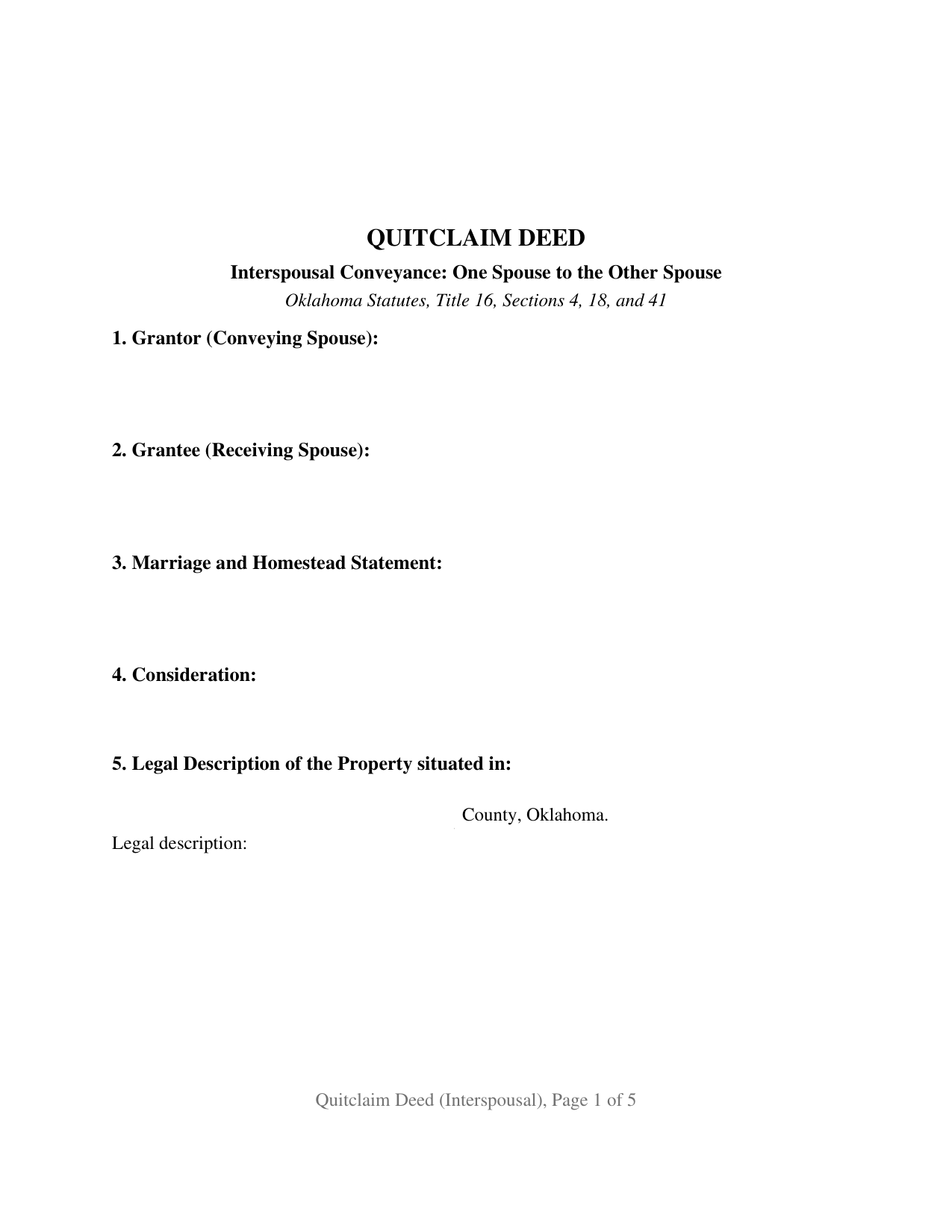
Both signatures on this Oklahoma quitclaim deed come from the same marriage, and one of the two signers is the spouse receiving the property. Section 1 names the spouse who conveys, Section 2 names the spouse who takes, Section 3 puts the marriage and the homestead status on the face of the deed, and Section 12 closes with a signature block for each of them. Whatever the conveying spouse holds crosses over with no covenant or warranty of title, on the statutory quitclaim pattern of 16 O.S. Sections 18 and 41.
Why the receiving spouse signs as well
On most deeds the grantee signs nothing. Oklahoma changes that arithmetic where a married couple's homestead is in play: 16 O.S. Section 4(A), carrying Article XII, Section 2 of the Oklahoma Constitution, makes a deed affecting the homestead valid only when subscribed by both husband and wife while both are living and not divorced or legally separated. Where the person on the receiving end is the other spouse, the signature that answers that rule and the signature that accepts the conveyance are one and the same, and Section 11 of the form devotes a sentence to saying so: the receiving spouse subscribes as spouse, transfers nothing back, and makes no covenant or warranty. The recorded chain never shows whether a parcel was the family home on the day of signing, so a deed bearing both spouses' names answers that question in advance.
What one spouse may convey to the other
Oklahoma lets spouses deal with each other in property. Under 43 O.S. Section 204, either husband or wife may enter into any transaction with the other respecting property that either might if unmarried, subject, in transactions between themselves, to the rules that govern persons occupying confidential relations. Under 43 O.S. Section 203 neither spouse holds an interest in the separate property of the other, and 16 O.S. Section 13 lets a married person convey separate nonhomestead real estate without the other joining. Dower and curtesy are gone from Oklahoma law under 84 O.S. Section 214, so nothing in this deed releases them. A spouse moving a house inherited during the marriage into the other spouse's name, and a spouse releasing an undivided share so that record title stands alone for a refinance, present the interspousal pattern this deed recites.
A release, not a promise
Section 41 of Title 16 supplies the operative words, do hereby quitclaim, grant, bargain, sell and convey, and leaves the warranty phrase out; 16 O.S. Section 18 gives the finished instrument its reach, all the right, title, and interest of the maker in the premises. Between spouses that carries a practical edge: the mortgage, the judgment liens, the plat restrictions, and the severed minerals stay exactly where they were, and the spouse who signed the note still owes it. Section 8 lists encumbrances for information and states on the deed's face that a listing or an omission there creates no warranty. Searches for a quit claim deed, a quick claim deed, or a spousal transfer deed in Oklahoma land on this instrument; the statutes spell the word quitclaim.
The entries that get it recorded
Two Oklahoma gates decide whether the county clerk takes the deed. Documentary stamp tax attaches under 68 O.S. Section 3201 when consideration or value exceeds $100, and 68 O.S. Section 3202 exempts deeds between husband and wife where no actual consideration passes, an exemption Oklahoma clerks expect to see identified on the face of the deed by its paragraph number, which Section 9 of the form collects. Section 10 answers 60 O.S. Section 121, which since November 1, 2023 has kept a covered deed off the record unless the notarized land ownership affidavit of the party obtaining title rides along as an exhibit or an exemption appears on the face of the deed. The pages follow 19 O.S. Section 298 as amended in 2024, with two inch top margins throughout, and each signature carries its own certificate in the short form of 49 O.S. Section 119, so the spouses may appear before different officers on different days.
The download delivers the interspousal deed as a fillable PDF, a completed example worked through a Rogers County homestead conveyed from husband to wife, and a plain language guide covering the twelve sections, the homestead signature rule, the notarial certificates, and the trip to the county clerk. The materials describe Oklahoma law in general terms and are not legal advice.
Important: County-Specific Forms
Our quitclaim deed (interspousal) forms are specifically formatted for each of the 77 counties in Oklahoma.
After selecting your county, you'll receive forms that meet all local recording requirements, ensuring your documents will be accepted without delays or rejection fees.