Oklahoma Quitclaim Deed (Trustee Grantee)
County Specific Legal Forms Validated as recently as September 9, 2026 by our Forms Development Team
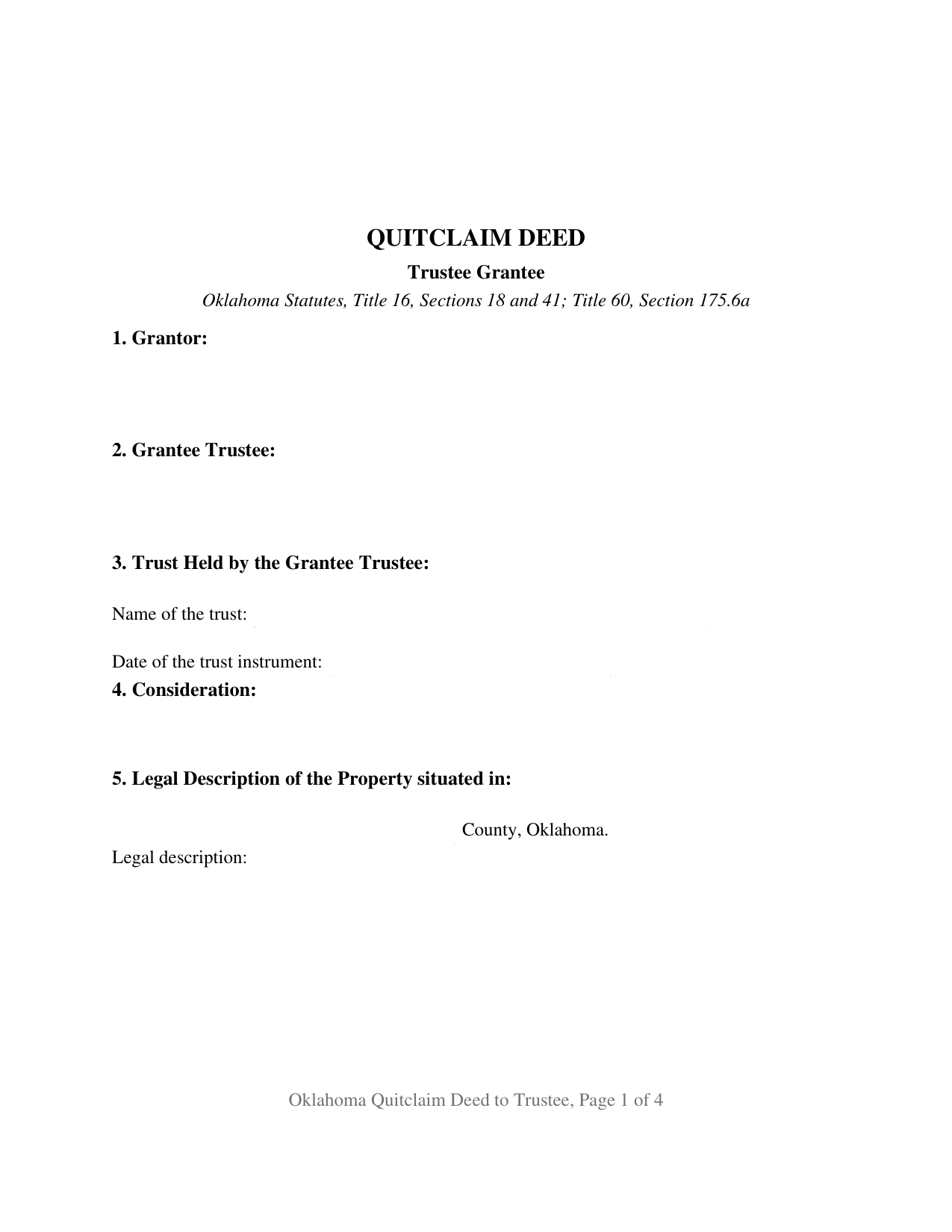
About the Oklahoma Quitclaim Deed (Trustee Grantee)
How to Use This Form
- Select your county from the list
- Download the county-specific form
- Fill in the required information
- Have the document notarized if required
- Record with your county recorder's office
What Others Like You Are Saying
"A suggestion: Include instructions on how to add your spouse to the deed, rather than transferring c…"
"This was super easy to use, especially if you remember to look for a downloaded PDF file, not a Word…"
"So easy to use. The directions are very clear."
"Exactly what I needed and with the help of ChatGPT who needs a damn lawyer for anything."
"AWESOME!"
4.8/5 from 4,828 reviews. Read all
The receiving side of this Oklahoma quitclaim deed is a fiduciary. Section 2 names a trustee, Section 3 names the trust and the date of its trust instrument, and Section 12 places whatever the grantor holds in that trustee, in that capacity and no other, along with the successors in trust. One grantor signs, nothing about the title is warranted, and the statutory quitclaim pattern of 16 O.S. Sections 18 and 41 supplies the words that do the work.
A grantee who holds in a capacity
Most deeds name a grantee taking for their own account. This one names a grantee taking for someone else. The grantee block carries the trustee's name followed by the word Trustee, and the section beneath it carries the trust name and the date of the trust instrument, so the fiduciary character of the vesting sits on the face of the recorded document. The granting language runs to the successors in trust as well, so a later change of trustee leaves no gap in the record vesting. One signature closes the instrument and one notarial certificate follows it, because a trustee accepting a conveyance signs nothing here. A co-owner releasing an undivided share to the trustee of a trust that already holds the rest of a parcel, an heir passing an inherited interest to the trustee of the family trust that will administer it, and a parcel left out when a trust was funded and deeded over years later are the patterns this configuration is built around.
Two ways Oklahoma puts land into a trust
Oklahoma says out loud what many states leave to practice: a trust may hold land in its own name. Under 60 O.S. Section 175.6a real property may be acquired and held in the name of an express trust, a transfer of property so held is made in the name of the trust by its trustee, and when title moves in the trust's name the trustee files a memorandum of trust with the county clerk where the land lies. That memorandum is a separate recorded instrument, prepared and recorded on its own, and it is not part of this package. This deed takes the other route, putting title in the trustee as trustee of a named trust. Section 175.6a also presumes that someone signing while purporting to be trustee of such a trust acts within the scope of that authority, in an action to set the conveyance aside brought against a bona fide purchaser for value.
A release, not a promise
16 O.S. Section 41 supplies the operative words, do hereby quitclaim, grant, bargain, sell and convey, and omits the warranty phrase the statutory warranty deed carries. 16 O.S. Section 18 states the effect: the instrument passes all the right, title, and interest of the maker in the premises described. None of the covenants that 16 O.S. Section 19 implies in a warranty deed arise here, so the mortgage, the judgment liens, the plat restrictions, and the severed minerals cross into the trust exactly as they stood. Shoppers looking for a quit claim deed, a quick claim deed, or a deed putting property into a trust in Oklahoma are reading about this instrument.
The trust affidavit and the stamp paragraph
Of the two gates at the county clerk's counter, one reads differently for a trust. Since November 1, 2023, 60 O.S. Section 121 has let a covered deed onto the record only with the affidavit of the party taking title attached as an exhibit, or with an exemption identified on the deed itself. The Attorney General publishes a separate affidavit for business entities and trusts, and it asks whether the trust's grantors, trustees, and all direct and contingent beneficiaries are United States citizens or bona fide residents of Oklahoma. Section 10 holds the stamp entry: 68 O.S. Section 3202 lists exemptions by paragraph, and Paragraph 4 covers a deed between any person and an express revocable trust created by that person or that person's spouse. Format follows 19 O.S. Section 298 as SB57 rewrote it in 2024, with a 2 inch top margin on every page instead of the first alone.
The download delivers the trustee-grantee deed as a fillable PDF, a completed example worked through a Payne County parcel released to the trustee of a revocable living trust, and a plain language guide to the fourteen numbered sections and the recording steps. The package describes Oklahoma law in general terms and is not legal advice.
Important: County-Specific Forms
Our quitclaim deed (trustee grantee) forms are specifically formatted for each of the 77 counties in Oklahoma.
After selecting your county, you'll receive forms that meet all local recording requirements, ensuring your documents will be accepted without delays or rejection fees.