Oklahoma Quitclaim Deed (Married Grantor with Non-Owner Spouse Joinder)
County Specific Legal Forms Validated as recently as September 29, 2026 by our Forms Development Team
About the Oklahoma Quitclaim Deed (Married Grantor with Non-Owner Spouse Joinder)
How to Use This Form
- Select your county from the list
- Download the county-specific form
- Fill in the required information
- Have the document notarized if required
- Record with your county recorder's office
What Others Like You Are Saying
"Your service is a life saver! I'm a paralegal and new to lien releases especially in Platte Co., MO.…"
"answeed many questions I had."
"Great was not hard at all to do and process only wished it told how much it cost to actually submit …"
"Quick and easy download with instructions and a sample document to ensure conformity to the differen…"
"The process was quite easy, following the instructional guide. I have yet to find out if the deed wa…"
4.8/5 from 4,828 reviews. Read all
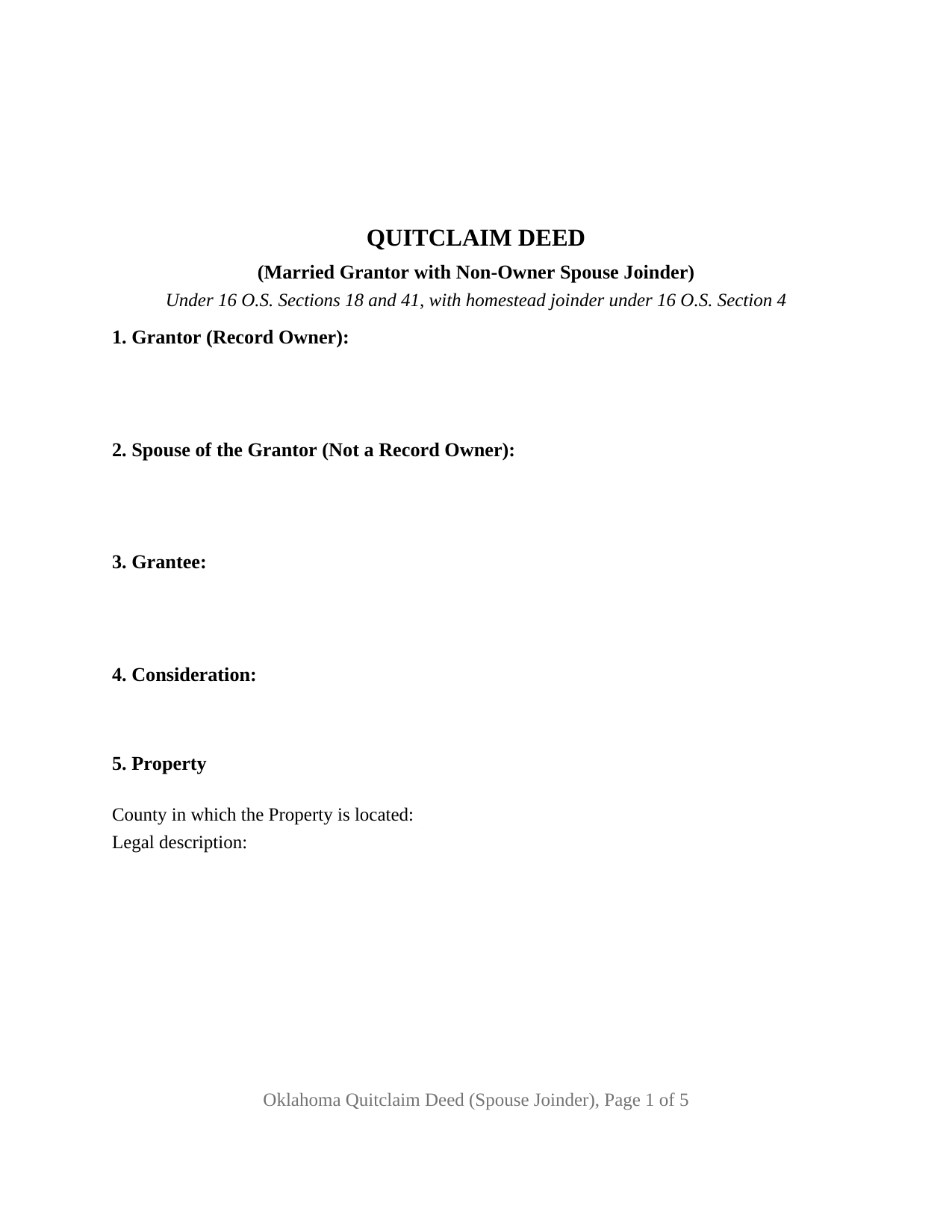
Two people sign this Oklahoma quitclaim deed, and only one of them owns the land. The grantor is one record owner who is married; the person named in Section 2 holds no record title and subscribes for one reason, the homestead subscription rule of 16 O.S. Section 4. Whatever interest the owner holds passes to the grantee without covenant or warranty of title, and the deed states on its face that the joining spouse gives up no ownership and warrants nothing.
The signature the constitution asks for
One statute does this work in two sentences. Section 4(A) of Title 16 provides that no conveyance of real estate is valid unless subscribed by the grantors, and then that no deed affecting the homestead exempt by law is valid unless subscribed by both husband and wife when both are living and not divorced or legally separated, the rule Article XII, Section 2 of the Oklahoma Constitution supplies. The second rule follows the land rather than the title, applying according to whether the parcel is the homestead, whichever spouse the vesting deed happens to name. Atkinson v. Barr, 428 P.2d 316 (Okla. 1967), states the consequence without softening it: a homestead estate cannot be alienated by a married owner unless the spouse joins in the instrument of conveyance, and an attempted conveyance without that joinder is void.
One grantor, two labeled signature blocks
The architecture of the form follows that split. Section 1 names one record owner as the only grantor, and Section 2 names that owner's spouse and marks the person, on the face of the deed, as someone who is not a record owner. Section 12 performs the conveyance in the words 16 O.S. Section 41 supplies, do hereby quitclaim, grant, bargain, sell and convey, then devotes its own sentence to the joinder: the spouse subscribes to comply with the homestead rule, conveys no separate ownership interest, and makes no covenant or warranty of title. Section 13 carries a labeled block for each signer, one as record owner and one as to the homestead, each followed by a certificate in the short form of 49 O.S. Section 119, so the two signatures may be taken on different days or before different officers. Title taken in one name before the marriage, a residence devised to one spouse alone, and a marriage-era deed naming a single spouse present the pattern this deed recites.
Why the joinder appears even where nobody calls the land homestead
Homestead character depends on occupancy and on the acreage and value limits of 31 O.S. Sections 1 and 2, and none of those facts reach the recorded chain. An examiner reading the record alone cannot tell whether a parcel was the family home on the day a deed was signed, which is why the subscription of a non-owner spouse turns up so often on Oklahoma conveyances. The Section 9 statement puts the marriage and occupancy facts into the record, and the Section 12 language keeps the second signature from being read as a conveyance or a promise. Where the land is separate property outside the homestead, 16 O.S. Section 13 lets the owning spouse convey with no joinder at all.
No title promises, and two gates at the counter
This deed releases without assuring. Under 16 O.S. Section 18 a quitclaim in substantial compliance with the statutes carries the maker's whole interest in the premises, while the covenants that 16 O.S. Section 19 reads into a warranty deed do not arise, so recorded mortgages, easements, restrictions, and severed mineral interests ride through untouched. Section 10 states the documentary stamp posture under 68 O.S. Section 3201, and Section 11 addresses 60 O.S. Section 121, which keeps a covered deed off the record without the incoming owner's notarized land ownership affidavit attached or an exemption shown. The page format tracks amended 19 O.S. Section 298: a two inch top margin on every page, one inch on the other three sides, and twelve point body type. Shoppers looking for a quit claim deed or quick claim deed with a spousal signature are reading about this instrument; Oklahoma spells the word quitclaim.
The download delivers the fillable deed, a completed example worked through an Oklahoma County residence that was homestead on the day of signing, and a plain language guide covering the thirteen sections, both certificates, the homestead rule, and the trip to the county clerk. The materials describe Oklahoma law in general terms and are not legal advice.
Important: County-Specific Forms
Our quitclaim deed (married grantor with non-owner spouse joinder) forms are specifically formatted for each of the 77 counties in Oklahoma.
After selecting your county, you'll receive forms that meet all local recording requirements, ensuring your documents will be accepted without delays or rejection fees.