South Dakota Quitclaim Deed (Interspousal)
County Specific Legal Forms Validated as recently as October 1, 2026 by our Forms Development Team
About the South Dakota Quitclaim Deed (Interspousal)
How to Use This Form
- Select your county from the list
- Download the county-specific form
- Fill in the required information
- Have the document notarized if required
- Record with your county recorder's office
What Others Like You Are Saying
"The site was easy to navigate."
"I was very impressed. Your program makes it very user friendly which is a must for most of the publi…"
"Thank you for this service, saved me from driving down town. It was quick and very easy to navigate.…"
"So far, it's been a very seamless experience! Easy way to get documents recorded. Worth the money"
"just what I needed Thank You"
4.8/5 from 4,836 reviews. Read all
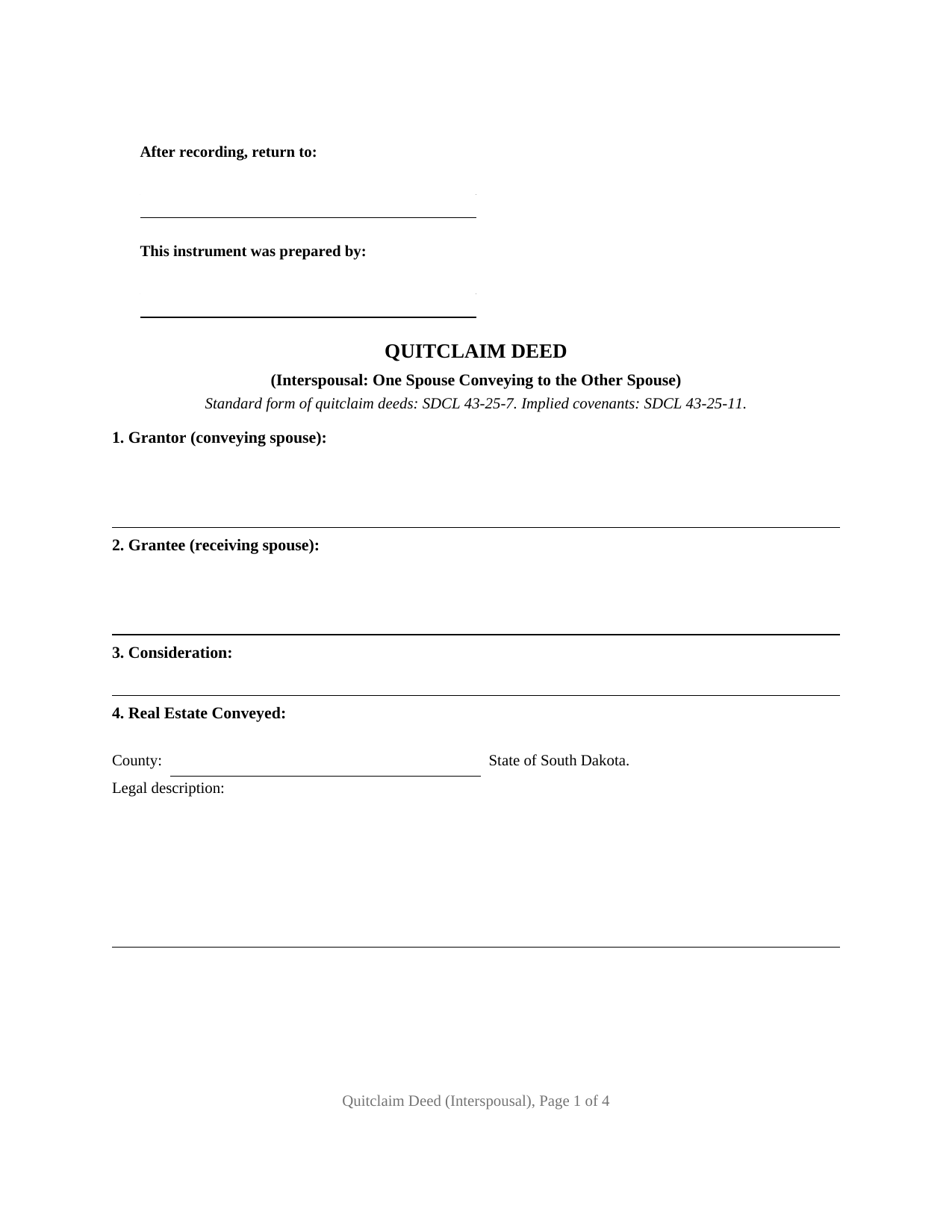
On this South Dakota quitclaim deed, the spouse who receives the property signs it as well. The Grantor is one spouse and the Grantee is the other, the deed states on its face that the two are married to each other, and the Grantee's signature block sits beside the Grantor's. The fillable form prepares that conveyance on the standard quitclaim pattern of SDCL 43-25-7.
Why the receiving spouse signs
SDCL 43-31-17 asks a question about the marriage rather than about the vesting deed: a conveyance of a homestead by its owner, if married and both spouses reside in this state, is valid if both husband and wife concur in and sign it, by joint instrument or by separate instruments. Where the land is going to the other spouse, that second signature is available on the same page. Section 8 states what it does and does not do: the Grantee concurs in the conveyance so that both spouses have concurred in and signed one instrument, and the Grantee conveys no interest and gives no covenant or warranty of title. Away from the homestead the signature is harmless surplus, because SDCL 25-2-4 leaves either spouse free to convey separate property alone.
A quitclaim that promises nothing, by express terms
South Dakota quitclaims say more than their name suggests. Under SDCL 43-25-11 a conveyance using the words remise, release, or quitclaim implies two covenants unless it restricts them by express terms: no earlier conveyance of the same estate by this grantor to anyone else, and no encumbrance on the estate made, done, or suffered by this grantor. Section 8 takes the statute's express-terms route in capital letters, so what reaches the receiving spouse is interest and nothing more. SDCL 43-25-8 fixes the reach at the interest held on the date of the conveyance, and the deed carries no words passing title acquired later.
The nominal consideration exemption
An interspousal transfer usually records without the realty transfer fee, and the reason is specific. SDCL 43-4-22 (5) exempts a transfer of title between husband and wife with only nominal actual consideration from the fee that SDCL 43-4-21 sets at fifty cents per five hundred dollars of value. County registers expect the claim on the face of the instrument, and Section 7 receives the recital with its subdivision number. A transfer between spouses supported by real consideration falls outside subdivision (5) and pays the fee in the ordinary way. The certificate of real estate value described in SDCL 7-9-7 travels with the deed either way, as its own Department of Revenue filing carrying the exemption number when one is claimed.
What the deed recites, and what it is not set up for
The form names exactly two people: one Grantor spouse and one Grantee spouse, each with a full legal name and mailing address, the second of which SDCL 43-28-23 makes recording content. Each has a signature block with the printed-name line that section requires beneath a signature, and each has its own acknowledgment certificate, so the two acknowledgments may fall on different days or before different officers. Patterns presenting this architecture in the South Dakota record include a couple moving a parcel out of one spouse's name into the other's, one spouse releasing an interest in a jointly held parcel so title stands in a single name, and a conveyance carrying out a marital settlement agreement identified in the additional-provisions section. The deed recites a marriage between its two parties: an unmarried owner, co-owners with no marriage between them, spouses conveying together to a buyer, a grantee who is not a spouse, and trustee or entity grantors each print a different configuration. The guide covers the ownership forms South Dakota recognizes when a deed names more than one grantee, from the tenancy-in-common default of SDCL 43-2-12 to an expressly declared joint tenancy.
Recording happens at the register of deeds where the land lies, for the statewide thirty dollar fee of SDCL 7-9-15 covering a deed's first fifty pages, and the document follows the SDCL 43-28-23 format standards: a three inch reserve atop page one with the return and preparer blocks at its left, one inch margins elsewhere, and ten point type. The purchase delivers three pieces: the blank interspousal quitclaim deed as a fillable PDF, a completed example built on a Codington County fact pattern, and a plain-language guide covering every numbered section, the notarization mechanics, and the recording package. The materials are informational and are not legal advice.
Important: County-Specific Forms
Our quitclaim deed (interspousal) forms are specifically formatted for each of the 66 counties in South Dakota.
After selecting your county, you'll receive forms that meet all local recording requirements, ensuring your documents will be accepted without delays or rejection fees.