South Dakota Quitclaim Deed (Trustee Grantor)
County Specific Legal Forms Validated as recently as October 13, 2026 by our Forms Development Team
About the South Dakota Quitclaim Deed (Trustee Grantor)
How to Use This Form
- Select your county from the list
- Download the county-specific form
- Fill in the required information
- Have the document notarized if required
- Record with your county recorder's office
What Others Like You Are Saying
"No review provided."
"Great service, convenient, fast and easy to use. Thumbs Up!!!!w"
"Just found this site, what a great resource ! Thank you so much for providing affordable help to tho…"
"The website is easy to maneuver and information needed was readily available. Thanks so much!"
"So far so good"
4.8/5 from 4,829 reviews. Read all
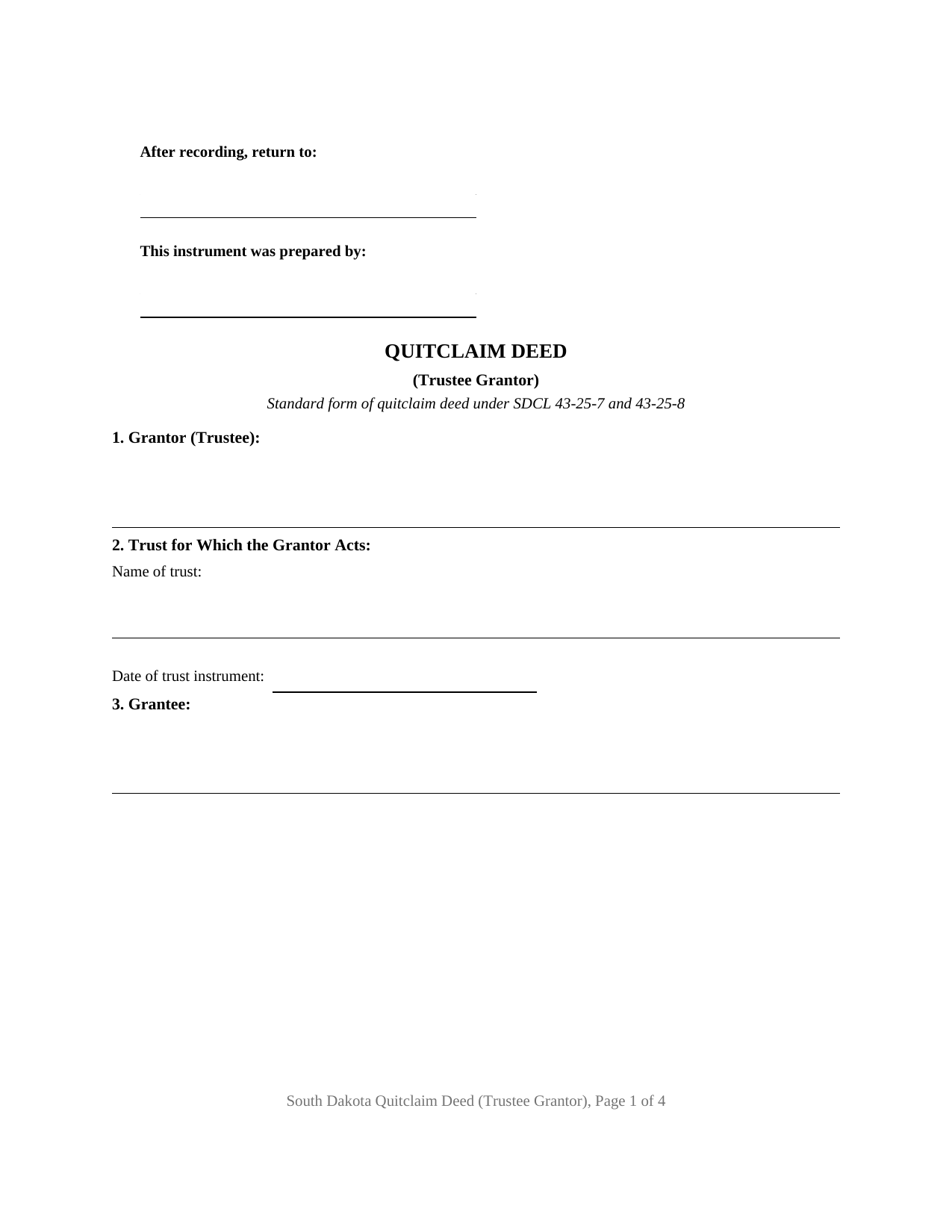
The grantor signing this South Dakota quitclaim deed is parting with property nobody personally owned. A trustee holds legal title for a trust, and when trust land leaves the trust the record has to show which hat the signer wore. The fillable form prepares that conveyance on the standard quitclaim form of SDCL 43-25-7: one trustee as grantor, the trust named on the deed's face, a conveyancing sentence reciting the fiduciary capacity.
Capacity rides inside the conveyancing sentence
Section 11 carries the operative language: the grantor, acting solely as Trustee of the Trust identified in Section 2 and not individually, conveys and quitclaims all interest held as trustee in the land described in Section 6. Section 1 takes the signer's name with the capacity, a successor trustee's included, and Section 2 the trust's exact name and the date of its instrument, the pair a title examiner reads to tell one trust from the next.
Where a trustee's authority actually lives
No deed supplies the power to sign it. SDCL chapter 55-1A gives trustees default powers, the power to dispose of a trust asset among them, which apply unless a trust instrument specifically excludes them. Authority reaches the public record through a certificate of trust: executed under SDCL 55-4-51 and recorded under SDCL 55-4-51.1 against the land it describes, it documents the trust's existence, the trustees, and their powers and limits as though the whole trust instrument had been recorded. Section 8 takes the recording reference of a certificate already on file, or the word None; such a certificate is recorded separately and is not included here.
A self-dealing rule no deed language can answer
SDCL 55-4-13 constrains what a trustee may do with the other hand. Absent express authorization in the trust instrument, or in a will or other instrument creating the trust relationship, a trustee may not directly or indirectly lease, buy, or sell trust property from or to itself, an affiliate, or a relative, employer, partner, or other business associate. A quit claim deed running from a trustee to that same person individually, or to a relative, sits inside that section, and no deed wording moves it out.
What passes out of the trust, and what is promised
SDCL 43-25-8 measures a standard-form quitclaim at the date of the conveyance: the interest held then passes, and title arriving later stays put unless the deed adds words saying otherwise, which this one does not. Under SDCL 43-25-11 the words remise, release, or quitclaim imply two covenants unless express terms restrict them, one denying an earlier conveyance of the same estate by this grantor, one denying encumbrances traceable to this grantor. Section 11 excludes both in capital letters, and adds that no personal covenant of the individual signing as trustee travels with the deed.
One fiduciary signature, one certificate, an open grantee side
The form recites a single trustee, one signature block with the printed-name line SDCL 43-28-23 requires, and one notary acknowledgment certificate. Architectures like this one appear in the South Dakota record when a successor trustee distributes trust land to named beneficiaries, when a trustee sells a parcel to an outside buyer, and when a trustee deeds land back to a revocable trust's settlor. Co-trustees required to act together, an owner conveying in a personal capacity, and a homestead conveyance under SDCL 43-31-17, where both spouses concur and sign, each print a different configuration. One grantee or several may take, and Section 4 holds any co-ownership designation the parties enter, measured against the SDCL 43-2-12 default the guide sets out.
The recording package a trustee hands across the counter
A deed records where the land lies, at the thirty dollar charge SDCL 7-9-15 sets for its first fifty pages. The SDCL 43-4-21 realty transfer fee is collected before recording unless an SDCL 43-4-22 exemption is claimed on the deed's face, which Section 9 receives; the example claims subdivision (15), for a conveyance accommodating a fiduciary relationship. A certificate of real estate value under SDCL 7-9-7 rides along as its own Department of Revenue filing. Format answers to SDCL 43-28-23: three inches clear atop page one, an inch elsewhere, ten point type, and the grantee's mailing address.
Three files ship: the deed as a blank fillable PDF, a completed example worked through on a Hughes County distribution out of a family trust, and a plain-language guide to the numbered sections, the notarization mechanics, and what the register of deeds collects. The materials are informational and are not legal advice.
Important: County-Specific Forms
Our quitclaim deed (trustee grantor) forms are specifically formatted for each of the 66 counties in South Dakota.
After selecting your county, you'll receive forms that meet all local recording requirements, ensuring your documents will be accepted without delays or rejection fees.