South Dakota Quitclaim Deed (Trustee Grantee)
County Specific Legal Forms Validated as recently as October 7, 2026 by our Forms Development Team
About the South Dakota Quitclaim Deed (Trustee Grantee)
How to Use This Form
- Select your county from the list
- Download the county-specific form
- Fill in the required information
- Have the document notarized if required
- Record with your county recorder's office
What Others Like You Are Saying
"Thought it was pretty simple to use."
"It was quick and easy to download the forms I need to modify a property deed. No problems n the leas…"
"So far so good I was able to find the documents I needed."
"My service today was outstanding.your rep asked me several questions and was able to get me all the …"
"Thank You deeds.com, your site helped me accomplish a difficult mission."
4.8/5 from 4,836 reviews. Read all
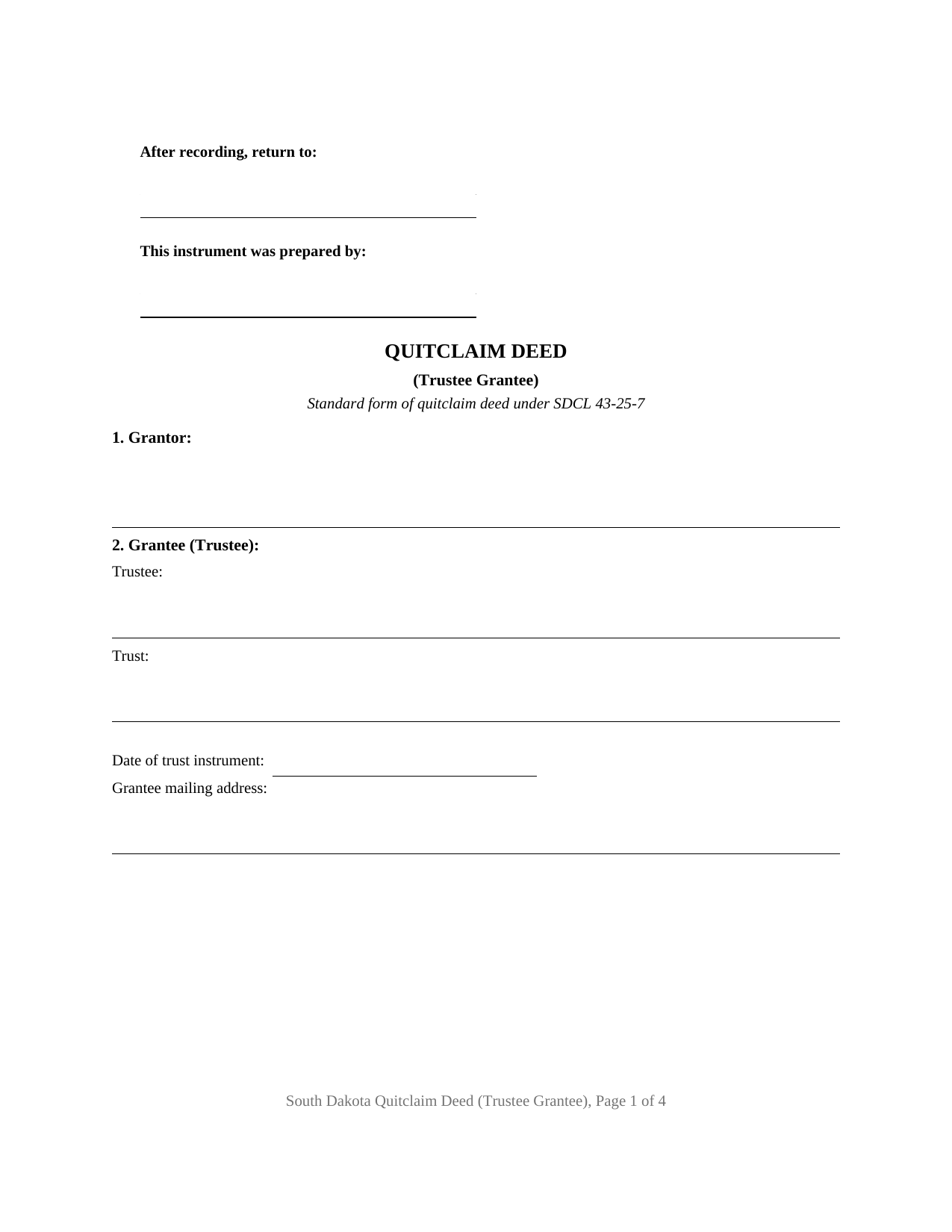
Almost every deed variant turns on the person signing. This fillable South Dakota quitclaim deed turns on the person receiving: the grantee line names a trustee, who takes for a named trust and not personally, and the conveyancing sentence itself says so. One individual grantor signs, on the standard quitclaim pattern SDCL 43-25-7 has carried since 1911.
Capacity is part of what the deed conveys
A trustee who takes property wears a second hat, and the record has to show which one. Section 9 conveys to the grantee as Trustee of the trust identified in Section 2 and not individually, so the instrument separates the fiduciary holding from the person's own estate instead of leaving a later title examiner to infer it from a name trailed by an abbreviation. The section behind that sentence collects the trustee's name with any successor language, the trust's exact name, and the date of the trust instrument, which is how a South Dakota chain of title tells one trust from the several a family may have signed over the years.
Trust authority sits in a separate recorded instrument
South Dakota keeps the trust's terms off the public record and puts the trustee's authority in a short document instead. A certificate of trust executed under SDCL 55-4-51 states the trust's existence, the trustees, their powers, and any limits on those powers; SDCL 55-4-51.1 lets it be recorded against the land it describes, where it documents those matters as though the whole trust instrument had been recorded, and SDCL 55-4-51.3 supplies a form of certificate for a real property transaction. Because that companion is what a future buyer or lender reads, Section 6 receives the recording reference of a certificate already on record, and the word None where there is none. Any certificate is recorded on its own and is not part of this package.
What a quit claim moves, and what it withholds
The operative words are conveys and quitclaims. Under SDCL 43-25-8 the instrument passes all right, title, and interest the grantor has in the premises described, stopping at the interest held when the deed is made, with no reach into title acquired afterward unless words saying so are added; none are here, and the deed states it. South Dakota then does something unusual. SDCL 43-25-11 reads two covenants into quitclaim words unless express terms restrain them: that this grantor has not already passed the same estate to someone else, and that no encumbrance on it traces to this grantor. Section 9 restrains them in capital letters, so what reaches the trust is interest with no title promises attached.
One grantor, one certificate, no grantee signature
The form recites a single individual grantor with name, marital status, and mailing address, one signature block carrying the printed-name line SDCL 43-28-23 requires, and one notary acknowledgment certificate. The trustee signs nothing: a grantee takes under a South Dakota deed without executing it. Patterns appearing in the record with this architecture include an owner funding a revocable living trust with the family home, and a parcel moved to a trustee named in an estate plan. Two or more record owners, a homestead conveyance where SDCL 43-31-17 calls for both spouses to concur and sign, and a trustee appearing on the grantor side instead each print a different configuration than this deed recites.
At the register of deeds
Thirty dollars covers a deed's first fifty pages under SDCL 7-9-15. The realty transfer fee set by SDCL 43-4-21 is collected before recording unless one of the SDCL 43-4-22 exemptions is claimed on the face of the instrument, which Section 7 receives; subdivision (15) reaches a transfer between a fiduciary and a beneficiary of the fiduciary, or between a fiduciary and a third party, made to accommodate the fiduciary relationship, and the example claims it. A certificate of real estate value under SDCL 7-9-7 travels along as its own Department of Revenue filing. Layout answers to SDCL 43-28-23: three inches reserved atop page one for the stamp, with the return and preparer blocks at its left, an inch elsewhere, ten point type, and the grantee's mailing address.
Three files arrive with the purchase: the blank trustee grantee quit claim deed as a fillable PDF, a completed example filled in for a Lawrence County lot conveyed by its owner to herself as trustee of her own revocable trust, and a plain-language guide to the sections, the signing formalities, and the recording package. The materials are informational and are not legal advice.
Important: County-Specific Forms
Our quitclaim deed (trustee grantee) forms are specifically formatted for each of the 66 counties in South Dakota.
After selecting your county, you'll receive forms that meet all local recording requirements, ensuring your documents will be accepted without delays or rejection fees.